
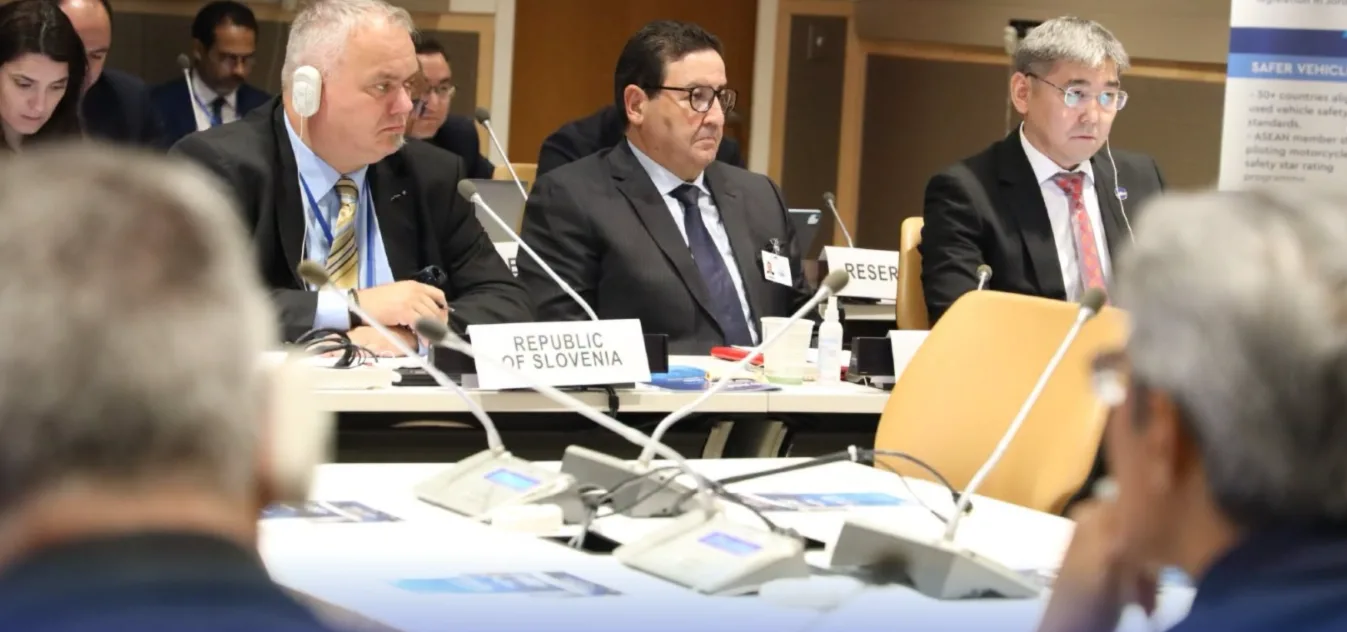
Agadir – Morocco showcased its road safety strategy during a series of high-level meetings at the United Nations headquarters in New York, with Minister of Transport and Logistics Abdessamad Kayouh outlining the county’s national reforms, international leadership, and commitment to reducing road traffic deaths by 2030.
Speaking during the United Nations General Assembly High-Level Meeting on Road Safety, a World Health Organization (WHO) event, and the United Nations Road Safety Fund (UNRSF) Donors Conference, Kayouh said Morocco has made road safety a central pillar of its sustainable development agenda while strengthening international cooperation to save lives.
Addressing the UNRSF Donors Conference, Kayouh said Morocco has “placed road safety at the heart of its sustainable development efforts,” emphasizing that the country remains committed to supporting global initiatives as chair of the UN Road Safety Fund’s Advisory Board.
The minister said Morocco is “proud to be a partner” of the UNRSF and stressed that the donors’ conference was “not only about financial contributions, but also a privileged space to work together to save more lives.”
Kayouh noted that motorcyclists remain among the most vulnerable road users, saying Morocco has therefore made their safety a national priority.
He recalled that Morocco launched the Mohammed VI International Prize for Road Safety during the Fourth Global Ministerial Conference on Road Safety, held in Marrakech in February 2025. The conference also featured a Road Safety Village promoting helmet use and awareness among motorcyclists, alongside helmet distribution initiatives.
The UNRSF Donors Conference, co-organized by France, Jamaica, the UN Secretary-General’s Special Envoy for Road Safety, and the Office of the UN Regional Commissions in New York, seeks to mobilize $10.6 million to support the Fund’s work during the remainder of the Decade of Action for Road Safety.
National strategy through 2030
During a WHO meeting held on the sidelines of the UN General Assembly session, Kayouh said road safety has been a national priority in Morocco for more than two decades.
He said Morocco has steadily strengthened its legal framework, enforcement mechanisms, road safety education, and emergency response capabilities since launching its first National Road Safety Strategy in 2004.
According to the minister, the country now operates under a new National Road Safety Strategy and action plan extending to 2030, fully aligned with the Global Decade of Action for Road Safety.
He said the strategy establishes clear responsibilities, funding mechanisms, monitoring tools, and performance indicators to measure progress.
Among the measures already implemented, Kayouh said Morocco has deployed 552 new automated speed control radars, while continuing investments in safer road infrastructure.
He also pointed to the ongoing implementation of the Safe Autocar program, aimed at modernizing public transport buses with advanced safety technologies.
In addition, he said Morocco continues to promote road safety education through schools and interactive educational centers across different regions of the country.