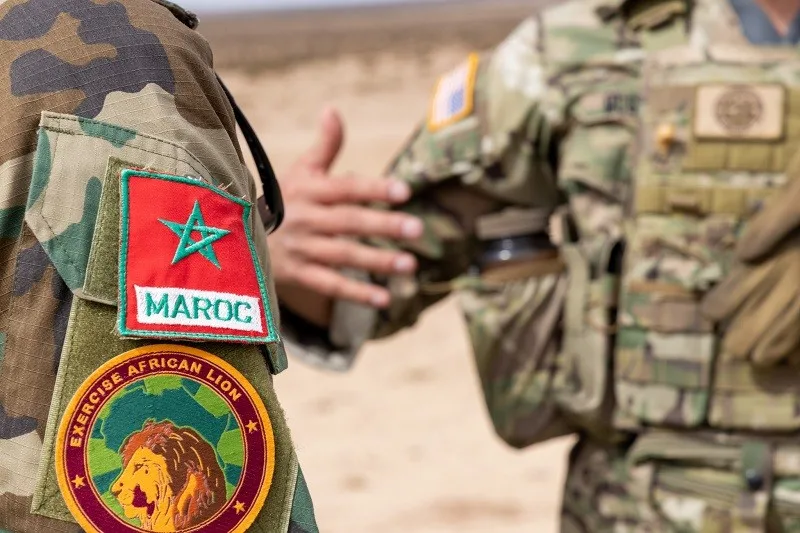
Marrakech – Morocco is preparing to train the thousands of foreign troops expected to secure Gaza under the multinational stabilization force tied to US President Donald Trump’s postwar plan. The role marks a sharp expansion of the kingdom’s involvement in a mission it formally joined only last week.
According to a report aired Tuesday by Israel’s public broadcaster Kan 11, the first foundational training of the International Stabilization Force (ISF) will take place in the coming weeks on Moroccan soil.
Correspondent Itay Blumental reported that Morocco will assume “a significant” share of the mission’s future planning, with Moroccan personnel responsible for training thousands of soldiers set to be deployed to the enclave. That work is being developed “with the support of Israeli security officials,” noted the broadcaster.
Kan 11 added that representatives from the American command in Kiryat Gat arrived in Rabat in recent days to plan the first training cycle alongside Moroccan army officers.
The program is expected to cover live-fire exercises, marksmanship, physical conditioning, operational drills, and additional instruction – part of a broader Moroccan role in Gaza’s future security arrangements. Officials on the Board of Peace told the broadcaster that Morocco is preparing to send roughly 500 soldiers to Gaza.
To date, four countries have agreed to contribute troops: Morocco, Kosovo, Kazakhstan, and Albania. Indonesia, which had previously pledged around 800 soldiers, “has not yet joined the force” and has not submitted a request to reach the Kiryat Gat headquarters, according to Kan 11.
The soldiers are expected to operate first in Israeli-controlled territory, securing a new district described as “New Rafah.” The area is to be built by the United Arab Emirates and defined as “clean of Hamas.”
Despite the technical progress, no date has been set for the entry of foreign troops into Gaza, with the earliest estimate placing it after the Israeli Knesset elections on October 27, likely at the start of next year.
Why Rabat
The Israeli outlet JFeed reported that the planners now in Rabat come from the ISF’s Kiryat Gat headquarters, the US-run coordination center in southern Israel. It described Morocco as “the lead partner shaping the Gaza stabilization force” and called the Moroccan contingent “the clearest working example of the ISF concept functioning in practice,” noting that early pledges from Kazakhstan and Albania have been slower to materialize.
According to JFeed, Morocco’s normalization ties with Israel under the Abraham Accords have allowed “a level of coordination between the Israeli and Moroccan militaries that is not available to every ISF contributor.”
Rabat has framed its role as an extension of its record in UN peacekeeping and its domestic counterterrorism and deradicalization programs, which Foreign Minister Nasser Bourita has indicated will inform Morocco’s police-training work in Gaza.
The training role builds on steps taken earlier this year. AFP reported that a contingent of Moroccan military officers arrived at the ISF headquarters in southern Israel on June 18, in a deployment first announced in February.
A Board of Peace official, speaking on condition of anonymity, indicated the group would help develop the force’s overall structure and provide expertise in areas including policing, and confirmed the presence of four Moroccan officers. “Their arrival strengthens the international effort to support the people of Gaza,” the Board of Peace said at the time.
Morocco’s deradicalization work has also drawn attention as a possible template for postwar Gaza. In a July 1 analysis, The Washington Institute’s Salma Annasse argued that Rabat’s state-led religious system could help rehabilitate the territory’s institutions, pointing to “the proven exportability of Rabat’s deradicalization machinery and the kingdom’s good working relations with the Israeli government.”
Built after the 2003 Casablanca bombings, the system combines regulated clerical training, a standardized curriculum, and a sermon-vetting process overseen by the state.
Annasse noted that Morocco would train Palestinians to run the system rather than impose it directly, using “the same ‘train the trainer’ approach Rabat already uses with clergy in Tunisia and Mali.”
She cautioned that the fit is imperfect, citing the absence of a deep historical relationship between Moroccan and Palestinian Muslim communities and the different doctrinal roots of Hamas, but concluded that the kingdom’s ties to Israel through the Abraham Accords “could greatly ease coordination with authorities on all sides.”
What comes next
Morocco’s participation was formalized on July 15, when it signed its Participating Country Agreement with the ISF. The ceremony in Rabat drew Bourita, senior defense officials, and Nickolay Mladenov, the Board of Peace envoy for Gaza, alongside the ISF commander.
The Moroccan National Defense Administration said the accord “reflects the shared determination to contribute, through concrete humanitarian and security actions, to the establishment of a climate of peace and security in the region.”
The Gaza Peace Council welcomed the decision, citing the planned deployment of senior officers, gendarmerie and police personnel, and a military field hospital. Morocco is the first Arab country to join the mission.
A Jerusalem Post analysis called Morocco’s commitment a major milestone for the US plan and “a key part of what comes next,” noting that Rabat “is a friend of the US and of Israel.”
The piece placed the move in the context of the Abraham Accords, of which Morocco is a member, and pointed out that Hamas still controls an estimated 30 to 40% of Gaza, where around two million civilians remain.
The Board of Peace thanked King Mohammed VI, stating that “Moroccan forces will support humanitarian aid delivery to Gaza and help train the Palestinian Police Force.” Mladenov credited the kingdom with “translating its longstanding commitment to the Palestinian people into concrete action.”
The ISF’s stated long-term goal, JFeed reported, is a force of roughly 20,000 troops and 12,000 trained police officers, beginning in Gaza’s Rafah sector before expanding elsewhere.