
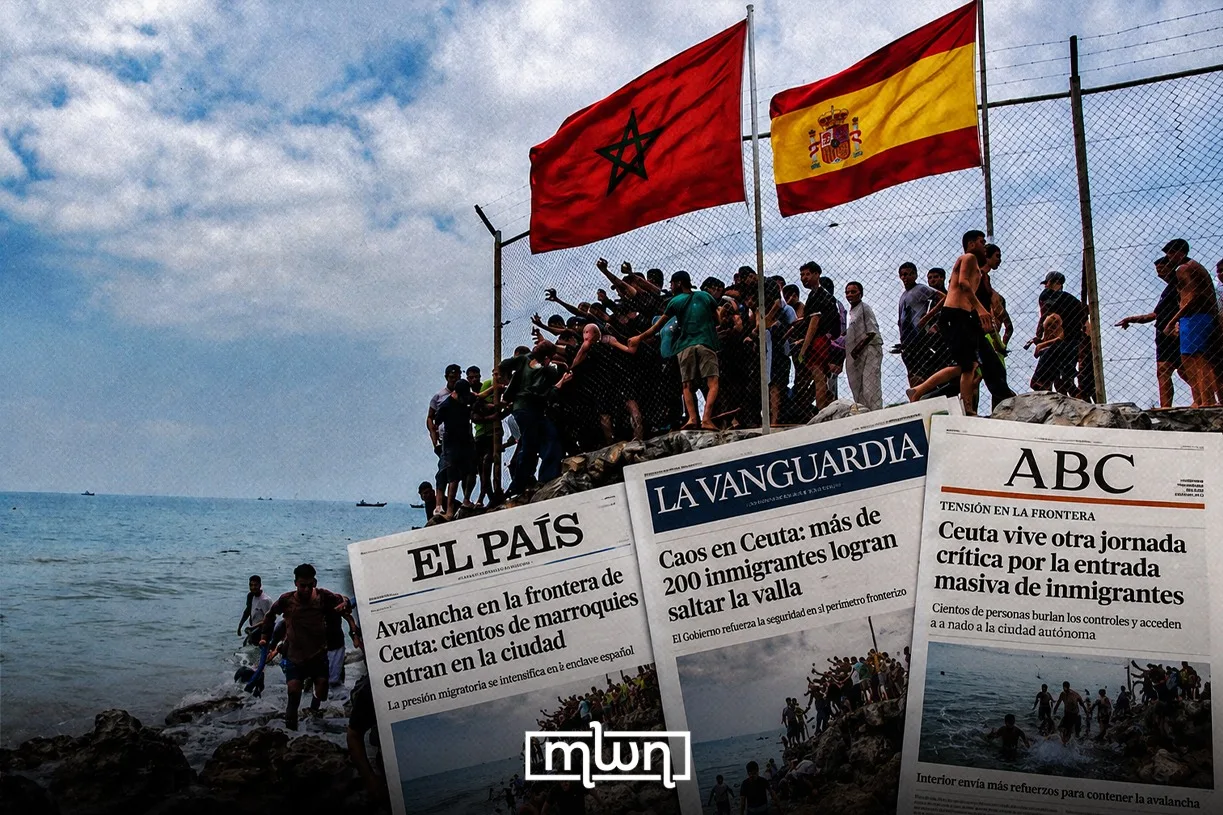
It is perfectly normal and understandable that large segments of Spanish public opinion have been shocked by the sudden and unprecedented wave of undocumented migrants crossing into Ceuta. Had something similar occurred in Morocco, Moroccans would have reacted in exactly the same way.
It is a deeply human response that, when people witness or experience an event of this magnitude, their first reaction is one of rejection, anger, indignation, or outrage. In that sense, some of the outrage and atavic comments coming out of Spain in the wake of the Ceuta crisis are legitimate and entirely understandable.
However, the problem I have with Spain is that while the President of the Government, Perdo Sanchez, the Interior Minister, Fernando Grande-Marlaska, and Minister of Foreign Affairs, Manuel Albares, have sought to reassure the public by explaining that there is no serious evidence whatsoever that Morocco acted deliberately or in bad faith, nor that it intended to use this situation as a tool of political pressure, and that there are no objective or credible grounds to back up the blackmail thesis that many radical voices on both sides of the Spanish political spectrum have pushed forth over the past few days, there has nevertheless been an extraordinary flood of pseudo-analysis asserting, without the slightest evidence, that Morocco was directly behind what happened in Ceuta.
Why would Morocco shoot itself in the foot?
For anyone trying to make sense of the confusing picture springing from the mismatch between Madrid’s official discourse of gratitude toward Morocco and the Morocco-hashing theatrics saturating the Spanish public sphere, the fundamental question to consider is actually very simple: why would Morocco do such a thing? Because whenever one analyzes an event like the Ceuta crisis, the first question that should be asked is: who stands to benefit? And in this case, it is clearly not Morocco?
There can be no doubt that what happened has caused significant reputational harm to Morocco. And so, any serious analyst who wants to genuinely capture the ins and outs of this tragedy ought to ask why Morocco would deliberately provoke a crisis that was bound to inflict serious damage on its own international reputation.
Yet the hard and sad truth, as I have documented in both my 2024 and 2026 books about the Sahara dispute and my 2021 book about the long history of tumultuous Morocco-Spain relations, most Spanish intellectuals do not have the patience for sober, dispassionate, and fact-driven analysis when it comes to capturing or chronicling Morocco. They almost invariably analyze Morocco through a prism of permanent suspicion. They never grant the kingdom the benefit of the doubt. They never stop to ask themselves: “What if Morocco did not do this deliberately? What if we examined the facts from different angles to determine whether the evidence points in another direction?”
But no. They unleashed an avalanche of accusations and insults from the very first moment the events unfolded. In their slanted imaginary and racialized vision of Moroccans, the most natural explanation of the Ceuta event was to simply fulminate against Moroccan blackmail. As a result, they elected to take it for granted, in spite of all evidence mounting in the opposite direction, that Morocco had deliberately opened the border in order to pressure Spain.
Insults directed at Morocco and at King Mohammed VI multiplied, while virtually nobody paused to consider the facts and context at hand. Had they done so, they would have been tempted to ask the most basic question of all: what political, geopolitical, economic, or reputational benefit would Morocco derive from such an operation? The answer is self-evident: none. They did not like that evident answer; so they continued charging Morocco while taking their false and hostile allegations for the truth it has never been.
In this avalanche of falsehoods and racist paternalism, one of the most outlandish theories to have gained traction is that Morocco deliberately coordinated with Israel and the United States in order to pressure or punish Spain because of its political positions on Palestine and Iran. It is an empty argument that does not withstand even the most superficial serious scrutiny.
Spain-Morocco relations are beyond the purview of Israel’s supposed long arms
Morocco is a sovereign state that formulates and conducts its foreign policy according to its own national interests. It is difficult to believe that Rabat would willingly jeopardize its strategic relationship with Spain or sacrifice important economic, security, and diplomatic interests merely to serve the agenda of another country, whether Israel or anyone else. Quite simply, that is not how the Moroccan state conceives or conducts its foreign policy.
If there is one country with which Morocco maintains its most strategic relationship, and one that it simply cannot afford to damage permanently, it is Spain. Geography, economic interdependence, and the dense human ties linking the two countries, including the presence of more than one million Moroccans in Spain, make the country a partner of paramount importance to Morocco. At the same time, Morocco has over the years remained an indispensable partner for Spain’s stability, prosperity, and security.
Relations between the two countries are currently at their highest point in more than five decades. Since Morocco gained its independence, there has never been such a profound level of mutual understanding and respect between the two governments as exists today. Likewise, never before have the two countries achieved such an advanced degree of economic integration and interdependence. The same can be said of cooperation in the fields of security and migration, regardless of what second-rate commentators may claim.
By recognizing the Moroccan Autonomy Plan as the only serious and realistic basis for resolving the Sahara dispute, the Spanish government ultimately gave Morocco what Rabat had been seeking since the 1960s. That move means Spain has committed to distance itself or reject any conduct that would obstruct Morocco’s efforts to recover its sovereignty over the Western Sahara region. Why would Morocco now put all that diplomatic progress in jeopardy to score short-lived tactical points?
Anyone who argues that Morocco used the events in Ceuta as a trial balloon or a dress rehearsal for organizing a march similar to the Green March in order to bring an end to Spain’s presence in the enclave is doing nothing more than engaging in unfounded speculation and peddling absurdities.
For Morocco, it has always been Sahara before Ceuta and Melilla
Morocco has absolutely no interest in reopening the question of Ceuta and Melilla, either with the current Spanish government or with whichever government emerges from the next general elections. As I have explained in three of the four books I have published on relations between the two countries, ever since the dawn of Morocco’s independence, Rabat’s overriding priority has been the recovery of the Sahara.
During a meeting with Spain’s then Minister of Information and Tourism, Manuel Fraga Iribarne, on July 9, 1963, King Hassan II assured him that he was prepared to set aside Morocco’s territorial claims over Ceuta and Melilla for three or four generations if Spain were willing to open negotiations on the future of the Sahara.
Three months earlier, during a meeting with Spain’s ambassador to Morocco, Manuel Aznar, on April 22 of that same year, the Moroccan monarch went even further in his concessions in order to persuade Spain to negotiate the return of the Sahara to Morocco. As a quid pro quo for opening direct negotiations on the outstanding territorial dispute, Hassan II offered Spain preferential participation in the exploitation of the Sahara’s natural resources, the conclusion of a security pact concerning the Canary Islands, and even the possibility of establishing a Spanish military base in the Sahara.
More importantly still, Hassan II informed his interlocutor that he was prepared to relegate the question of Ceuta and Melilla to the background, provided Spain understood and respected the fact that Morocco’s overriding priority was the recovery of its sovereignty over the Sahara and Ifni. As further proof of King Hassan II’s good faith- and of the confidence he placed in General Franco’s willingness to reciprocate this gesture- Morocco refrained, following their meeting at Madrid-Barajas Airport on July 6, 1963, from raising the question of Ceuta and Melilla before the Fourth Committee of the United Nations. And this was at a time when colonial powers, including Spain, were required to submit the list of Non-Self-Governing Territories still awaiting decolonization.
For more than a decade thereafter, Morocco completely refrained from raising the issue before the Fourth Committee. The only time it did so was on January 27, 1975, with the aim of pressuring Spain and discouraging it from adopting any measure that might undermine Morocco’s efforts to recover its sovereignty over the Sahara.
Since then, the rare occasions on which Morocco has signaled a willingness to use Ceuta and Melilla as leverage against Spain have always coincided with Spanish decisions that Rabat regarded as openly hostile to the legitimacy of Morocco’s claim to its southern provinces.
One such occasion was Javier Rupérez’s visit to the Tindouf camps in October 1978. Rupérez, who was then responsible for foreign affairs within the Union of the Democratic Centre (UCD), the party of Spanish Prime Minister Adolfo Suárez, paid a visit that foreshadowed the Spanish government’s subsequent shift in policy toward the Polisario Front. That shift materialized a year later when Adolfo Suárez met Polisario Front Secretary-General Mohamed Abdelaziz in Algiers during his official visit to Algeria.
In response to that visit, which Morocco regarded as clearly hostile and contrary to both the letter and the spirit of the Madrid Tripartite Agreement signed by Spain, Morocco, and Mauritania on November 14, 1975, Moroccan Foreign Minister Mohamed Boucetta declared Morocco’s intention to reclaim Ceuta and Melilla during an address at Georgetown University’s Strategic Institute on October 9. “Morocco’s territorial integrity has not yet been completed, since the country has still not recovered the Moroccan cities of Ceuta and Melilla, nor several small islands off its Mediterranean coast,” Boucetta said.
Morocco’s chief diplomat reiterated this point roughly a week later, declaring that “Ceuta and Melilla are Moroccan and will remain so, just as Gibraltar is Spanish.”
Since then, with the exception of 1995, when Spain was debating the Statutes of Autonomy for the two enclaves, Morocco has largely placed its claims over Ceuta and Melilla on the back burner. This has not been because Rabat has abandoned its claims, but because it has consistently judged that preserving and strengthening its strategic relationship with Spain, while giving absolute priority to the Sahara issue, better serves its long-term national interests.
Back in December 2008, Spanish Prime Minister José Luis Rodríguez Zapatero described the Moroccan Autonomy Plan as “serious and credible“ and “a positive contribution” to resolving the Sahara conflict. At the time, there appeared to exist a tacit understanding between Rabat and Madrid whereby Morocco would continue to place the question of Ceuta and Melilla on the back burner in exchange for what was then perceived in Rabat as a more constructive Spanish approach to the Sahara dispute.
Yet that tacit understanding was disrupted following U.S. President Donald Trump’s recognition of Moroccan sovereignty over the Sahara in December 2020, when Spanish Minister of Foreign Affairs Arancha González Laya made a series of statements that were widely perceived in Rabat as hostile to Morocco’s position on the Sahara.
Immediately afterward, Morocco’s then Head of Government, Saad Eddine Othmani, made a series of statements reminiscent of those delivered four decades earlier by former Foreign Minister Mohamed Boucetta.
However, ever since Spain officially recognized the primacy of the Moroccan Autonomy Plan as the only serious and realistic basis for resolving the Sahara dispute, an objective Morocco had pursued consistently for more than four decades, there has been no objective reason whatsoever for Rabat to place the question of Ceuta and Melilla back on the bilateral agenda.
Had that truly been Morocco’s intention, the statement issued by the Moroccan Ministry of the Interior earlier this week would almost certainly have referred to “Ceuta and Melilla” as occupied enclaves or “Moroccan cities under occupation.” Instead, Morocco made a conscious and carefully considered decision not to employ such language because it has no desire either to pour fuel on the fire or to break the tacit understanding that has prevailed between the two governments to keep this dispute outside the framework of their bilateral relationship.
As King Hassan II once quipped to Spain’s ambassador to Morocco, Manuel Aznar, Morocco’s doctrine has always been to allow time to do its work, in the hope that this dispute may one day be resolved in a manner that neither generates unnecessary tensions nor damages the broader relationship between the two countries.
Anyone who strikes a balance of calm, dispassionate, and fact-based analysis when making sense of the Ceuta mass crossings is bound to land on the inevitable conclusion that Morocco had absolutely no interest in provoking this crisis. What occurred was the result of the convergence of a series of objective factors that happened to coincide at a particular moment.
Algeria’s obsession with Morocco offers a more reasonable theory
As I argued in a previous article, the migration surge of July 29 and 30 was the product of the convergence of years of accumulated economic hardship, powerful migration pull factors, rumors amplified through social media, and a ruling by a Spanish court that many interpreted as opening a legal pathway into Europe. Simplistic political narratives may generate headlines and attract clicks, but they do little more than obscure the structural realities that continue to drive irregular migration.
And perhaps the principal beneficiary of all this is neither Morocco nor Spain, but Algeria. It is certainly not in Algeria’s interest for Morocco to maintain strong, prosperous, and strategically close relations with Spain. Seeing Morocco regionally isolated and subjected to negative international media coverage that damages its image clearly serves the interests of a country that has yet to come to terms with Spain’s decision to support Morocco’s position on the Sahara.
It is therefore not inconceivable that the Algerian intelligence services may have played some role in amplifying, through social media, the rumor that the Spanish Constitutional Court’s new legal interpretation had effectively created a pathway whereby those who managed to swim to Ceuta would not be immediately returned to Morocco.
While there is no public evidence corroborating this conclusion, the possibility cannot be dismissed outright. Over the past two decades, weakening Moroccan-Spanish relations and reversing Rabat’s diplomatic momentum on the Sahara issue has been the number one order on Algeria’s geopolitical menu. Algeria may not be the main or sole culprit in this affair, but the fact that it is the regional actor that has stands to draw the most benefit from the Ceuta crisis and its accompanying conspiracy theories should be enough to raise this alternative, more reasonable reading.
Samir Bennis is the co-founder and publisher of Morocco World News. You can follow him on Twitter @SamirBennis.