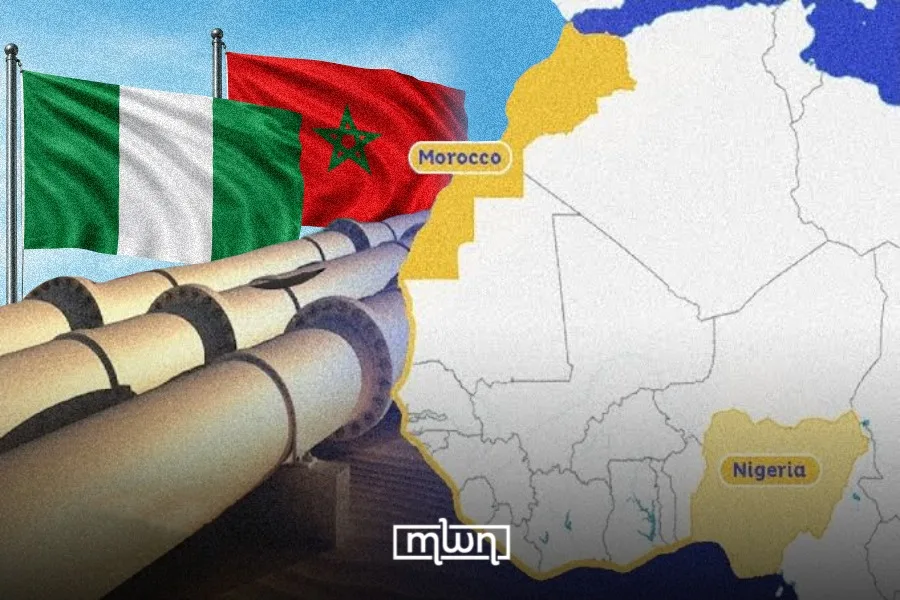
By formalizing on July 19 the collective accession of ECOWAS heads of state to the Intergovernmental Agreement (IGA) governing the African Atlantic Gas Pipeline (AAGP), the Moroccan-Nigerian duo crossed a threshold ten years of quiet diplomacy had prepared. The event exceeds the technical scope of an energy agreement: it consecrates a transcontinental corridor worth $25 billion, designed to carry up to 30 billion cubic meters of gas per year from the Niger Delta to Morocco’s Atlantic coast, crossing thirteen West African countries.
That same month, Algeria consolidated its own rival corridor toward Europe, the Trans-Saharan Gas Pipeline (TSGP), whose Algerian section entered construction on June 4, 2026. This essay analyzes the genesis, institutional architecture, technical parameters, and geoeconomic scope of the Moroccan-Nigerian project, before examining its most significant dimension: the strategic competition pitting it against the Algerian project for access to the European gas market as the continent’s energy supply grapples with the consequences of Russia’s war on Ukraine. The thesis is that the AAGP cannot be reduced to its energy rationale alone; it is a foreign-policy instrument through which Morocco converts a resource it does not possess — Nigerian gas — into a lever for regional integration, continental repositioning, and securing its relations with the Sahel. Two reading grids illuminate this dossier: the political economy of energy, which gauges the project against raw physical parameters, and geoeconomics, which reads the infrastructure as a vector of diplomatic relationships and status independent of profitability alone. The second grid explains why a gasless country has positioned itself as the principal architect of a continental gas corridor, and it structures the argument that follows.
- Historical genesis and political economy of the project
The project traces its origins to December 2016, during King Mohammed VI’s visit to Abuja, where the Sovereign and then-Nigerian President Muhammadu Buhari laid the groundwork for bilateral gas cooperation, part of a package of twenty-one agreements . This impetus survived Nigeria’s political alternation, with President Bola Ahmed Tinubu reaffirming support (Morocco World News, 2026a).
The project is steered by a binational tandem pairing Morocco’s National Office of Hydrocarbons and Mines (ONHYM) with the Nigerian National Petroleum Company Limited (NNPC Ltd.), whose collaboration allowed, a decade after the political launch, the completion of front-end engineering design, environmental impact, and technical feasibility (FEED) studies. One fact deserves early mention: Morocco holds virtually no gas reserves of its own. The apparent paradox — a gasless country carrying a continental gas project — is the key to reading this project: Morocco is not selling gas; it is selling a corridor, a governance structure, and access to the sea.
- The institutional architecture: from Rabat to Freetown
The signing of the IGA at the ECOWAS summit in Freetown on July 19, 2026, formalizes the project’s integration into the bloc’s decision-making processes. Sierra Leonean President Julius Maada Bio, then ECOWAS chair, welcomed the signing, stressing the gas would soon benefit all coastal countries involved. Notably, Morocco — not an ECOWAS member — co-sponsored the agreement and secured its adoption by the entire bloc, demonstrating its capacity to rally continental support beyond its formal institutional status.
This does not exhaust the legal calendar: the bilateral agreement with Mauritania, indispensable to the route’s geographic continuity, is expected in fall 2026. Such a sequencing — community accession first, peripheral ratification second — reflects a strategy of anchoring multilateral support before addressing the most sensitive bilateral segments.
- Technical Parameters and Metric Uncertainties
The project’s physical characteristics vary considerably from source to source, itself a sign of this dossier’s still-evolving nature. The route’s length is estimated at 6,800 kilometers, 6,900 kilometers per a hybrid offshore-onshore alignment, or as low as 6,000 or 5,600 kilometers.
Meanwhile, cost estimates range between $25 billion and $27 billion. What does command consensus is the targeted annual capacity of 30 billion cubic meters, roughly half reserved for the West African domestic market and the other half channeled toward Morocco and, via the Maghreb-Europe Gas Pipeline (GME), toward Europe. The project also envisions branch lines to Niger, Burkina Faso, and Mali, linking it to the Kingdom’s broader Sahel policy.
- Governance, timeline, and final Investment decision
The agreement expected in fall 2026 is meant to establish two governance bodies: a project management company headquartered in Casablanca, steering the financial, commercial, and operational components, and a regulatory authority, the Pipeline Higher Authority, headquartered in Abuja.
Only once these structures are in place can promoters mobilize international investors and prepare the Final Investment Decision (FID), a prerequisite for heavy construction. The timeline places the start of work between 2027 and 2028, with first gas around 2031.
No public timeline for effective gas interconnection of the Sahel states exists to date; this integration remains, per an Atalayar analysis, more a matter of principle than a project with a fixed deadline.
- Integration into the Royal Atlantic Initiative
The pipeline cannot be understood in isolation from the Atlantic Initiative. Launched by King Mohammed VI in November 2023, the initiative offers the landlocked Sahel states — Mali, Niger, Burkina Faso, and potentially Chad — strategic access to the Atlantic through port, road, and rail investments on Moroccan territory . The foreign ministers of the concerned states endorsed the offer at a Marrakech meeting in December 2023, reiterating support before the Sovereign in Rabat in April 2025.
The pipeline is one of the Initiative’s energy pillars, alongside the Dakhla deep-water port and an associated green hydrogen project . King Mohammed VI has framed this approach as a break with the security-first paradigm historically championed by France in the Sahel, betting on cooperation and shared development rather than military arrangements alone.
This has gained relevance amid deteriorating Algeria-Sahel relations. After Algerian forces destroyed a Malian military drone near the shared border in 2025, Mali, Niger, and Burkina Faso have recalled their ambassadors. They called the Algerian move an act of aggression, and their actions and discourse since then have continued to open and endorse a diplomatic avenue Morocco has been keen to occupy to advance its vision for regional stability and shared prosperity. 6. The European Geoeconomic Dimension
The revival of this transafrican energy corridor cannot be separated from the post-2022 European energy context. Russia’s invasion of Ukraine reshuffled Europe’s gas supply routes. This has pushed the EU toward diversification, as reinforced in 2026 by a ban on Russian pipeline gas and LNG imports.
In this context, and with proven reserves estimated at roughly 5,940 billion cubic meters, among Africa’s largest, Nigerian gas has become a contested prize between two competing routes toward Europe.
The AAGP’s targeted 15 billion cubic meters per year for Europe would represent a modest but non-negligible fraction of the roughly 270 billion cubic meters Europe imported in 2025. This explains Rabat’s interest in American financing, an avenue the Kingdom continues to explore alongside institutional investors.
- A structuring rivalry: the AAGP versus the Trans-Saharan Gas Pipeline
Any analysis would be incomplete without situating the project against its direct competitor, the Trans-Saharan Gas Pipeline (TSGP), sometimes called NIGAL, linking Nigeria to Algeria via Niger. Dating to the 1980s and formalized by a 2009 tripartite agreement, this rival project saw a spectacular relaunch in 2026. Algerian, Nigerian, and Nigerien energy ministers met in Algiers on June 3 for the fifth steering-committee meeting, and construction of the Algerian section was launched the next day in Adrar, based on a feasibility study by the British firm Penspen.
On purely metric grounds, the TSGP holds an advantage: its route, roughly 4,100 to 4,128 kilometers, crosses only three countries, compared with the AAGP’s 6,800 kilometers and thirteen countries, making it cheaper and, on the face of it, faster to complete. Commentators close to Algiers have accordingly dismissed the Moroccan project as disproportionate and less viable.
However, such a strictly metric reading misses the strategic logic at work, according to Morocco World News: while the TSGP remains a simple evacuation pipe crossing the empty Sahara, the AAGP was designed by Rabat as an instrument deploying, around the gas itself, layers of trade, diplomacy, food security, and multilateral cooperation, linking thirteen coastal states and four Sahel states in a corridor the Kingdom intends to structure durably, regardless of the commissioning timeline.
This divergence matters because the rivalry between the two corridors is inseparable from the broader Rabat-Algiers antagonism: each project exists, in part, because the other exists, in a dynamic of counter-signaling where the revival of one precedes or responds to the other. The TSGP’s Sahel-flank fragility was demonstrated by the 2025 Algiers-Niamey crisis following the Tinzaouaten incident, which temporarily deprived the Algerian project of its only transit state, before a February 2026 normalization allowed construction to resume. In a sense, this constituted a reminder that each corridor’s viability remains hostage to the Sahel’s shifting political balances more than to technical or financial parameters alone.
- Critiques, uncertainties, and analytical limits
Beyond the Moroccan-Algerian rivalry, several uncertainties affect the project’s medium-term credibility. First, Morocco’s lack of gas resources places it as intermediary rather than producer, raising questions about its case before international financial partners.
The second uncertainty has to do with financing. Despite completed technical studies, the financing consortium and FID remain, as of July 2026, still pending, keeping the project in budgetary uncertainty the TSGP has partly moved past.
Third, security risks inherent in crossing Sahel and Nigerian zones marked by armed-group activity and smuggling, documented for both routes. A rigorous reading thus distinguishes the diplomatic gains already secured — federating the West African bloc — from the industrial scope, which remains conditional and may never materialize in the form currently announced.
- The geopolitics of the corridor versus the geoeconomics of the pipe
The elements above converge toward a central conclusion: the AAGP’s value should be measured not only against its intrinsic energy profitability but its capacity to reshape West African alliances. By linking the gas project’s revival to the Atlantic Initiative, federating thirteen coastal states and four Sahel states around shared infrastructure, and capitalizing on the diplomatic vacuum left by deteriorating Algerian-Sahel relations, Rabat has converted a bilateral energy partnership initiated in 2016 into a foreign-policy instrument with continental ambitions.
Whether first gas reaches Tangier in 2031 as announced, or the project experiences substantial delays against the more advanced TSGP, the geopolitical recomposition already produced — ECOWAS’s accession, the Sahel bloc’s re-engagement, interest from international lenders — is itself a strategic gain, independent of the industrial timeline. This also invites nuancing the official narrative of an unambiguous South-South cooperation devoid of power dynamics. The partnership is rooted in continental solidarity, yet it remains marked by an asymmetry of endowment — Nigeria the producer, Morocco the corridor and governance provider — and by open competition with Algeria, which claims rival legitimacy to organize West African gas exports to Europe. As such, its success will depend as much on Rabat and Abuja overcoming these regional rivalries as on mobilizing external financing.
In conclusion, the Nigeria-Morocco African Atlantic Gas Pipeline illustrates how a state with no gas resources of its own can position itself as architect of a continental energy corridor, combining long-term royal diplomacy, patient institutional engineering, and skillful exploitation of rival regional fault lines.
ECOWAS’s collective accession, formalized in Freetown on July 19, 2026, is less a culmination than a step in a process whose industrial outcome remains suspended on the FID, effective mobilization of international financing, and the continued political stability of the states to be crossed.
The structuring rivalry with the Algerian TSGP is a reminder that West Africa and the Sahel have become the theater of a geoenergy competition with heavy symbolic charge, in which mastery of the diplomatic narrative matters at least as much as mastery of the technical route in determining which corridor will shape Africa-Europe energy architecture for the decade ahead.