


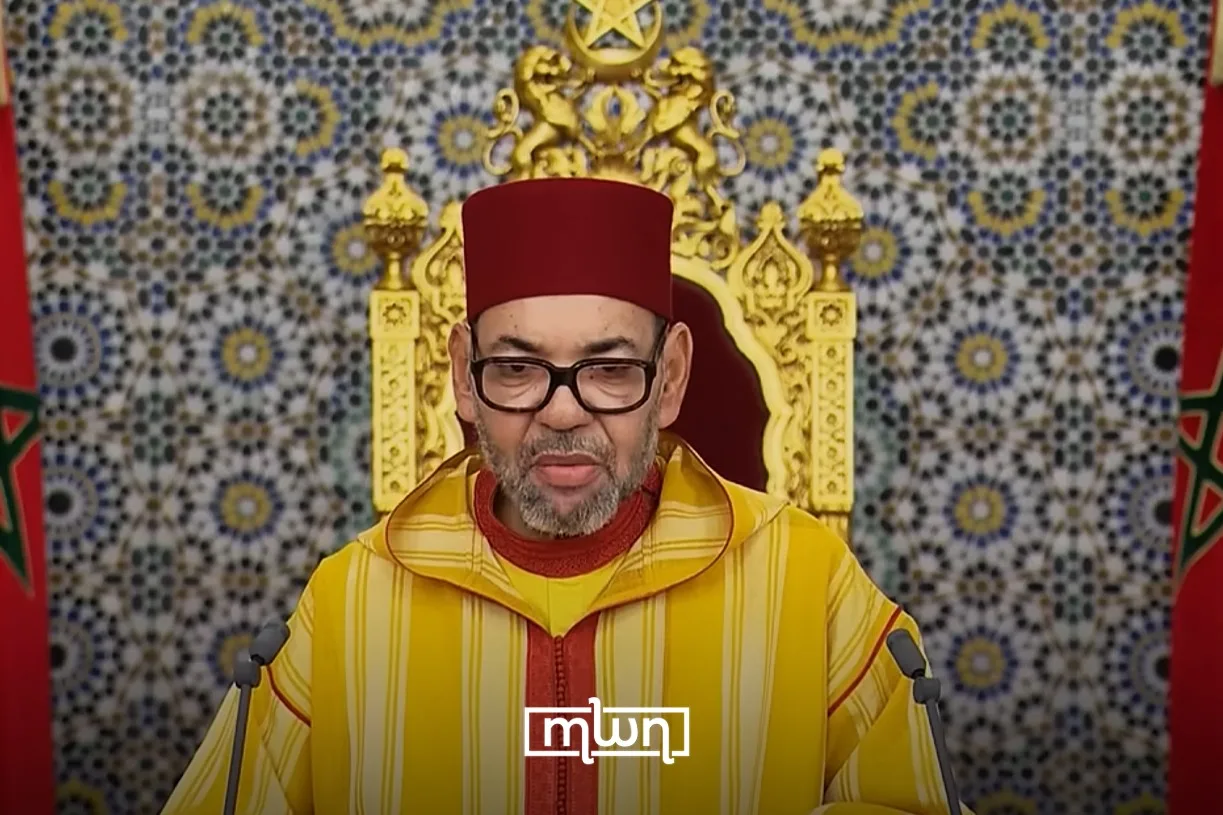
The speech King Mohammed VI delivered on the occasion of the 27th anniversary of His accession to the Throne inscribes itself within a well-established rhetorical tradition, that of the performative genre of the Moroccan royal speech, in which the sovereign’s utterance simultaneously fulfills religious, political, and pedagogical functions toward the nation. Far from being a mere protocolary review, this text constitutes an apparatus of legitimation that articulates three intertwined discursive registers: the theological register of divine grace and gratitude (chukr), the register of quantified economic performance, and the register of security stability erected as a supreme national good. This analysis proposes to examine the argumentative structure of the speech, its enunciative strategies, its lexical choices, and its silences, situating them within the broader framework of the scholarly literature devoted to the legitimacy of the Sharifian monarchy.
The guiding hypothesis of this study is that the 2026 speech falls under what the political scientist Rabia Naguib describes as “transitional continuity,” that is, a narrative procedure through which monarchical power displays a perpetual movement of reform and modernization while fully preserving the traditional architecture of its authority (Naguib, 2019). The royal text, in this sense, does not merely draw up a record of achievements: it actively shapes the very categories through which that record is meant to be perceived by its addressees.
The enunciative framework: Religious opening and the posture of gratitude
The speech opens, according to the consecrated formula, with the basmala and the invocation of praise to God and blessings upon the Prophet, a rhetorical device that from the outset situates the royal utterance within the continuity of the Islamic tradition of authoritative discourse. This opening is not a mere stylistic ornament: from the very first sentence, it actualizes the monarch’s religious function as Amîr al-mou’minîn (“Commander of the Faithful”), a function that historically constitutes one of the three cardinal sources of Alaouite legitimacy alongside Sharifian descent and allegiance (bay’a) (Daadaoui, 2011).
The Qur’anic citation “If you are grateful, I will surely increase you [in favor]” (Sura Ibrahim, verse 7) deserves particular attention. By inserting this scriptural reference at the very heart of the political review, the Sovereign performs a fundamental semantic shift: economic and institutional results cease to be presented as the exclusive product of governmental or technocratic action and become instead the manifestation of divine favor, for which the nation is charged with bearing witness through gratitude and continued effort. This device, which might be called the theologization of the political record, has the performative effect of placing the debate outside the field of ordinary partisan contestation: to criticize the record would, within this discursive logic, amount to a lack of gratitude toward a divine blessing rather than an evaluation of public policy.
The text moreover closes the argumentative loop on this same register, citing in conclusion the verse “God does not wrong those who do good.” This circular closure, which echoes the opening, constructs a closed hermeneutic frame in which the Sovereign’s action is presented as intrinsically belonging to the register of beneficence (ihsân).
The ethos of servant humility and the construction of the royal figure
The rhetoric of humility is articulated around the historical figure of the “king of the poor” that Mohammed VI constructed from the earliest years of his reign, and which has been analyzed as one of the pillars of his own narrative of legitimation, distinct from that of his father (Naguib, 2019). The 2026 speech reactivates this same positioning: the Sovereign presents himself not as a head of state seeking international recognition, but as a servant (khâdim) whose sole preoccupation remains the dignity and freedom of his fellow citizens. The systematic use of the majestic pronoun (“We”), combined with formulas of service (“My sole concern has always been to discharge, to the best of My ability, the responsibility [entrusted to Me]”), produces a hybrid ethos that articulates the institutional grandeur of the Throne together with a claimed affective proximity to the people.
Stability as strategic capital
The argumentative core of the speech rests on the assertion that “stability is the key variable in the equation of development in Morocco” and constitutes “the strategic capital that is the country’s pride.” This insistence must be read in light of the regional context explicitly invoked by the text: “a regional and international context beset by numerous convulsions and multiple tensions.” The speech thus draws an implicit yet insistent comparison between Morocco and its immediate geopolitical environment, without ever naming the countries or crises in question — a device that allows a favorable contrast to be suggested while avoiding any explicit diplomatic commitment liable to antagonize regional partners.
By ranking stability above every other consideration, the royal speech implicitly reaffirms the idea that deeper institutional reforms, often demanded by part of civil society and by certain political parties, remain subordinate to the higher imperative of preserving order. The mention of the management of the Gharb floods, presented as evidence of “resilience,” likewise illustrates a discursive strategy that consists of converting every conjunctural ordeal into confirmation of the system’s structural solidity.
On a strictly stylistic level, one should also note the constant recourse to superlative adjectives and intensifying formulas (“immense pride,” “deep satisfaction,” “historic performance”), which lend the text an avowedly laudatory tonality. This lexical choice, far from being incidental, is consistent with the conventions of the solemn genre of the Throne Day speech, whose ceremonial function permits, and indeed calls for, a register of emphasis that would not be found in an ordinary policy address to Parliament.
The narrative of economic performance: A rhetoric of quantified proof
The speech deploys an impressive accumulation of quantified indicators: a growth rate of 4.9% in 2025, a share of more than 40% of exports accounted for by the automotive and aeronautics sectors, an automotive production capacity of approximately one million vehicles, coverage of nearly 80% of national needs in the agri-food and pharmaceutical industries, and close to 20 million tourist visitors.
The economic narrative is also organized around a temporality of technological anticipation: the aeronautics hub, electric batteries, green hydrogen. This emphasis on anticipation makes it possible to project the image of a Morocco that is not merely catching up on a development lag, but positioning itself ahead of global technological shifts — a discourse that connects with the theme of “emerging Morocco” already mobilized in earlier royal speeches and analyzed as a constant axis of the reign’s institutional communication (Institut du Moyen-Orient, 2025).
Sovereignty, strategic self-sufficiency, and diplomatic positioning
The speech devotes considerable development to the notions of “national sovereignty” and “strategic self-sufficiency,” terms that take on particular relief within the explicitly invoked international context of the “return of protectionism” and the “securing of supply chains.” The reference to the establishment of an “industrial and technological base for defense and cybersecurity” constitutes a notable departure from earlier speeches, which were more centered on civilian sectors, and conveys a desire to project the image of a rising regional power in the security domain, in keeping with the stated ambition of making the Kingdom a credible actor in international partnerships.
On the diplomatic level, the speech affirms that Morocco has become “a reliable, respected, and influential player on the global stage,” capable of formulating “constructive partnership offers.” This deliberately general formulation avoids any nominal reference to the sensitive diplomatic files of the moment — whether the French-Moroccan strategic partnership, the gas corridor linking Nigeria to Morocco, or relations with European and American partners. This choice of generality contrasts with the numerical precision of the economic section and suggests a deliberate intention not to fix, within so solemn and widely broadcast a speech, positions that remain subject to the evolution of bilateral negotiations.
The social and territorial dimension: Between program and generality
The section devoted to human development remains, as noted above, markedly more elliptical than the economic section. The “generalization of social protection” and “integrated territorial development programs” are mentioned as achievements still being consolidated. The speech nonetheless insists on the requirement of territorial inclusion “without any exception,” a formula that can be read as an implicit, though unstated, acknowledgment of persistent regional disparities between coastal urban areas and the rural and mountainous regions of the interior — an issue long documented by research on Moroccan territorial development.
The appeal addressed to the “national financial sector” to broaden access to financing for small and medium-sized enterprises and for innovation reflects an implicit acknowledgment of a structural bottleneck in the Moroccan economy, namely the difficulty of access to credit for the productive fabric of the nation outside the large corporate groups. This injunction, addressed directly to financial actors rather than to the government, illustrates a recurring rhetorical figure of Moroccan royal discourse that the literature describes as institutional dualism: the Sovereign positions himself as an overarching arbiter who calls upon intermediary bodies — here the banking sector — while distinguishing himself from the government, whose action implicitly remains subject to a separate regime of evaluation (Naguib, 2019).
Dynastic continuity and legitimation through descent
The speech closes with a pointed evocation of the security forces — the Royal Armed Forces, the Royal Gendarmerie, the National Police, the Auxiliary Forces, Civil Protection — placed “under Our command,” recalling that military and security authority remains a reserved domain of the Sovereign, in accordance with the regime’s constitutional architecture. This evocation is immediately followed by the memorial invocation of the “martyrs of the Nation,” foremost among them Mohammed V and Hassan II, a rhetorical gesture that inscribes the current reign within an uninterrupted genealogy of founding sovereigns and links the reigning monarch’s personal legitimacy to the cumulative historical legitimacy of the Alaouite dynasty.
This memorial closure confirms what several political scientists have identified as the distinctive trait of the Moroccan monarchy relative to other regimes in the region: its capacity to articulate a traditional-type historical legitimacy, grounded in Sharifian descent and dynastic continuity, together with a charismatic and rational-legal legitimacy grounded in contemporary governmental performance (Daadaoui, 2011). By closing the speech with homage to the royal ancestors rather than with a programmatic projection, the text reaffirms that the ultimate source of royal authority remains genealogical and sacred, with economic performance intervening only as a contemporary confirmation, and not as the foundation, of that legitimacy.
Reading the official narrative
It must finally be emphasized that the absence of any nominal reference to a specific bilateral file — whether the French-Moroccan relationship, the Nigeria-Morocco gas corridor, or regional diplomatic developments — in no way signifies that these files are neglected in Moroccan governmental practice; rather, it reflects a generic convention proper to the Throne Day speech, a genre whose function is less to announce precise diplomatic orientations than to consecrate, in a solemn and timeless register, the unity of the national political body around the Sovereign. This distinction between the ceremonial register of the Throne Day speech and the operational register of speeches opening the parliamentary session or ministerial statements constitutes an essential methodological point for anyone undertaking a comparative analysis of the corpus of Moroccan royal speeches.
Conclusion
The 2026 Throne Day speech illustrates, with remarkable economy of rhetorical means, the formula of “transitional continuity” that has characterized the political communication of the Moroccan monarchy for more than two decades (Naguib, 2019). The text articulates three complementary discursive strata: a theological stratum that places royal action under the seal of divine grace and pre-emptively neutralizes any frontal criticism; a technocratic stratum that, through the accumulation of quantified indicators, constructs an ethos of managerial rigor; and a memorial and dynastic stratum that ties present legitimacy to a sacred, uninterrupted genealogy dating back to Mohammed V.
Ultimately, the study of this text confirms that the speech cannot be analyzed in isolation from the balance of forces and the structural stakes of contemporary Moroccan society. It constitutes a first-rate document for understanding the mechanisms of monarchical legitimation, but its full interpretation requires that it be systematically cross-referenced with independent socio-economic data and with the scholarly literature devoted to governance and democratization in Morocco.
References
Bertelsmann Stiftung. (2026). BTI 2026 country report: Morocco. Bertelsmann Stiftung Transformation Index (BTI). https://bti-project.org/fileadmin/api/content/en/downloads/reports/country_report_2026_MAR.pdf
Chtatou, M. (2026, May 27). The political process in Morocco: Monarchy, reform, and incremental democracy. Eurasia Review. https://www.eurasiareview.com/27052026-the-political-process-in-morocco-monarchy-reform-and-incremental-democracy-analysis/
Daadaoui, M. (2011). Moroccan monarchy and the Islamist challenge: Maintaining Makhzen power. Palgrave Macmillan. https://doi.org/10.1057/9780230117628
Naguib, R. (2019). Legitimacy and “transitional continuity” in a monarchical regime: Case of Morocco. International Journal of Public Administration, 43(12), 1054–1065. https://doi.org/10.1080/01900692.2019.1672733
Temsamani, S. (2025, October 11). King Mohammed VI and the power of purposeful leadership. The Arab Weekly. https://thearabweekly.com/king-mohammed-vi-and-power-purposeful-leadership


