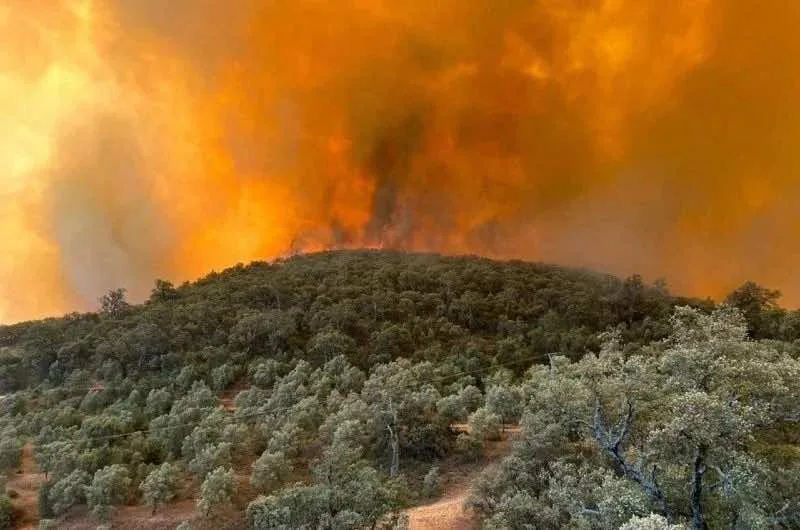
The National Agency for Water and Forests (ANEF) said forest fires in Morocco declined by nearly 31% compared to the annual average of around 3,130 hectares.
ANEF’s Director General Abderrahim Houmy said on Wednesday that Morocco recorded 340 fires since the beginning of 2026, burning approximately 2,150 hectares.
Houmy said the effectiveness of Morocco’s national forest fire prevention and response system should not be measured by the number of fires.
Instead, the assessment should be more focused on the ability to contain fires and prevent their spread within a very short time, he said.
He said Morocco is among the countries with the lowest rates of burned forest areas compared with many Mediterranean nations.
For Houmy, protecting forests is a shared responsibility involving multiple institutions under a national strategy led by King Mohammed VI and based on close coordination among all relevant actors.
Nearly 55% of the burned areas consisted of grasslands and secondary vegetation. Only about 45% involved forested areas, Houmy said, attributing the situation to the abundant rainfall during the winter season.
He said the rainfall encouraged dense grass growth before vegetation dried out during heatwaves, increasing its flammability.
“These results reflect the effectiveness of Morocco’s national forest fire management strategy,” Houmy said, explaining that ANEF analyzes weather conditions, temperatures, humidity, wind speeds, and vegetation cover on a daily basis using satellite imagery and advanced scientific models.
Houmy added that the agency deploys significant technical capabilities, including over 2,800 forest lookouts and rangers mobilized to monitor forests and provide early warnings.
Morocco’s ground response includes an aerial fleet that includes Canadair firefighting aircraft, each capable of carrying six tons of water, as well as helicopters with a two-ton capacity and Turbo Thrush aircraft capable of carrying between 1.5 and 3 tons of water.
Morocco also deploys vehicles to respond to fires, Houmy said, noting that the effectiveness of the system depends not only on the scale of the resources but also on the immediate coordination among all responders.