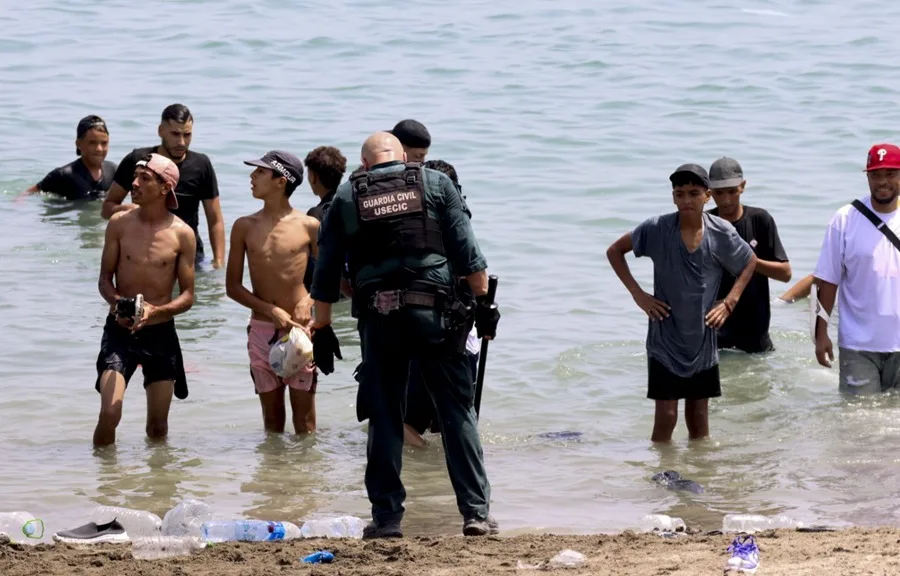
French journalist and political communications adviser Françoise Degois has joined the growing chorus of analysts challenging claims that Morocco deliberately orchestrated the recent mass migration to the Spanish enclave of Ceuta.
The journalist argued that such narratives fail to take into account the broader political and historical context and questioned theories suggesting that Rabat intentionally used migration to pressure Spain.
Degois argued that it is difficult to believe Morocco would deliberately undermine its strategic relationship with Spain or overshadow the symbolic significance of Throne Day by triggering a crisis of such magnitude
“All of this happened on Throne Day, one of the most important occasions in Morocco. Would King Mohammed VI have had any interest in undermining his own celebration, his own reign, and his own monarchy? This is difficult to believe,” she wrote on X.
The French journalist also questioned who benefits from images prompting reactions from far-right circles around the world, suggesting that it all began with a rumor circulating on social media.
“Who first posted that rumor, particularly on TikTok? Who used algorithms to amplify it and turn it into an accepted narrative? Who stood to gain from that?” she asked.
She recalled how Spain, under Pedro Sánchez’s government, has for years been committed to fighting criminal networks that exploit the free-trade status of the enclaves of Ceuta and Melilla.
“Creating chaos in Ceuta also serves to divert attention and tie up security and emergency resources for days,” Degois wrote.
The claims promoted by the far right and by those who lack context and historical knowledge of relations between Spain and Rabat continue to circulate despite statements from Madrid.
One of the first reactions from the Spanish government was to thank Morocco for its cooperation in tackling the mass migration crisis.
Morocco also responded to the situation swiftly by agreeing with Spain on the return of migrants who entered Ceuta illegally.
Morocco also emphasized its commitment to continuing to strengthen border control and cooperation.
The two countries’ mobilization and Madrid’s description of Rabat as a strong ally counter allegations that Morocco is using the situation to pressure Spain, including claims that went as far as alleging the crisis was part of a U.S. plan against the Spanish government over its position on Palestine.
Over 69,000 people returned from Ceuta, with tens of thousands deciding to go back voluntarily.
Many migrants used local media to speak of the violence and mistreatment they said they were subjected to upon entering Ceuta. Reports of missing people filed by relatives are also increasing.
Spain and Morocco share strong diplomatic relations at all levels, with both countries determined to continue boosting cooperation, including on migration.
In 2024, bilateral trade surpassed €22.7 billion, with Spanish exports to Morocco reaching €12.86 billion and Moroccan exports to Spain totaling €9.83 billion.
The two countries further strengthened cooperation, particularly in 2022, when Spain joined more than 130 countries in supporting Morocco’s Autonomy Plan as the most credible, serious, and realistic basis for resolving the Western Sahara dispute.