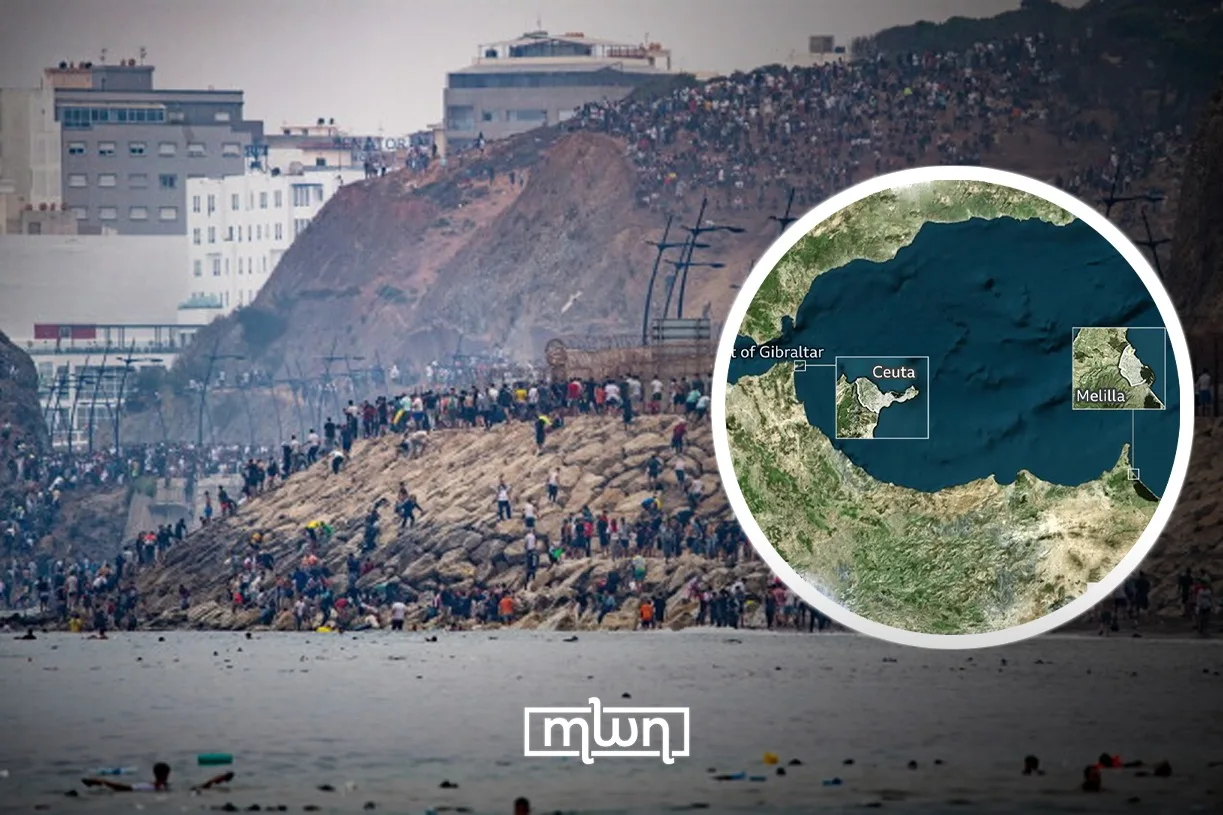
Over the course of only a few days, tens of thousands of people converged on the beaches and border crossings leading to Ceuta and, to a lesser extent, Melilla— centuries-old Spanish enclaves on Morocco’s Mediterranean coast whose sovereignty Morocco continues to contest. The images quickly became emblematic of the crisis: teenagers clutching inflatable rings, young men diving into the sea, women, newly married couples, entire families and, according to widely reported accounts, even a mother attempting the crossing with her newborn baby only days after giving birth.
At first glance, these events appeared to be another episode of irregular migration across the Western Mediterranean. Yet they were about far more than attempts to cross a border. They exposed deeper questions about opportunity, social mobility and the expectations of a generation coming of age in a Morocco that has undergone profound economic and social transformation.
The central question is therefore not why irregular migration exists. That question has occupied scholars and policymakers for decades. The more revealing question is why tens of thousands of young people from remarkably different social and economic backgrounds became collectively prepared to respond to a call whose outcome was uncertain and whose risks were evident. Understanding that readiness is essential not only for explaining what happened in Ceuta, but also for understanding one of the most important public policy challenges facing Morocco today.
The scale of the mobilization was unprecedented. Railway stations, bus terminals, and roads leading north became increasingly crowded as young people travelled towards Fnideq, convinced that an opportunity—however uncertain—had suddenly emerged. Within hours, images of the crossings dominated Moroccan, Spanish, and international media, transforming what initially appeared to be a localized border incident into one of the most closely watched migration events in the Western Mediterranean in recent years. Political debate intensified almost immediately, accompanied by an abundance of competing explanations.
Some commentators and sections of the media framed the events as evidence of deeper shortcomings in Morocco’s development trajectory, interpreting the crossings through a broader critique of the country’s socioeconomic performance.
Others approached the events primarily through a geopolitical lens, linking them to the broader dynamics of Morocco-Spain relations or to regional strategic rivalries. In some cases, this quickly gave rise to speculative interpretations and conspiracy theories attributing the crossings to hidden political calculations despite the absence of verifiable evidence. While geopolitics inevitably forms part of the broader context surrounding Ceuta and Melilla, reducing a complex social phenomenon to unsubstantiated strategic narratives risks obscuring the more immediate economic, social and demographic factors that shaped the decisions of those who attempted the crossing.
A third explanation focused on the interaction between legal developments in Spain, migration policy and the role of social media. In the weeks preceding the crossings, a ruling by Spain’s Constitutional Court concerning the legal treatment of people arriving irregularly by sea on Spanish territory received considerable attention in both Spanish and Moroccan media. Around the same period, Spain’s extraordinary regularization program for certain undocumented migrants already residing in the country was also widely reported. Although the program was explicitly limited to individuals who met strict legal and residency requirements and did not apply to new arrivals, its visibility contributed to a broader public perception that access to legal status in Spain had become more attainable.
Read also: Ceuta Crisis: Facts and Political Context Over Conspiracy
These developments were rapidly amplified through anonymous social media accounts, particularly on TikTok, where videos, maps, and practical advice circulated alongside misleading claims that the “border was open” or that crossing into Ceuta would prevent immediate return. According to reporting by the Spanish newspaper El País, some accounts identified crossing points, recommended equipment such as wetsuits, flippers and goggles, and later disappeared from the platform.
Ultimately, the decisive factor was not simply the legal substance of these developments, but how they were perceived, interpreted, and amplified through media coverage, social networks and digital platforms. Migration decisions are rarely based on a detailed understanding of immigration law; they are often shaped by perceptions of opportunity, however accurate or inaccurate those perceptions may be. The Ceuta episode illustrates how judicial decisions, public policy announcements, media coverage, and algorithm-driven digital platforms can interact to generate powerful perceptions of opportunity that influence collective behaviour, even when those perceptions are incomplete or inaccurate.
Each of these interpretations captures part of the story. None, however, fully explains what happened. The defining feature of the Ceuta episode was not simply that thousands of people attempted to migrate. Irregular migration across the Western Mediterranean is neither new nor unique, nor can the events be explained solely by the speed with which information travelled online. Digital platforms undoubtedly amplified rumours, accelerated collective behaviour and coordinated individual decisions, but they did not create the underlying motivations that made so many people willing to respond.
The more fundamental question therefore lies elsewhere. Why were so many people already prepared to respond?
That readiness is perhaps the most striking—and least examined—aspect of the entire episode. Every day, millions of social media users encounter rumours, misinformation and calls to action that they simply ignore. Such messages only become socially significant when they resonate with a population already receptive to them. The central question raised by Ceuta is therefore not why anonymous TikTok accounts encouraged irregular migration, but why tens of thousands of people considered those messages sufficiently credible—or sufficiently worth the risk—to leave their homes, board buses and trains, travel hundreds of kilometres and, in many cases, contemplate swimming across open water despite the obvious dangers involved.
Equally revealing was the diversity of those attempting the crossing. Public debate has often oscillated between two overly simplistic narratives. One portrays everyone heading towards Ceuta as fleeing extreme poverty. The other points to smartphones, branded clothing or isolated testimonies—such as a young woman who reportedly said she had sold her motorbike to finance the journey—as evidence that economic hardship cannot have been a significant factor.
Reality is considerably more nuanced. Material deprivation alone cannot explain the phenomenon, just as the possession of consumer goods does not necessarily indicate economic security, social mobility, or confidence in the future. The motivations behind irregular migration often emerge from a complex interaction of economic circumstances, personal aspirations, perceived opportunities, peer influence, and changing expectations about adulthood.
Among those heading north were minors, university-age youth, unemployed young people, individuals reportedly engaged in occasional work, women, newly married couples, and entire families. Some interviews suggested prolonged disengagement from education and employment. Others reflected frustration with low wages, difficult working conditions, or limited prospects for upward mobility despite having access to work. Still others spoke of curiosity, peer influence, or the hope that one opportunity—however uncertain—might fundamentally change the course of their lives. These different trajectories cannot be reduced to a single social category, nor can they be explained through a single variable.
This is precisely why the debate needs to shift. Rather than asking why irregular migration exists—a question that has occupied researchers for decades—we should ask why such a broad cross-section of Morocco’s younger generation became collectively prepared to embrace one of the most dangerous forms of mobility in pursuit of an uncertain future. That question extends well beyond border management. It leads directly to Morocco’s labor market, the transition from education to adulthood, the growing challenge of young people not in employment, education or training (NEETs), the changing aspirations of Generation Z, the influence of digital platforms, migration culture, housing, wages, social mobility, institutional trust and, ultimately, the relationship between economic transformation and individual opportunity.
Understanding the events surrounding Ceuta therefore requires looking beyond the border itself. They should not be read simply as a migration story, nor solely as a geopolitical episode. Rather, they offer a window into one of the defining public policy questions facing Morocco today: how can a country that has undergone profound economic transformation ensure that an increasingly diverse generation of young people believes its future can be built at home?
Why youth has long been at the center of Morocco’s development agenda
Before attempting to explain why so many young people were prepared to respond to the calls that spread across social media, it is important to place the debate in its proper historical context.
The scenes witnessed in Fnideq and around the Spanish enclaves of Ceuta and Melilla should not lead to the simplistic conclusion that Morocco has ignored its youth. Such an interpretation would overlook more than two decades of strategic thinking during which youth has consistently occupied a central place in the country’s long-term development vision.
A review of successive Throne Day speeches reveals a remarkable continuity. While the priorities have naturally evolved alongside Morocco’s economic transformation, one theme has remained constant: the conviction that the country’s future ultimately depends on investing in its people, particularly its younger generations.
Year after year, King Mohammed VI has returned to issues such as education reform, vocational training, employment, entrepreneurship, territorial equity, health and social protection, human capital, social mobility and the development of the competencies required by an increasingly competitive global economy. At no point has the official strategic discourse portrayed Morocco’s development as complete or free from shortcomings. On the contrary, many royal speeches have openly acknowledged structural challenges, implementation gaps and the persistence of social and territorial inequalities, while calling upon governments, institutions, elected officials and economic actors to accelerate reforms and ensure that development produces tangible improvements in citizens’ daily lives.
This distinction is essential. The debate today is therefore not whether Morocco’s youth challenges have been identified. They have been identified repeatedly, consistently and at the highest level of the State. The more difficult question is whether public policies have succeeded in translating that long-term strategic vision into measurable improvements in young people’s everyday experiences. This is where the discussion becomes less political and more analytical. Public policy is not evaluated solely by the quality of its diagnosis. It is ultimately judged by implementation, coordination and outcomes.
In recent years, this strategic direction has become even more explicit. Beyond reaffirming the importance of education, employment and entrepreneurship, Morocco has sought to place youth more firmly at the center of public action. Following the Gen Z youth mobilizations in 2025, renewed emphasis was placed on accelerating territorial development programs, strengthening health and education services, improving employment opportunities, expanding economic inclusion, and encouraging greater participation of younger generations in public life, including measures designed to facilitate broader political participation by citizens under the age of 35.
These initiatives reflect an important reality: Morocco has not remained static. Public policy has continued to evolve in response to emerging economic, demographic and social challenges.
Yet evolution alone does not guarantee impact. Indeed, one of the defining characteristics of development is that success changes the nature of future policy challenges. Morocco today is not confronting the same questions it faced at the beginning of the century. The Kingdom has invested heavily in strategic infrastructure, industrial ecosystems, renewable energy, logistics, automotive manufacturing, digital connectivity and international competitiveness. These achievements have transformed the country’s economic landscape and strengthened its regional position.
The challenge now is different. It is no longer sufficient to ask whether Morocco is creating growth. The more important question is whether that growth is generating pathways through which young people can build autonomous, dignified, and hopeful lives. This distinction may appear subtle, but it fundamentally changes how youth policy should be understood.
For many years, discussions about youth focused primarily on employment, which remains essential, but it is no longer enough as a standalone indicator of success. Young people evaluate their future through a much broader lens.
Can education lead to meaningful work? Does employment provide a pathway towards financial independence? Can wages support housing, family formation, and long-term stability? Are skills rewarded? Do institutions respond to changing aspirations? Can talent flourish regardless of geography or social background?
These questions increasingly shape how younger generations assess opportunity. They also explain why seemingly contradictory realities can coexist.
Morocco continues to create jobs in sectors such as manufacturing, logistics, hospitality, transport, and agriculture, while employers in certain regions report persistent recruitment difficulties. At the same time, official statistics continue to record high levels of youth unemployment, inactivity, and labor-market vulnerability.
This is not necessarily a contradiction. It suggests that Morocco’s challenge increasingly lies beyond the simple arithmetic of job creation.
It concerns the quality of employment, the relationship between wages and living costs, career progression, working conditions, geographical mobility, skills matching and, above all, whether employment offers a credible pathway towards adulthood and economic independence.
This distinction is particularly relevant for Generation Z. Unlike previous generations, today’s young Moroccans compare opportunities not only with those available to their parents, but with those they observe every day through digital platforms, global media, and transnational social networks. Their aspirations have become global, while many of the opportunities available to them remain local.
Understanding this changing relationship between aspirations and opportunities may prove more important than understanding the migration attempt itself. Because before asking why thousands of young people attempted to reach Ceuta, Morocco must first understand why so many believed that leaving—even at considerable personal risk—deserved to be considered as one possible path towards a better future.
That question cannot be answered by economics alone. Nor can it be answered by politics alone. It requires understanding the generation that is now coming of age in a Morocco profoundly different from the one into which their parents were born.
Generation Z: One generation, multiple pathways
If the events surrounding Ceuta revealed anything, they revealed the danger of treating Morocco’s youth as a single, homogeneous category.
Public debate often oscillates between two equally incomplete portrayals. The first presents Generation Z as Morocco’s first fully digital generation: technologically connected, globally exposed, increasingly familiar with artificial intelligence and preparing for an economy driven by innovation and advanced industries. The second reduces young Moroccans to unemployment statistics, migration aspirations or social frustration. Neither portrait captures the full reality.
Generation Z is not defined by a single experience of Morocco’s transformation. It is experiencing that transformation through different life trajectories, shaped by educational opportunities, geography, family circumstances, labor-market integration and access to economic opportunity.
This distinction is particularly important because one of the central messages repeatedly articulated in Morocco’s strategic vision has been the need to ensure that development benefits all citizens and all territories. In his 2025 Throne Day Speech, King Mohammed VI warned that “there is no place today or tomorrow for a Morocco that moves at two speeds,” calling for a new generation of integrated territorial development capable of translating economic progress into more balanced social development across the Kingdom. This observation provides an important framework for understanding today’s youth.
Morocco has undergone profound economic transformation over the past two decades. Major investments in infrastructure, industrial ecosystems, renewable energy, logistics, digital connectivity, and export-oriented industries have positioned the Kingdom among Africa’s most diversified economies. These achievements are real and increasingly recognized internationally.
Yet development does not produce identical outcomes for every young person. Some members of Generation Z are successfully entering emerging sectors such as automotive manufacturing, aerospace, renewable energy, digital services, finance, entrepreneurship, and technology. Others are pursuing university education, launching start-ups, or competing successfully in international labor markets. Others face a more difficult transition.
Some leave school before acquiring qualifications that match labor-market demand. Others move repeatedly between temporary employment, informal work, vocational training, and unemployment. Many struggle to translate education into stable employment, while others remain economically active but find that available jobs do not provide sufficient income or prospects to achieve financial independence and build an autonomous adult life.
Between these different trajectories lies the reality of most young Moroccans: neither fully excluded nor fully integrated, but navigating a period of prolonged uncertainty during the transition from education to employment and adulthood.
A recent report by Morocco’s High Commission for Planning (HCP) illustrates part of this complexity. Approximately one-third of Moroccans aged between 15 and 29—around 2.9 million young people—are classified as NEETs, meaning they are neither in employment, education, nor training. The report further shows that this population is far from homogeneous, with significant differences according to gender, educational attainment, and place of residence. The majority are young women, many possess limited formal qualifications, and a significant proportion live outside the country’s main economic centers.
These figures deserve careful attention. They identify one of Morocco’s most important public policy challenges. They should not, however, become a description of an entire generation.
Generation Z is considerably broader than the NEET population. It also includes university graduates, apprentices, entrepreneurs, skilled workers, researchers, artists, digital creators and thousands of young Moroccans already contributing to the country’s economic transformation. The challenge for policymakers is therefore not to design policies for one category of youth, but to recognize that different segments of the same generation require different pathways towards opportunity.
Seen from this perspective, the events surrounding Ceuta become more understandable. Those attempting the crossing did not represent one social profile.
Among them were minors, unemployed youth, occasional workers, women, newly married couples, entire families, and individuals with very different educational and economic backgrounds. Some reportedly expressed frustration with unemployment. Others spoke of low wages, limited prospects for advancement, or the belief that opportunities elsewhere would allow them to achieve goals that seemed increasingly difficult to realise at home.
This diversity suggests that the willingness to migrate cannot be explained by a single variable. Rather, it reflects different life trajectories arriving at a similar question:
Where do I believe I have the greatest chance of building my future?
Answering that question requires looking beyond migration itself and examining how economic transformation, labor-market transitions, housing, education, social mobility, digital influence, and institutional responsiveness interact to shape the expectations of Morocco’s youngest generation.
That is ultimately why the events in Ceuta matter. They are not simply a story about borders. They are a story about the next phase of Morocco’s development and the place of Generation Z within it.
Beyond ceuta: A shared responsibility and a new policy horizon
The events surrounding Ceuta and Melilla should neither be interpreted as a verdict on Morocco’s development trajectory nor dismissed as an isolated migration episode. Rather, they should be understood as a policy signal, highlighting the need to better connect economic transformation with the aspirations and opportunities of a new generation.
What made these events exceptional was not irregular migration itself—an enduring feature of the Western Mediterranean—but the remarkable readiness of thousands of people from diverse social and economic backgrounds to embrace considerable risks in pursuit of what they perceived as a better future. Social media, legal developments in Spain and digital misinformation undoubtedly acted as catalysts, but they did not create the conditions that made such a collective response possible. They accelerated a phenomenon whose roots lie in deeper economic, social and generational dynamics.
Looking ahead, one lesson deserves particular attention: migration governance in the Western Mediterranean can no longer be viewed as the exclusive responsibility of one country. Morocco has, for many years, played a central role in preventing irregular departures, dismantling organized smuggling networks and conducting search-and-rescue operations at sea, thereby contributing significantly to the security of both Spain and the European Union. European partners have repeatedly acknowledged this cooperation. Yet partnership should not be confused with substitution. Morocco is a strategic partner, not the permanent guardian of Europe’s southern border.
The recent events also illustrate how decisions taken on the European side of the Mediterranean can have immediate consequences on the southern shore. The interpretation by many prospective migrants of Spain’s Constitutional Court ruling concerning arrivals by sea, amplified through social media, demonstrates how judicial developments, digital ecosystems and migration networks can interact in unexpected ways. This episode is therefore a reminder that effective migration governance requires not only stronger border cooperation, but also responsible public communication, coordinated legal frameworks and closer operational dialogue between Morocco, Spain and the European Union.
Equally important is resisting narratives that oversimplify or politicize the events. Describing the crossings as an “invasion” of Spain or portraying those attempting to reach Ceuta and Melilla as part of an organized effort to “Islamise Europe” finds little support in the available evidence. The overwhelming majority were civilians—many of them minors, women, young couples and families—whose motivations appear overwhelmingly linked to migration aspirations rather than ideological objectives. Such narratives obscure the real policy questions while fuelling unnecessary polarization at a time when greater cooperation is needed.
For Morocco, the timing of these events also coincides with an important moment in its own institutional trajectory. The legislative elections of 23 September will inaugurate a new political cycle and, as outlined in the 2026 Throne Day Speech, a new phase in the country’s development agenda. They therefore offer an opportunity for all political actors—not only the future government, but Parliament, territorial authorities, civil society and the private sector—to move beyond fragmented approaches and place Generation Z at the center of the next decade of public policy.
The challenge is no longer to demonstrate that youth matters. That strategic choice has been reaffirmed consistently over many years through successive Throne Day speeches, where education, competencies, vocational training, employment, entrepreneurship and human capital have remained at the heart of Morocco’s long-term vision. The challenge now is one of implementation: ensuring that economic transformation translates more consistently into opportunities that young people can experience in their everyday lives, regardless of where they live or the pathway they follow into adulthood.
This requires moving beyond isolated programs towards an integrated approach that accompanies young Moroccans throughout their transition into adult life—from school to employment, from skills acquisition to entrepreneurship, from dependence to economic autonomy and from aspiration to opportunity. Such a framework should also recognize that Generation Z is not a homogeneous group. Policies designed for highly skilled graduates will not necessarily meet the needs of NEETs, just as labor-market reforms alone cannot address the broader questions of housing, mobility, mental well-being, civic participation, and confidence in public institutions that increasingly shape young people’s decisions.
Ultimately, the events surrounding Ceuta should neither be instrumentalized to diminish Morocco’s achievements nor ignored because they reveal uncomfortable realities. They should instead encourage a more mature conversation—one that recognizes both the substantial progress the Kingdom has made over the past quarter century and the equally important task that lies ahead: ensuring that development is measured not only by infrastructure, investment and economic growth, but also by the confidence that the next generation places in its future.
If Ceuta leaves one lasting lesson, it is perhaps that the sustainability of Morocco’s development model, the effectiveness of Mediterranean migration governance, and the quality of Morocco’s partnership with Spain and the European Union will increasingly depend on a shared capacity to create opportunity, restore confidence and offer young people credible reasons to choose hope over risk. That is a responsibility no single institution, no single government and no single country can fulfil alone.