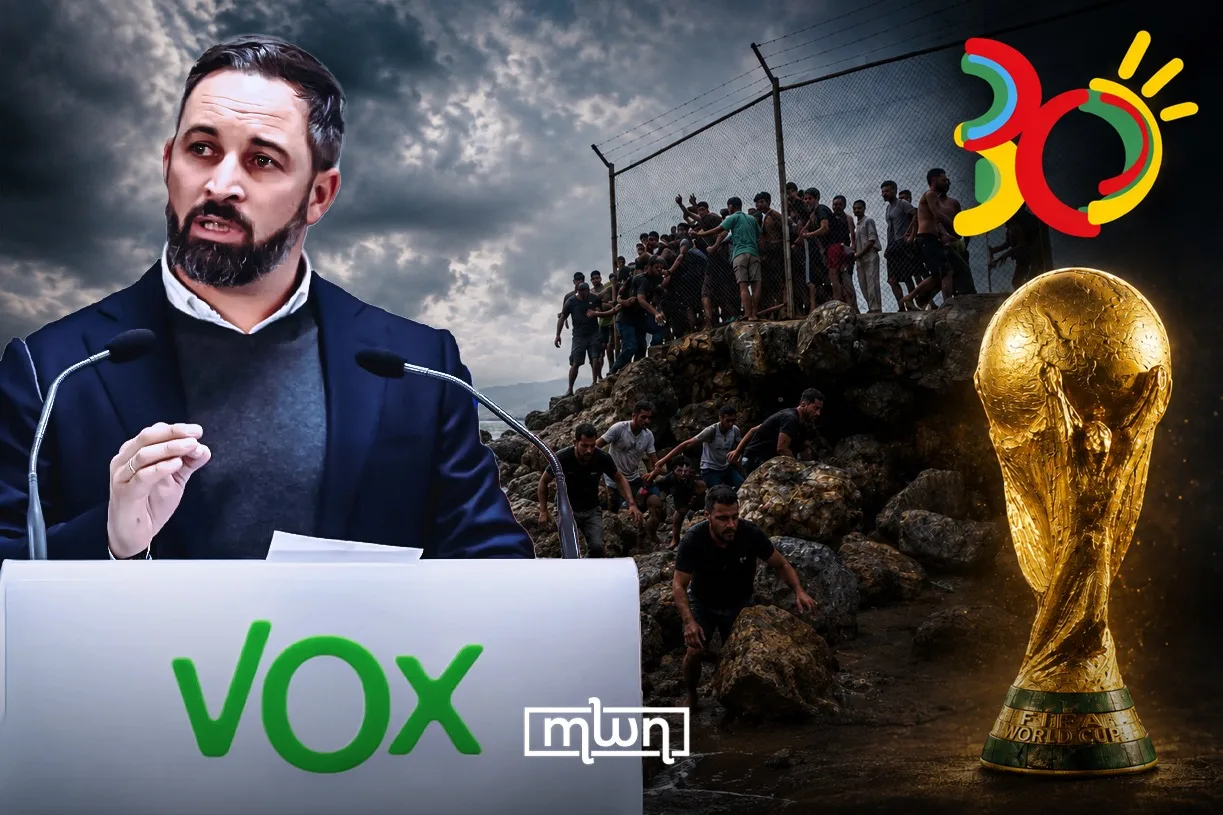
Rabat – Spain’s far-right politicians, including those from Vox, are continuing their anti-Morocco rhetoric, citing the Ceuta mass crossing as their new justification for their hostility toward Rabat.
Spanish outlet Cadena SER said on Thursday the Vox parliamentary group has submitted a non-binding motion calling for what they describe as a review of Morocco’s co-hosting rights for the 2030 FIFA World Cup.
“The extremely serious events that took place in Ceuta on July 30 and 31 have completely shattered the foundations of trust and cooperation on which a shared World Cup bid must necessarily rest,” the party claimed.
The accusations and anti-Morocco rhetoric, unsurprising coming from Vox, reflect how some Spanish parties continue to ignore the disputed and occupied status of Ceuta and Melilla.
Moroccans, along with some international observers, have long called for reopening dialogue to discuss the enclaves’ future, particularly amid far-right politicians’ claims, anti-Morocco rhetoric, and what Spain has deemed its “territorial integrity.”
The claims also come despite widespread international recognition of Morocco’s cooperation and efforts in tackling human trafficking networks, with several countries and international partners commending Rabat for its role in combating irregular migration.
These claims come at a moment when Morocco emphasizes how tackling the issue of irregular migration is a shared responsibility, especially as the country does not receive enough funding to tackle the crisis.
Morocco also rejects being regarded as Europe’s policeman or concierge, stressing that it cannot be asked to bear the consequences of what happened when it was a Spanish judge who dismantled a system seeking to tackle irregular migration.
A Moroccan government source has recently pointed to the Spanish Supreme Court ruling of July 8, which disallowed the hot return of migrants who entered the enclave of Ceuta by swimming.
The court ruling was exploited by trafficking networks, which, in addition to anonymous accounts, exploited the situation to allege that the borders to Spain would be open, encouraging mass crossings. Spain estimates the number of those who crossed to Ceuta at 70,000 last week, while Morocco says its official assessment shows 40,000 crossed to Ceuta and 1,000 to Melilla.
Ceuta crisis spills into 2030 World Cup politics
The Spanish government has been reiterating that Morocco has been essential in stopping the flow and has commended its cooperation with Rabat.
Amid its recognition and applause for its cooperation, Vox claimed Morocco is not a “loyal partner,” calling on the Spanish government.
Spain’s left-wing coalition partner Sumar made a similar move, requesting Spain not to co-host the 2030 World Cup with Morocco.
Portugal’s left-wing party Livre has also called for Morocco to be removed from the joint hosting of the 2030 FIFA World Cup following the recent migration crisis in Ceuta.
Spain’s exploitation of the Ceuta crisis also comes amid frustration that Morocco boasts more chances to host the tournament’s final.
Many Spanish media have been reeling that Morocco could defeat Spain in the bidding through its features and latest sports achievements, as well as its hosting of the AFCON, which was commended as historically successful.
Spanish Minister of Sports, however, said Spain boasts more chances, citing “common sense” and Spain’s World Cup win as some of the factors why Spain should host the final.