
When I started my university studies in the 70s, Morocco was in turmoil after the ICJ’s advisory opinion on the Moroccan Sahara and the decision of the late King Hassan II to organize the Green March to complete the territorial integrity of the Cherifian empire that had been carved up by the colonial powers in order to prevent the Kingdom from roaring in the future and isolate it geographically and diplomatically. But the genius of the kings of Morocco the late King Mohammed V, the late King Hassan II and his heir HM King Mohammed VI, God Assist Him, have foiled all plots and intrigues coming from the immediate or distant neighborhood.
In recent weeks there have been abnormal tensions in Moroccan-Spanish relations, which we hope will be a summer storm without more, including the demonstrations of force and military maneuvers in occupied Sebta, the bill to grant Spanish nationality to Moroccans born in the southern provinces before 1977 and above all the management of the migration crisis in Sebta orchestrated by invisible non-state actors identical to those that had sparked the Arab Spring via social media and hybrid warfare.
To understand this last event, it would be necessary to go back at least a year and contextualize it in the war in the Middle East, the redistribution of the cards at the international level and the new positioning of the great powers and some regional powers in decline that are trying to maintain their hegemony through a hybrid war, in particular the instrumentalization of their control of certain rare resources (gas, oil), waypoints or other types of strategic nodes.
Indeed, in a world where supply chains are intersecting and geopolitical tensions are multiplying, the countries that control choke points are in the spotlight, including the Kingdom of Morocco, which controls more than one chokepoint (Strait of Gibraltar, phosphates, migratory corridor, rare earths, green energy, strategic ports, soon the Atlantic-Sahel corridor, Nigeria-Morocco gas pipeline, etc.).
The year 2026 has reminded us with brutal clarity: the Strait of Hormuz – the strategic passage through which a fifth of the world’s oil passes – was almost paralyzed for several months, causing energy markets to falter. This disruption illustrated a truth that had too often been forgotten: geoeconomics has become the main language of power in the twenty-first century.
Morocco, a story of resilience and strategic reconquest
Morocco has never accepted the destiny that history seemed to impose on it. Victim of the colonial partition in 1906 when the Algeciras Conference sealed its dismemberment, the Cherifian kingdom was reduced to a simple island cut off from its natural environment. For decades, its neighbors – in particular Algeria – have sought to isolate it on the African and international scene, notably in 1984 by pushing it to leave the African Union, in order to better promote the separatist thesis in Western Sahara.
But Morocco resisted. He drew on a centuries-old diplomatic tradition, that of the “pendulum game”, which consists of taking advantage of rivalries between great powers to preserve its sovereignty. Under the Saadian dynasty, Ahmad al-Mansur forged an alliance conceived as a win-win pact with Elizabeth’s England against Philip II’s Spain. Later, Sultan Sidi Mohammed III made Morocco the first state to recognize independence from the United States. In the sixties, King Hassan II was one of the first to recognize the People’s Republic of China in the midst of the Cold War. Morocco has never chosen a side; He has always chosen to connect the camps.
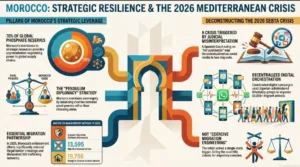
Today, this diplomacy of the in-between is bearing fruit. Morocco is establishing itself as a key regional power, with its state-of-the-art port infrastructure, its massive investments in renewable energies and its stranglehold on strategic resources, starting with phosphate, of which it controls 70% of the world’s reserves. This rise worries the neighborhood, in particular Algeria, but it gives the Kingdom an unprecedented capacity for negotiation.
Migration diplomacy
Migration diplomacy has been defined by Adamson and Tsouparas (Migration diplomacy in world politics 2018) as the use by states of diplomatic tools, processes and procedures to manage the cross-border mobility of populations, it should not be confused with the general migration policy of a state (such as the granting of visas or border control), except when these elements are used as negotiating tools in international relations.
Adamson and Tsouparas distinguish three categories of states according to their position in the international migration chain; host states that seek primarily to control immigration flows and derive strategic benefits from them; the States of origin use emigration as a political, diplomatic or economic lever, in particular through diasporas and financial transfers, and finally the transit States that exploit their geographical position on the migratory routes could exert this leverage on the States of destination and obtain concessions or gains in the form of assistance or cooperation agreements.
Migration diplomacy is often based on issues where migration is connected to security, the economy or “soft power”. States use two types of strategies: zero-sum strategies (Relative Gains) where the State seeks to win at the expense of the other, often through pressure to extract funds or achieve political gains; while Positive Sum Strategies (Absolute Gains), which are more desirable between neighboring countries, where the parties seek mutual benefit; as is the case with the “guest worker” agreements in Spain and Germany or the Bracero between the United States and Mexico, designed to meet both the labor needs of one and the unemployment of the other.
Migration has thus become a foreign policy instrument in its own right, Kelly Greenhill has focused, in his research, on zero-sum strategies in his model called Coercive Migration Engineering (CEM), he has identified at least 56 to 81 attempts at migratory coercion between 1951 and 2006. The context of the instrumentalization of migration is linked to a multiplicity of endogenous and exogenous factors and are often linked to the conflictual or cooperative state of relations between host countries, issuing and transiting; the domestic and regional political situation, the nature of political regimes and the occurrence of environmental crises or civil war in the issuing country.
The analysis grid of the EMC model is based on three cumulative criteria: triggering (is the flow controlled by an actor?), strategy (does it meet political objectives?) and coercion (does the target perceive a threat?). The model identifies two mechanisms—capacity saturation and normative blackmail—and three types of actors: generators, agents provocateurs, and opportunists.
Among the migration crises identified by K Grennhil that meet the cumulative criteria, he cites four typical illustrative cases: Cuba (1994) where Castro threatened to open the borders, forcing Washington to negotiate; Libya (2004) where Gaddafi exploited sub-Saharan flows to obtain the lifting of the embargo; Belarus (2021), where Lukashenko orchestrated the arrival of migrants at the Polish border to force the EU to negotiate, and Turkiye in 2016, when Ankara hardened its tone with the EU on the management of Syrian refugee flows.
Moroccan diplomacy and migration: the strategic vision
Morocco has chosen an “inclusive and innovative” migration policy, as welcomed by the head of mission of the International Organization for Migration (IOM) in Morocco, Laura Palatini. This vision has been materialized in particular by the National Strategy for Immigration and Asylum (SNIA), launched in 2013 under the impetus of King Mohammed VI, a strategy described as “global, inclusive, solidarity-based, humanist where respect for the rights of migrants is the foundation”
Morocco’s migration policy is based on the principles of sovereignty, responsibility and cooperation and the management of migratory flows is a shared responsibility between countries of origin, transit and destination, according to the Moroccan authorities. Rabat highlights the decisive role it plays in securing the Western Mediterranean migration route through considerable human, technical and financial resources, as well as close cooperation with Spain.
The figures are stubborn and prove the colossal effort of the Moroccan authorities who had intercepted more than 160,000 irregular migration attempts in 2024 and 2025, and 632 migrant smuggling networks have been dismantled and more than 32,000 rescue operations at sea have been carried out during this period. In total, more than 360,000 irregular migration attempts have been foiled in the last five years. (MAP 3 August 2026).
Morocco is not only a transit country but it has become a final destination, in this regard it has also strengthened its asylum system, hosting “19,756 refugees and asylum seekers” at the end of July 2025, including 5,149 Syrians, 1,241 Central Africans and 815 Sudanese. The country has implemented a national migration strategy that integrates the humanitarian dimension while strengthening border controls. In 2025, 4,372 irregular migrants opted for a voluntary assisted return to their country of origin.
These efforts have been supported by a strategic partnership with the EU, which has allocated “160 million euros” in sectoral budget support for the Kingdom’s National Immigration and Asylum Strategy for the period 2025-2027 (modest amount compared to real expenses at least threefold). Nevertheless the EU always praised Morocco’s central role in managing migration flows, while Spain saw a 5% drop in irregular arrivals on its shores in 2024 compared to the previous year.
The management of migration crises: the case of Sebta July 2026
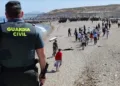
Between July 30 and August 1, 2026, between 50,000 and 60,000 migrants – mostly young Moroccans – crossed the border in the space of a few days, the majority by swimming around the Tarajal crossing, the enclave saw its population increase by nearly 70% in 48 hours. The massive arrivals far exceed those of May 2021, when about 10,000 migrants flocked to Sebta in a few days.
From 31 July, the situation was reversed. Spanish Interior Minister Fernando Grande-Marlaska announced that more than 48,000 people had already voluntarily returned to Morocco. To date, approximately 53,000 returns have been registered.
An exogenous trigger
The trigger for this massive mobilization was a decision of the Spanish Supreme Court issued on July 8, 2026. This prohibits the “hot pushbacks” of migrants intercepted at sea while trying to reach Sebta or Melilla. The Court ruled that rejection at the border only applies to those attempting to cross physical restraints (such as a fence) and not to those swimming by sea.
This decision was quickly decontextualized on social networks, presented as a guarantee of permanent residence in Spain, which was not the case. Both the Spanish Prime Minister and the Ministry of the Interior of the Kingdom of Morocco agree that “the trafficking mafias and smugglers have exploited this judicial decision, which has been misinterpreted, to create an appeal effect, have made a self-serving interpretation of this decision”, presenting it as an “open door” to migrants. The Moroccan government confirmed that the border crossings were “neither the result of spontaneous circumstances nor circumstantial factors”, citing criminal networks and disinformation.
Modus operandi engineering: a decentralized Nebula of non-state actors and cybernetic logistics
It should be remembered that the digital logistics that were used in Sebta is almost identical to the one that triggered riots in Tunisia in 2011, which marked the outbreak of the Arab Spring, the consequences of which were catastrophic and whose shock waves continue to this day.
The Sebta crisis of 2026 was neither spontaneous nor simply orchestrated by a single actor, it resulted from a complex modus operandi involving a sophisticated digital campaign, criminal networks and instrumentalization by external state actors who wanted to tarnish the reputation of the Kingdom of Morocco and stoke the creeping tension between the two neighbors.
According to a report (José María Gil Garre, co-director of the International Security Observatory) a coordinated digital campaign was the driving force behind the mobilization. The survey, conducted over 49 days (June 15 to August 2), examined content published on six platforms: WhatsApp, Facebook, TikTok, Instagram, Discord and X.
The campaign began in mid-July with the dissemination of information on transport, routes and assembly points. Trips from several Moroccan cities (Casablanca, Rabat, Fez, Marrakech, Tangier, Tetouan, Al Hoceima) were mentioned, as well as entries from Algeria to Morocco. Fnideq would have served as the main point of convergence
The architecture of the network is decentralized: content generators based in Algeria, Tunisia, France and Morocco fed the flows, while WhatsApp groups, some of which were administered from Algerian numbers (+213), served as logistics coordination centers to share routes, meeting points and updates in real time.
Algerian involvement, although denied by Algiers, was reportedly documented by several elements in the same report. The same report reveals that a former Algerian ambassador described the crisis as a “blue march” instrumentalized by Rabat in a hybrid war logic to put pressure on Spain. This evocation and reminder of the “Green March” is not accidental, it is purposely made to revive the wounds of self-esteem, memory and the unconscious of the Spanish right and far right which had suffered an unforgettable setback when the Kingdom forced Franquist Spain to return the Sahara to Morocco following the advisory opinion of the ICJ and the glorious Green March.
Does the latest Sebta crisis meet K Greenhil’s criteria qualification ? the following analysis will allow us to answer as much as possible because the archives of the management of this crisis will only be declassified after a period of legal embargo in Spain that can reach at least 35 years (extendable by 10 years) and the “Top Secret” information for 45 years (extendable by 15 years).
The migration crisis is not a coercive diplomatic act
According to the Moroccan Ministry of Foreign Affairs, the Moroccan authorities reject any accusations of having provoked the crisis and maintain that Morocco “assumes its responsibilities” in terms of migration control, not out of political calculation but as part of a constant commitment.
Morocco had warned Spain a few days before the Ceuta crisis that the ruling issued in early July by the Spanish Supreme Court, limiting the immediate return of migrants to Morocco, risked weakening an essential pillar of bilateral migration cooperation. (le Desk 3 August 2026)
Rabat also said it had warned Madrid of the consequences of this decision, while stressing that migration management is a shared responsibility between the two countries.
– The analysis of the facts and their interpretation in the light of political science and scientific explanatory frameworks tested during several migration crises reinforces the Moroccan narrative and refutes the allegations of certain Spanish far-right circles and Algerian social media who have jumped at this opportunity to tarnish the image and reputation of the Cherifian Kingdom.
The Sebta crisis doesn’t meet the scientific criteria well established by specialists, including Kelly Greenhil, to qualify the crisis as a coercive diplomatic act, namely:
The flow should be controlled by a single actor? The crisis is triggered to achieve political objectives and does the target perceive a threat ?.
- First , the sine qua non condition of orchestration by a single actor falls through, first the trigger is recorded by a Spanish court (July 2026) which granted legal guarantees for migrants intercepted at sea that do not give rise to immediate refoulement, then the modus operandi, described in detail by the GIL report, clearly demonstrates that the architecture of the trigger is diffuse, decentralized and multinational, to put the responsibility on an actor in this case, the Kingdom of Morocco, is a serious and unforgivable error; if there is only one actor that emerges as being behind this galaxy, it is the Algerian neighbor probably in connivance with other enemies/rivals of the Kingdom of Morocco in MENA region. It should be recalled that the silence of the Arab League and other regional organizations that have not expressed their support for Morocco in this crisis is scandalous and regrettable while Spain was supported by European interior ministers on August 4.
- secondly, the Kingdom of Morocco is a rising power, it is not a rogue state, it does not need to use migratory coercion to achieve its objectives, it has other more powerful levers to assert itself, in particular political stability and the legitimacy and prestige of the Moroccan monarchy and its King Commander of the Faithful, Morocco exports a label of moderate Islam essential to European social cohesion and the fight against radicalization, judicial and security cooperation with Spain, the control of scarce and critical resources including phosphates and other rare earths, economic attractiveness, particularly in the automotive industry, aeronautics and green energies and nearshoring and friend shoring platforms, the importance of which has increased in the face of disruptions in global value chains.
Last but not least, the outstanding issues between Morocco and Spain since the recognition of the Moroccanness of the Sahara in 2022, do not deserve an outcry, they will be settled in a spirit of respect for good neighborliness and perhaps in a partnership and broader integration with the EU.
- Thirdly, the perception of the threat: in his press conference, the Spanish head of government directly implicated “the mafias who traffic in human beings”, accusing them of having made a “self-interested reading” of a recent ruling of the Spanish Supreme Court, he did not accuse his neighbour of anything. The communiqué of the EU Ministers of the Interior of August 4 reinforces this position by insisting on the strengthening of the protection of the external borders, cooperation with partner countries, in particular Morocco.
In conclusion, I would like to remind you that Morocco’s diplomatic history teaches us that something bad is good; in a crisis situation often, if not always, Morocco’s position of firmness ends up paying off and Morocco comes out stronger and comes out of the crisis with its head held high, this was the case of the Moroccan-French crises in the sixties and seventies and in the eighties and between 2022 and 2024. History also teaches us that the seesaw game and the policy of non-dependence and its corollary, diversification, strengthen Morocco’s room for manoeuvre in crisis management. In a world where interdependence is increasingly instrumentalized, Morocco has been able to transform its position as an interface into a real negotiating power. Its in-between diplomacy, its strategic resources, its port infrastructure and its role as a responsible transit country allow it to navigate between competing powers.
Indicative bibliography
Farrell & Newman, « Weaponized Interdependence » (2019) ;
Greenhill, « Weapons of Mass Migration » (2010) ;
Böhmelt, « Coercive engineered migrations and environmental stress » (2025) ;
Tsourapas, « The Strategic Politics of Cross-Border Mobility » (2025) ; Song,
Saltalamacchia, « Migration diplomacy in Mexico–United States relations » (2026).