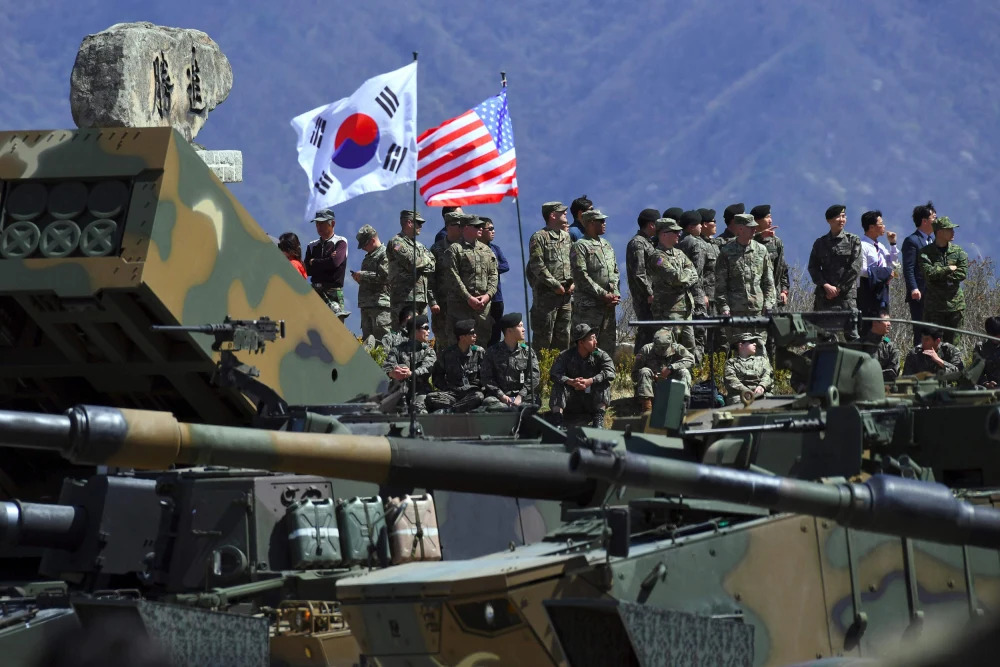
Rabat – US President Donald Trump has ordered the Pentagon to scale down the annual joint military exercises with Korea, pointing to Seoul’s refusal to join the war against Iran and what he described as his “very good” relationship with North Korea’s Kim Jong Un.
Announcing the decision on Sunday, Trump said it was too late to cancel the exercises, which began Monday. He argued that the drills sent a “signal that is totally inappropriate and hostile” to North Korea, describing Pyongyang as “unthreatening and respectful” during his presidency.
Tensions with Seoul shape Trump’s decision
After saying that Seoul had turned down his request to join efforts toward the “denuclearization” of Iran, Trump announced that he had directed Defense Secretary Pete Hegseth to “substantially reduce” joint military exercises with Korea.
Responding to the announcement, Korea’s presidential Blue House said it is reviewing Trump’s statement while voicing hope that his relationship with Kim Jong Un could help revive dialogue between Washington and Pyongyang and promote regional stability.
Reaffirming alliance commitments, Seoul emphasized that Korea and the United States will maintain close coordination regarding their joint defense posture and scheduled drills.
The 11-day Ulchi Freedom Shield exercises, scheduled to run through August 27, bring together about 18,000 Korean troops, US forces, and personnel from 11 United Nations Command member countries. According to defense officials, the joint drills aim to strengthen military readiness against evolving threats from Pyongyang.
North Korea’s Ukraine experience shapes training
Drawing on lessons from North Korean troops fighting alongside Russia in Ukraine, this year’s training focuses on evolving forms of modern warfare. Military officials noted that the exercise scenarios include defenses against unmanned drones, GPS jamming, and cyber operations.
According to reports highlighted by The Guardian, more than 14,000 North Korean troops have fought alongside Russian forces in the Kursk region. Their battlefield experience has raised concerns that Pyongyang could bring updated tactics and combat knowledge back to the Korean Peninsula.
The exercises began days after North Korea resumed ballistic missile testing off its eastern coast. Pyongyang has repeatedly condemned joint US-South Korean drills as “a rehearsal for an aggressive war,” warning it would respond with a “new level of a deterrent”.