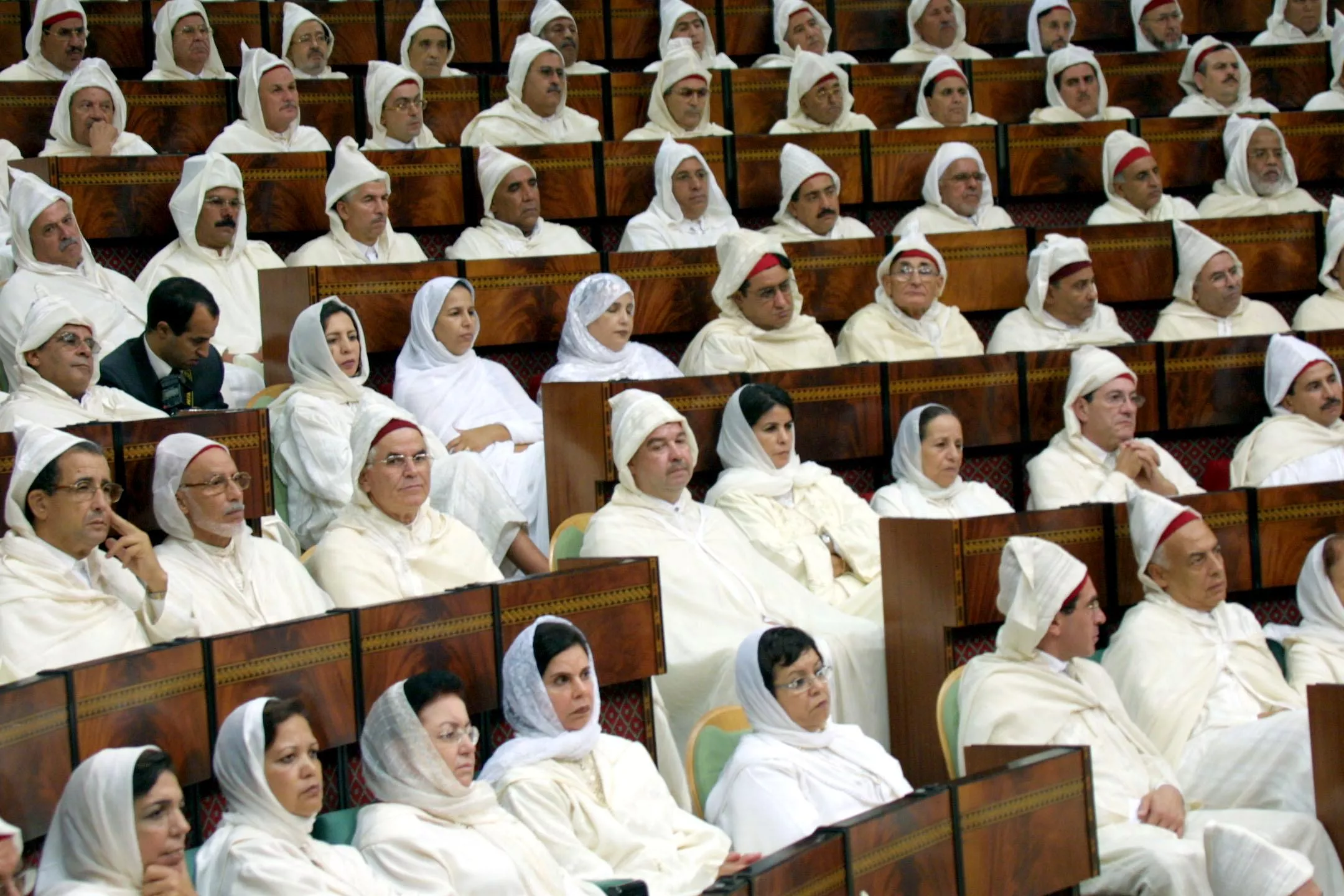
Marrakech – Morocco’s King Mohammed VI appointed Fatima Ezzahra El Mansouri as the country’s first woman head of government on September 29, following parliamentary elections, making her the third woman to hold the post in the Arab world.
Within this context, a new Arab Barometer survey finds Moroccan attitudes toward gender roles growing less traditional even as support for measures that would widen women’s political representation has fallen.
The findings come from Arab Barometer’s ninth wave, a nationally representative face-to-face survey of 1,210 citizens across all 12 regions. One to One for Research and Polling fielded it between August 23 and September 6, 2025, using a multistage clustered sample with a margin of error of ±3 percentage points.
Traditional views on male authority weakened on several fronts. 47% of respondents agreed that men make better political leaders than women, a drop of 10 points from 2023-24, with men and women equally likely to hold that view. Agreement that a man should have the final say in family decisions fell further, from 61% to 44%, a 17-point decline.
Those shifts did not carry over to support for quotas. Backing for reserving a minimum number of parliamentary seats for women dropped from 71% to 51%, while support for a minimum number of cabinet positions fell from 70% to 52%. The two reversals mark the sharpest movements in the survey, and they run against the broader liberalizing trend.
Support for equal workplace opportunities held steady at 64%, unchanged from the previous wave. When asked about barriers to women’s employment, Moroccans pointed to no single dominant obstacle. Social unacceptability and a lack of childcare were each cited by 13%, followed by inflexible working hours and bias against women in hiring at 12% each.
A lack of relevant skills or education and a scarcity of jobs drew 10% each, low wages and insufficient legal protection 9% each, and transportation 8%. Women were more likely than men to name childcare and job scarcity, while men more often cited inflexible hours and social unacceptability.
Perceptions of violence against women were mixed. 16% of respondents reported that such violence had increased over the previous year, up from 13% in 2023-24, while 42% judged it unchanged and 31% saw a decline. Another 10% held that it had never been a problem.
Family and police ranked as the main sources of help for women facing abuse. 48% identified a male family member as someone a woman could turn to, 38% a female relative, and 35% the local police. Far fewer pointed to a clinic or hospital, at 14%, or a local organization, at 6%, while 5% said a woman would be unable to find any assistance at all.
Recognition of harassment remained broad, though reported levels eased. 71% described harassment by strangers on the street as very or fairly widespread, 8 points lower than in 2023-24, and 58% said the same of the workplace, down 7 points. 36% viewed harassment in the home as widespread.
Taken together, the results describe a population moving away from traditional assumptions about men’s authority while turning more hesitant about state-mandated routes to women’s political inclusion. That divergence arrives at a notable moment, as a woman takes charge of the Moroccan government for the first time.
Read also: Women and Power: The Long Road to Breaking the Political Glass Ceiling in the Global South