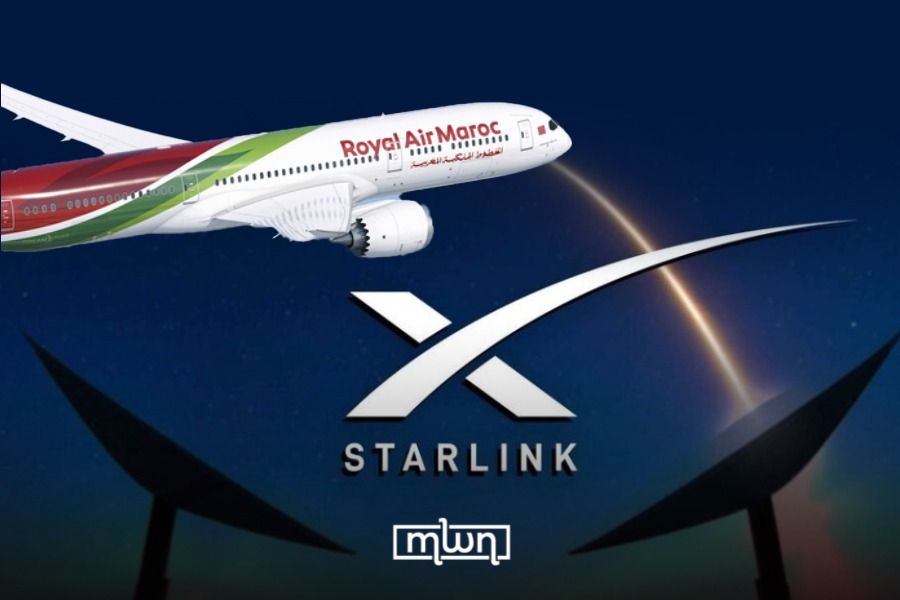
Marrakech – Royal Air Maroc (RAM) has become the first airline in Africa to sign with Starlink, the satellite internet arm of Elon Musk’s SpaceX, to bring Wi-Fi to its entire fleet. The national carrier, chaired by Abdelhamid Addou, concluded the contract on August 4 after long months of talks over price and technical terms.
According to a revelation by Africa Intelligence this Tuesday, the two sides finally agreed to deploy the wireless network across all of RAM’s aircraft. The outlet reported that the accord came “after long months of discussions on financial and technical terms,” ending a negotiation that had stalled over cost.
The rollout will move in stages. After a test phase on some planes in recent months, RAM plans to extend the service gradually across its fleet, which is composed mostly of Boeing jets, reaching full capacity in 2027. That timeline moves ahead of the schedule discussed in 2025, which had set service for 2028, when the carrier expects delivery of about 100 Boeing aircraft.
The contract, which Africa Intelligence called “unprecedented” for Musk’s group on the continent, makes RAM the earliest airline to use Starlink to equip its planes. Africa Intelligence noted that Ethiopian Airlines, the only other African carrier offering onboard Wi-Fi, does so through Ka-band satellite broadband rather than Starlink’s low-earth-orbit network.
The deal followed a dispute over money. RAM had judged Starlink’s first offer too expensive, while the American group tied the price to high operating costs and technical constraints specific to the Moroccan request.
Starlink applies a progressive pricing policy. When several airlines serving the same destinations use its network, the last to subscribe must receive more advanced technology to avoid interference and slowdowns for the others.
That structure applies to RAM, which shares several air corridors with Air France. The French carrier signed its own partnership with Starlink at the end of 2024 to equip its aircraft in phases.
The aviation contract stands apart from Starlink’s wider effort to enter Morocco. On March 5, Africa Intelligence reported that the firm had tried in vain since 2024 to gain a foothold in the country’s internet market, blocked by the reluctance of the main telecom operators.
That report described how, in the summer of 2025, Inwi president Azzedine el-Mountassir Billah discreetly received the teams of Starlink vice president Lauren Dreyer. Inwi proposed to become the sole official reseller of Starlink routers, an arrangement the group rejected in favor of its direct-sales model.
Though Starlink created a local subsidiary in Casablanca in early 2025, the ANRT telecom regulator had still not issued the commercial license. The agency consulted Inwi, Maroc Telecom, and Orange Maroc, while the DGSSI security body withheld its approval over national data concerns.
A year earlier, on March 5, 2025, Africa Intelligence had reported that Starlink was negotiating to operate over Western Sahara, a project supervised with the royal cabinet. Contact had been facilitated by a meeting between Musk and head of government Aziz Akhannouch during a European trip in the summer of 2024.
In November 2024, on the sidelines of the Qatar-Africa Business Forum in Marrakech, Lauren Dreyer followed up with Akhannouch’s cabinet on possible deployment in rural areas. That coverage carried potential civil and military applications and required approval from both the ANRT and the DGSSI.
Even so, RAM’s contract hands Starlink its first real foothold in the Moroccan aviation market, while its push to sell internet directly to Moroccan customers keeps hitting a wall.
Read also: Starlink Expands Across Africa as Governments Push Back on Digital Contr