
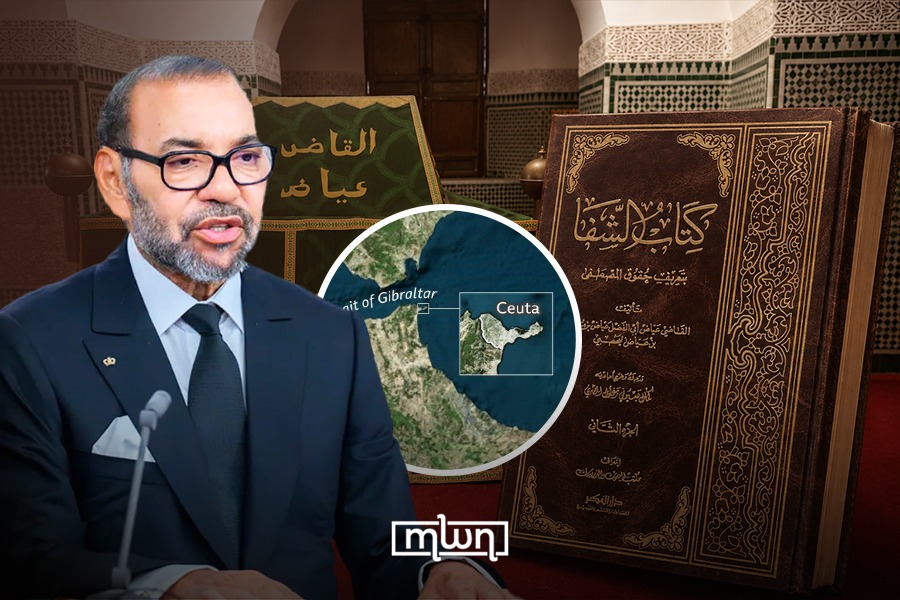
Fez — A reference to Ceuta during Morocco’s Mawlid ceremony on August 24 brought one of the medieval Muslim West’s most influential scholars to national consciousness.
King Mohammed VI, in his capacity as Commander of the Faithful, chaired the ceremony at the Royal Palace in Rabat. During the gathering, Minister of Endowments and Islamic Affairs Ahmed Toufiq presented the annual report on Morocco’s scholarly councils.
Toufiq then highlighted two scholars whose intellectual legacies began in Ceuta: Qadi Iyad, author of “Kitab al-Shifa” (The Book of Healing) and Abu al-Abbas al-Azafi, associated with “Al-Durr al-Munazzam” (The Ordered Pearls).
The official account makes the fact that both scholars are from Ceuta unmistakable.
The reference also echoed a royal initiative from September 2025. In a letter marking 15 lunar centuries since Prophet Muhammad’s birth, King Mohammed VI ordered a critical edition of Iyad’s “Kitab al-Shifa” and separately invoked al-Azafi’s work on the Mawlid.
These references reopen a larger historical question about who Qadi Iyad was, and how a scholar born in Ceuta became an authority across Sunni Islam.
Ceuta made the scholar
“Cadi Ayyad,” which is another way to spell his name, is familiar to many Moroccans because the university of Marrakech is named after him. But a few really know the man behind the name.

His fuller name was Abu al-Fadl Iyad ibn Musa al-Yahsubi al-Sabti. The final nisba, “al-Sabti,” identifies him directly with Sabta, the Arabic name for Ceuta.
Iyad was born in Ceuta in 476 AH, corresponding to 1083 CE.
Recent scholarship from Cambridge places his upbringing in a rapidly expanding port that had become one of the Maghrib’s most important gateways.
Ceuta connected Morocco to al-Andalus across the Strait of Gibraltar while receiving merchants, pilgrims, jurists, and traveling scholars moving through the western Mediterranean.
Iyad studied first with scholars in his hometown. Around 1113, he crossed into al-Andalus to deepen his training in Maliki jurisprudence and hadith.
His intellectual journey brought him into contact with prominent scholars in Córdoba, Murcia, Granada, and other Andalusian centers. Among the figures in his wider scholarly world was Ibn Rushd al-Jadd, the celebrated Maliki jurist and grandfather of the philosopher Ibn Rushd (known in the West as Averroes).

After returning home, Iyad eventually became qadi, or judge, of Ceuta. However, his surviving work shows that his importance went far beyond the courtroom.
Historian Janina Safran’s peer-reviewed study of Iyad’s “Al-Ghunya” reconstructs a network of teachers, texts, families, and scholarly relationships spanning the Almoravid world. The book records the scholars Iyad learned from and the works he obtained through formal transmission.
In other words, Iyad preserved not simply information, but the infrastructure through which knowledge moved.
The book that outlived kingdoms
Iyad’s greatest legacy is “Al-Shifa bi-Ta’rif Huquq al-Mustafa” (The Healing by the Recognition of the Rights of the Chosen One) usually shortened to “Kitab Al-Shifa.”
The work examines the qualities and status of Prophet Mohammed, the obligations believers owe him, his miracles, and questions of reverence, theology, and law.
Its influence traveled far beyond Ceuta. A European Union-funded research project coordinated by Spain’s Consejo Superior de Investigaciones Científicas (Spanish National Research Council) examined surviving manuscripts to understand the extraordinary circulation of “Al-Shifa.”
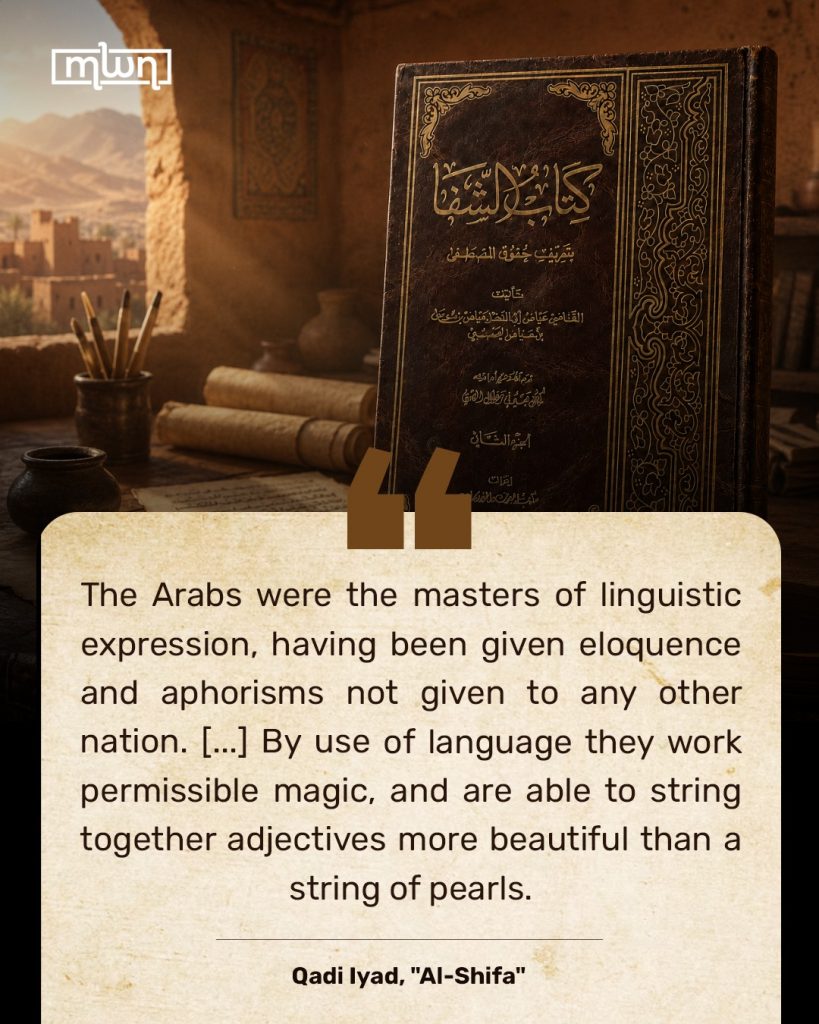
Researchers found a substantial manuscript tradition extending from the 13th century into the modern era and spreading both inside and outside the Islamic West. Dynasties that Iyad knew disappeared. Political borders changed repeatedly. Ceuta itself was transformed. Yet his book continued to be copied, read, taught, and interpreted across generations.
Iyad also wrote “Tartib al-Madarik” (The Arrangement of Perceptions), a monumental biographical work preserving the intellectual history of the Maliki school. His scholarship helped document the chain connecting generations of jurists to a legal tradition that remains foundational to Moroccan religious life.
Not a saintly figure outside politics
Iyad also lived through one of the most violent political transformations in medieval Moroccan history.
He was closely connected to the Almoravid order as the Almohad movement expanded across the Maghrib.

Cambridge scholarship traces his resistance during the Almoravid collapse and places the Ceutan judge directly inside the political struggle surrounding the rise of the Almohads.
Iyad eventually lost his position in Ceuta and died in Marrakech in 1149.
Later writers surrounded his final years with stories of persecution and martyrdom. Historians remain cautious about treating every version as established fact.
The same caution applies to the famous claim that Iyad personally ordered the burning of Abu Hamid al-Ghazali’s “Ihya Ulum al-Din” (The Revival of the Religious Sciences).
Historian Nora S. Eggen challenges that tradition, finding that the image of Iyad as a fanatical “book burner” appears in significantly later sources rather than solid contemporary evidence. His documented record is already complicated enough without relying on legend.
Why Ceuta changes the story
The connection to Ceuta gives Iyad’s biography particular weight today.
More than two centuries after his death, Portuguese forces conquered the city in 1415. The city came under Spanish rule in 1640 after the dissolution of the Iberian Union.
Ceuta is still administered by Spain, while Morocco maintains its claim to the city. But Iyad’s life belongs to a much earlier historical world.

He was born in Ceuta more than 330 years before the Portuguese conquest. His career unfolded when the city functioned inside the political, commercial, and intellectual networks of the Maghrib and al-Andalus.
That chronology gives Toufiq’s Mawlid reference its deeper significance.
The Enduring Impact of Qadi Iyad’s Legacy
Qadi Iyad and Abu al-Abbas al-Azafi were not peripheral scholars accidentally born on the edge of North Africa. They emerged from a Ceutan intellectual culture that produced ideas and books influential far beyond the city.
Iyad’s name survives on a major Moroccan university. His tomb remains part of Marrakech’s religious memory. His writings continue to be studied across the Muslim world. Morocco’s highest religious institutions are preparing a new critical edition of his most celebrated work.
Simply put, Qadi Iyad offers another map of medieval intellectual history. Islamic scholarship was not produced only in Baghdad, Damascus, Cairo, Córdoba, or even Fez. Ceuta produced one of the scholars whose writings helped define how generations of Sunni Muslims understood (and still do) law, learning, and devotion to Prophet Mohammed.
Long before Ceuta became a modern territorial dispute, it was already producing knowledge that crossed the Strait, survived empires, and traveled across the Muslim world.