Agadir – The Spanish government has made available five sport centers and several facilities in Ceuta to accommodate migrants still in the city following last month’s mass crossings.
Spain approved on August 25 a decree establishing a coordinated framework for managing the migration crisis, Spanish reports have indicated.
Under the decree, several infrastructures in Ceuta will be made available depending on the needs arising from the migrants.
The facilities specifically listed include the covered sports centers of Santa Amelia, La Libertad, Antonio Campoamor, Guillermo Molina, and Díaz Flor.
Beyond facilities, the decree provides the use of additional state infrastructure when necessary to maintain essential services or provide logistical, technical, technological, administrative, and communications support.
Among the sites identified are Defense Ministry land in Loma Margarita, facilities at the Equestrian Center, the former flour factory, and the former football field at the Cavalry Barracks.
Other facilities include land belonging to the Ministry for the Ecological Transition at the Guano esplanade, the site of the former Guano factory, as well as the covered sports center operated by the Ministry of Education, Vocational Training and Sports at the Puertas del Campo secondary school.
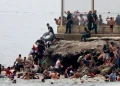
The move comes nearly a month after more than 70,000 migrants entered Ceuta from Morocco during the mass crossings of July 30 and 31. Spanish authorities have said that the vast majority subsequently returned to Morocco, while thousands remain in the city. Estimates of the number still in Ceuta vary, with Spanish authorities citing around 5,000 and other reports putting the figure higher.
Migrant minors remain key issue
The situation of unaccompanied minors remains one of the most sensitive issues in the aftermath of the mass crossings.
Unlike adults, unaccompanied minors cannot simply be returned through the same procedures. Reuters reported earlier this month that at least 1,100 unaccompanied minors were still in Ceuta.
Morocco has repeatedly called for the return of Moroccan minors in the occupied enclave. In particular, Justice Minister Abdellatif Ouahbi has accused Spanish authorities of obstructing efforts to repatriate Moroccan children and said Rabat remains committed to recovering them through legal and political channels.
Spain has additionally faced criticism over its handling of the crisis. Recent international reporting has questioned the speed of Madrid’s response.
The issue became particularly contentious after Madrid announced plans to transfer hundreds of unaccompanied migrant children from Ceuta to mainland Spain, while authorities in Ceuta and political opponents have called for their return to Morocco.