
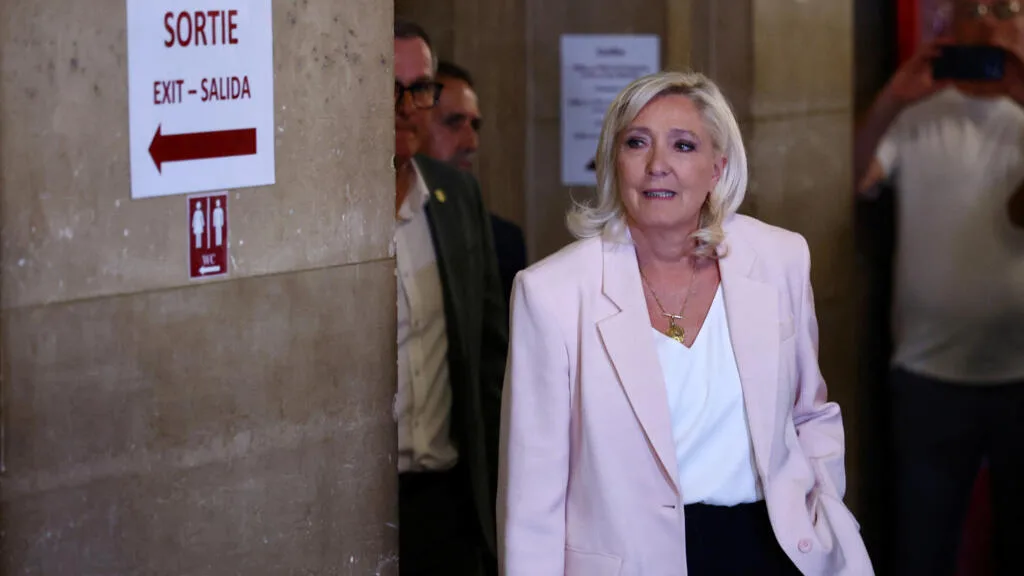
Rabat – Marine Le Pen is entering the final months before France’s 2027 presidential election as the leading candidate, while her main opponents remain divided across the political center and left.
With President Emmanuel Macron constitutionally barred from seeking a third consecutive term, an unusually large field of candidates is taking shape ahead of next year’s election. The growing number of contenders is raising concerns that divided votes could make it easier for candidates from the political extremes to reach the second round.
Le Pen, leader of the far-right National Rally (RN), is widely viewed as the candidate to beat. Polling has placed her ahead of her rivals for months, giving her what could be her strongest chance yet of reaching the presidency after losing the 2017 and 2022 elections to Macron.
Her path to another presidential campaign was cleared in July, when a Paris appeals court reduced her period of ineligibility following her conviction for misusing European Parliament funds. The ruling allowed her to remain eligible to run in 2027.
Mélenchon gains ground
Behind Le Pen, the race remains much less certain.
Jean-Luc Mélenchon, leader of the radical-left La France Insoumise (LFI), has emerged as one of her strongest potential challengers. He has confirmed that he will run for president for a fourth time after finishing third in 2022 and fourth in 2017 and 2012.
A recent poll showed Mélenchon moving closer to a possible second-round spot, adding to concerns among centrist and mainstream parties that the election could produce a runoff between the far right and radical left.
The possibility of such a contest has increased pressure on moderate parties to unite behind a single candidate. So far, however, they have failed to agree on how to do so.
Center struggles to unite
Former Prime Minister Édouard Philippe remains one of the leading candidates from the centrist camp, but he faces competition from another former prime minister, Gabriel Attal of Macron’s Renaissance party.
On the right, Les Républicains candidate Bruno Retailleau is also staying in the race.
The three candidates are competing for voters who could potentially form a stronger alternative to Le Pen, but efforts to unite them have made little progress. Philippe has rejected the idea of a primary, while Retailleau has backed one. Former political leaders have called for greater coordination, but no agreement has emerged.
The mainstream left faces a similar problem.
Raphaël Glucksmann, a leading center-left figure, is seeking to build support through a left-wing primary, while former President François Hollande has suggested he could run if the process fails to produce a strong candidate. Socialist Party leader Olivier Faure has also entered the race, adding another name to an already crowded field.
Fragmentation could benefit the far right
The growing number of candidates has revived memories of the 2002 presidential election, when 16 candidates split the first-round vote and Jean-Marie Le Pen, Marine Le Pen’s father, unexpectedly reached the runoff.
Political observers now warn that another highly fragmented first round could again benefit the National Rally.
The issue is particularly important because Macron cannot seek another term, leaving the center without an established incumbent to rally behind.
France is also entering the election amid major economic and international challenges, including high public debt, weak economic growth, the war in Ukraine, tensions involving Russia, and uncertainty over the future of the trans-Atlantic alliance.