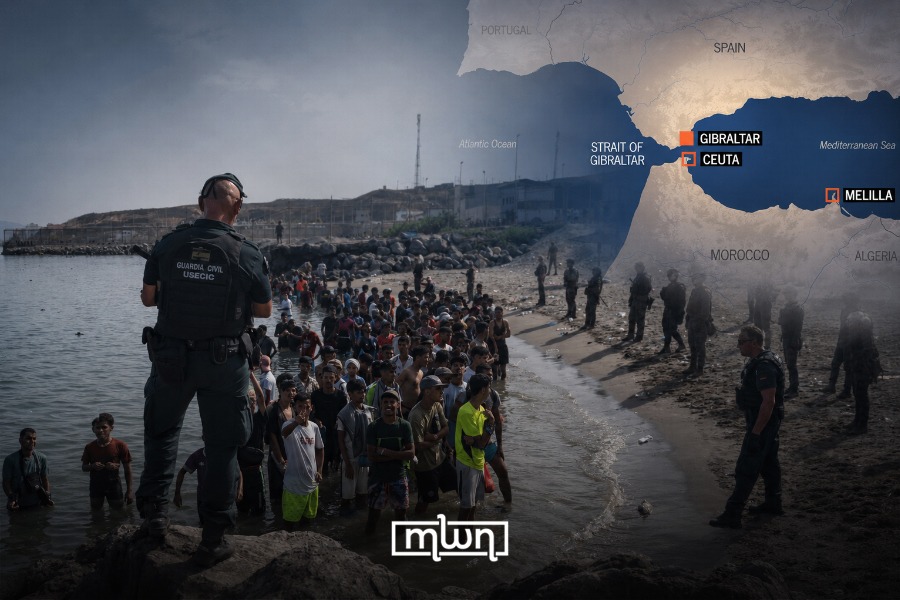
The migration crisis in Ceuta has stirred up an old political reflex in Spain, on both the right and the left. Morocco has once again become the neighbor that gets accused, suspected, and reduced to a problem.
The far right talks of “invasion,” of demographic threat, of European fortresses under siege. Part of the left, meanwhile, has picked up the same vocabulary of security and Moroccan “responsibility.”
This reading is dangerous and historically simplistic. Before presenting Ceuta and Melilla as eternal fragments of Spain, it’s worth revisiting their actual history.
They sit on Moroccan territory. Geography alone rules out treating them as natural extensions of the Iberian Peninsula.
Ceuta was only conquered by Portugal in 1415, before passing to the Spanish crown during the union of the Iberian crowns. When Portugal broke away, the city chose to remain under Philip IV; the Treaty of Lisbon in 1668 then formalized its status as Spanish. Melilla was only taken by Castile in 1497. In both cases, then, the Spanish presence is anything but ancient — it’s the product of a history of Portuguese and later Spanish expansion.
Starting in the 19th century, in the context of European colonial rivalry, Spain occupied the Chafarinas Islands in 1848, then attacked Morocco in 1859-60. The Treaty of Tetouan that followed forced an expansion of the territory around Ceuta in Morocco, along with a war indemnity that would bankrupt the country and push it straight toward the Protectorate.
Not as historically Spanish as the nationalist myth suggests
The history of these enclaves, then, is not one of a natural European border — it’s the story of a colonial power gradually consolidating military and territorial footholds on Moroccan soil.
For the sake of memory, dignity, and historical accountability, the Rif also deserves attention. Between 1921 and 1927, Spain waged chemical warfare in the Rif. Yet that chapter remains largely absent from Spanish political debate. As many in Madrid see it, it’s simply more comfortable to paint Morocco as the aggressive neighbor than to reckon with the violence of one’s own imperial past.
There’s another paradox: the 1936 military uprising against the Spanish Republic began, in part, in northern Morocco. Tens of thousands of Moroccan Regulares fought in the Spanish Civil War on the side of Franco’s forces. That fact alone should be enough to dismantle the narrative that Moroccans have always been a threatening “other” to Spain. They shed blood on Spanish soil in a war that would shape the country’s political future — a history conveniently forgotten by those who insult Morocco and Moroccans today.
History is uncomfortable precisely because it wrecks tidy narratives. There’s another forgotten memory too: the thousands of Spanish Republicans who fled to Tangier, Casablanca, and other Moroccan cities. Morocco was neither rich nor powerful at the time, but it welcomed them with generosity and humanity. That memory alone should rule out any contemptuous reading of the relationship between the two peoples.
Add to this the expulsions of 1492 and 1609–1614: many Sephardic Jews and Moriscos found refuge in Morocco. Spain’s history is also that of a country that expelled part of its Jewish and Muslim populations to the other shore of the Mediterranean — to Morocco.
Spanish-Moroccan relations, in other words, cannot be reduced to the story of a civilized European people facing an eternally threatening Moorish neighbor. They are made up of conflict, occupation, influence, exile, welcome, and mixing.
The Ceuta crisis is real, and it is tragic. It deserves to be treated seriously — looking honestly at migration, security, smuggling networks, and the responsibilities of every actor involved. But it also has to be shielded from political exploitation. Turning migrants into “proof” of some supposed Moroccan ambition to “invade Spain” has more to do with identity-driven fantasy than strategic analysis. That obsession may trace back to the memory of eight centuries of Moorish presence on the peninsula — but that shared past also gave rise to one of history’s great civilizations, one that Spain and the world still benefit from today.
Madrid’s reckoning
A state has every right to protect its borders. But when it cooperates with its neighbor on that front, it also has to acknowledge that cooperation. Spain cannot maintain close economic, security, and diplomatic ties with Morocco while simultaneously presenting that same country as an existential threat. That’s Madrid’s paradox: protecting Ceuta and Melilla, keeping cooperation with Rabat at full strength, and still treating the enclave question as permanently settled — three positions that are becoming harder and harder to reconcile, arguably impossible to hold at once.
Morocco is no longer the country of its early years of independence. It is now a major economic and security partner for Europe, and above all, a neighbor that isn’t going anywhere. Neither is Spain.
So the real question isn’t who “wins” a standoff — it’s how much longer Madrid can keep managing a 21st-century historical issue with 19th-century political reflexes.
The question of Ceuta and Melilla won’t disappear just because Spain refuses to ask it. Morocco sees them as a matter of national territory; Spain sees them as Spanish. Both positions exist, and no media firestorm will erase either one. The real variable is time. Borders presented as eternal never quite are. History has seen empires vanish, decolonization unfold, territories restored, and borders once thought immovable change hands peacefully.
Madrid has a choice to make: a relationship permanently built on mistrust, migration crises, and electoral opportunism — or a strategic relationship with the immediate neighbor on whom part of Europe’s southern border security actually depends.
Pragmatism should push Spain to move past its imperial nostalgia. Ceuta and Melilla can be Spanish today without that status being immune to history. A 21st-century Spain should be confident enough in itself not to turn two Moroccan enclaves into symbols of a bygone imperial grandeur. It could instead open a historical and political conversation with Morocco about their future — without threats, without insults, without inflamed nationalism. Because Ceuta and Melilla aren’t just two Spanish cities.
They are also two Moroccan questions, sitting on Moroccan soil. Historical questions that go unaddressed never really vanish. They just wait.
Read also: Why Spain Owes Morocco an Apology?