


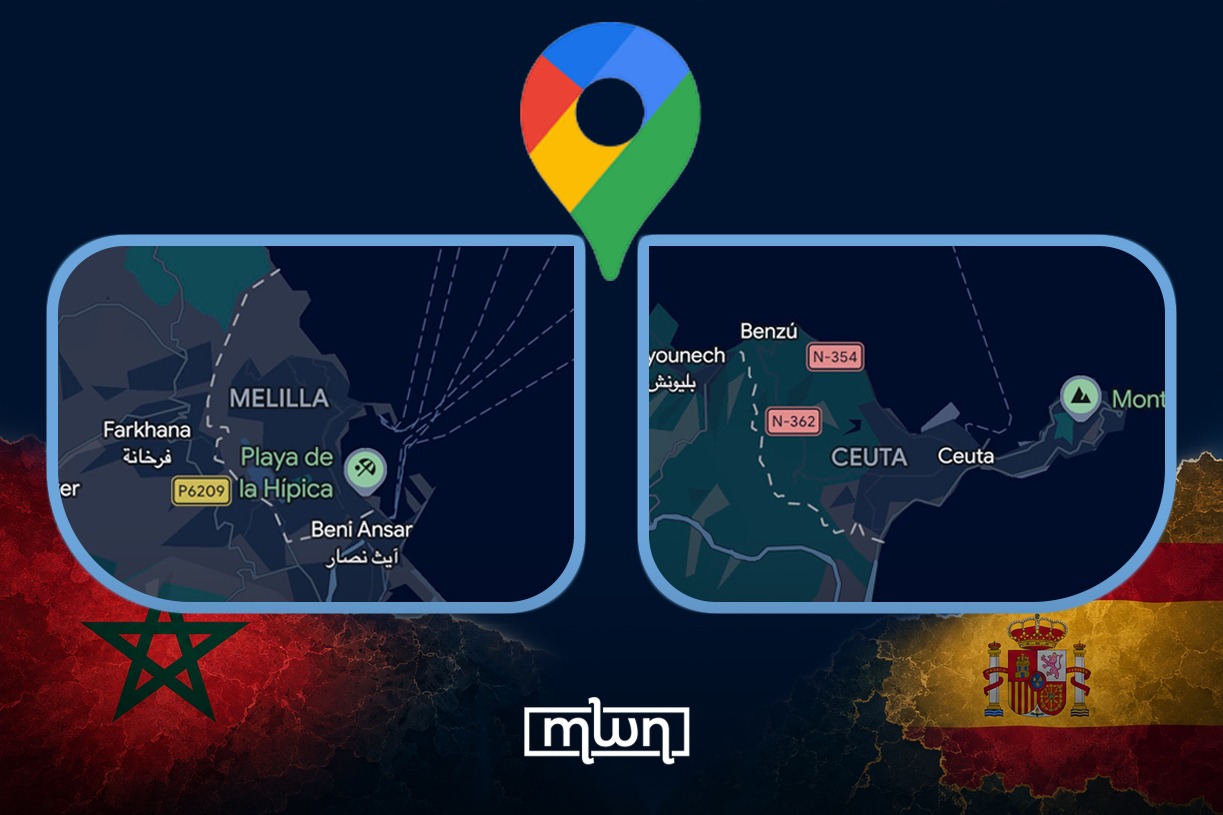
Marrakech – Google Maps traces the land borders between Morocco and the occupied cities of Ceuta and Melilla with a gray dashed line, the marker the American company reserves for frontiers it treats as disputed. The same convention appears on Google’s rendering of Western Sahara, Kashmir, and Crimea. In Madrid, the choice has drawn open anger.
The controversy resurfaced after late July, when Ceuta recorded one of the largest episodes of irregular entries in its history. On the night of July 30 to 31, tens of thousands of people – by varying accounts between 50,000 and 80,000 – swam across the El Tarajal and Benzú breakwaters from the Moroccan side.
Screenshots of the dashed borders spread within days across X, Instagram, TikTok, and LinkedIn, and many users read the lines as Google’s reaction to the migration crisis.
That reading is wrong. The representation predates the crisis by years. A user questioned the dashed frontier on Google’s own Maps forum on May 14, 2020, and several news outlets reported on it in 2023. The Spanish fact-checkers Newtral and Maldita.es both confirmed that Google did not alter the map after July 2026.
Similarly, Google has not suddenly “recognized Moroccan sovereignty” or changed its position in Morocco’s favor. Still, it does not cartographically represent the Ceuta-Morocco and Melilla-Morocco boundaries in the same way as uncontested Spanish international borders. It uses its dashed-line convention for “disputed” or “discussed” boundaries, thereby indicating the existence of a sovereignty/boundary disagreement rather than adjudicating it.
Google applies three line types. Solid lines mark recognized international borders, as between Spain and Portugal. Dotted lines mark internal administrative limits, such as those between provinces. Dashed lines mark frontiers that are temporary, applied de facto, or defined differently by two or more states.
Google told Maldita.es it stays “neutral in geopolitical debates” and shows disputed territories “objectively,” relying on data from cartographic authorities worldwide, including the United Nations. It named no specific source, and it did not answer when the lines for Ceuta and Melilla first appeared.
Spanish users point to a double standard. Google renamed the Gulf of Mexico as the “Gulf of America” after pressure from Donald Trump. Apple, in a comparable case, began showing Crimea as Ukrainian for users outside Russia after the 2022 invasion; Google still draws Crimea as disputed.
In Kashmir, Google’s map shifts depending on whether it opens from India or Pakistan – an asymmetry that, for Ceuta and Melilla, favors Spain in neither version.
The pushback has a history. In 2023, the Observatory of Ceuta and Melilla, through its director Carlos Echeverría, wrote to Google Spain’s general director, Fuencisla Clemares, asking the company to correct what it called an error affecting both Spain’s borders and the European Union’s external frontier.
The issue has now become active enough that, on August 4, a Spanish user filed a Google Maps support request demanding a change; a Google Product Expert replied that the dashed line signals a border dispute without taking a position on who is right. The boycott calls have produced nothing, and questions from Newtral and Maldita.es went unanswered.
A sovereignty dispute written into the record
Spain rests its case entirely on its own domestic law. Its Constitution and the two cities’ Statutes of Autonomy declare them part of the Spanish nation, yet that is legislation Madrid wrote for itself, and no state manufactures sovereignty over contested land by its own decree. The “centuries” of Spanish presence trace back to acts of conquest – Melilla seized in 1497, Ceuta in 1578 – the colonial occupation of two Moroccan cities on African soil.
Even Europe treats them as an exception: when the European Commission ruled in 2022 that all Spanish territory belongs to the Schengen area, “including Ceuta and Melilla,” it still conceded that Schengen does not apply there as it does to the rest of Spain.
Morocco’s position is also formally recorded in its treaty practice and Official Gazette. Upon ratifying the UN Convention on the Law of the Sea (UNCLOS) in 2007, Rabat attached an official declaration formally reaffirming its claim to the territories. Under Dahir No. 1-04-134, issued by King Mohammed VI on May 23, 2008, and published in Official Gazette No. 5714 on March 5, 2009, “the government of the Kingdom of Morocco reaffirms that Sebta, Melilia, the Alhucemas islet, the Vélez rock and the Chafarinas Islands are Moroccan territories.”
Its wording – reaffirms – casts the claim as long-standing, not new. The text calls the enclaves territories “under Spanish occupation” and states that Morocco “has never given up its major concern to recover” them “in order to achieve its territorial integrity.” Ratifying the Convention, it adds, “cannot in any way be interpreted as recognition of this occupation.”
Spain formally answered that declaration on September 10, 2008, when the UN Secretary-General received Madrid’s response to Morocco’s May 31, 2007 UNCLOS declaration. The Iberian country maintained that Ceuta, Melilla, the Peñón de Alhucemas, Peñón Vélez de la Gomera and the Chafarinas Islands are integral parts of the Kingdom of Spain, over which it exercises “full and total sovereignty,” including over their maritime areas.
The opposing declarations are recorded together in the UN Treaty Collection’s entry for UNCLOS, providing a formal record of the two states’ incompatible positions. That record does not determine sovereignty, but it does show that Morocco’s claim is neither political invention nor merely rhetorical. Google’s dashed-boundary convention likewise does not resolve the dispute; it simply reflects the existence of a contested boundary.
Why Morocco has kept the claim in the background
Morocco has disputed Spanish sovereignty over Ceuta and Melilla since independence, but the claim has rarely occupied the same place in Rabat’s foreign policy as Western Sahara. Moroccan analyst Samir Bennis traces that hierarchy back to the early 1960s, when King Hassan II sought to persuade Francisco Franco’s Spain to resolve Morocco’s outstanding territorial disputes gradually.
In July 1963, Hassan II reportedly told Spanish minister Manuel Fraga Iribarne that Morocco was prepared to put its claims to Ceuta and Melilla “in parentheses” for three or four generations if Madrid agreed to negotiate over the Sahara.
Following Hassan II’s meeting with Franco at Madrid’s Barajas airport that same month, later associated with the “Spirit of Barajas,” Morocco refrained for more than a decade from bringing Ceuta and Melilla before the UN decolonization committee, deliberately placing the issue on the back burner while prioritizing the recovery of the Sahara and Ifni.
Rabat did raise the issue before the UN on January 27, 1975, formally requesting that Ceuta, Melilla, Alhucemas, Vélez de la Gomera and the Chafarinas Islands be placed on the list of Non-Self-Governing Territories. The UN never added them to that list, where they remain absent today. The 1975 move itself was made largely in the context of Morocco’s overriding struggle over Western Sahara, as a means of pressuring Spain not to obstruct Rabat’s efforts there.
After the Sahara’s recovery process began, Hassan II still did not immediately reactivate the Ceuta and Melilla claim, partly because he did not want to undermine King Juan Carlos or destabilize Spain during the sensitive post-Franco transition.
That long-standing prioritization of Western Sahara should not be confused with an abandonment of Morocco’s claim to the two cities. The issue has periodically returned to the foreground, particularly during moments of bilateral friction or when Spanish initiatives were seen in Rabat as further consolidating Madrid’s control, as occurred amid tensions over Western Sahara in the late 1970s and during Spain’s move to grant Ceuta and Melilla autonomy in the 1990s.
Morocco has otherwise largely kept the dispute in the background while concentrating its diplomatic capital on Western Sahara and maintaining its strategic relationship with Spain.




