


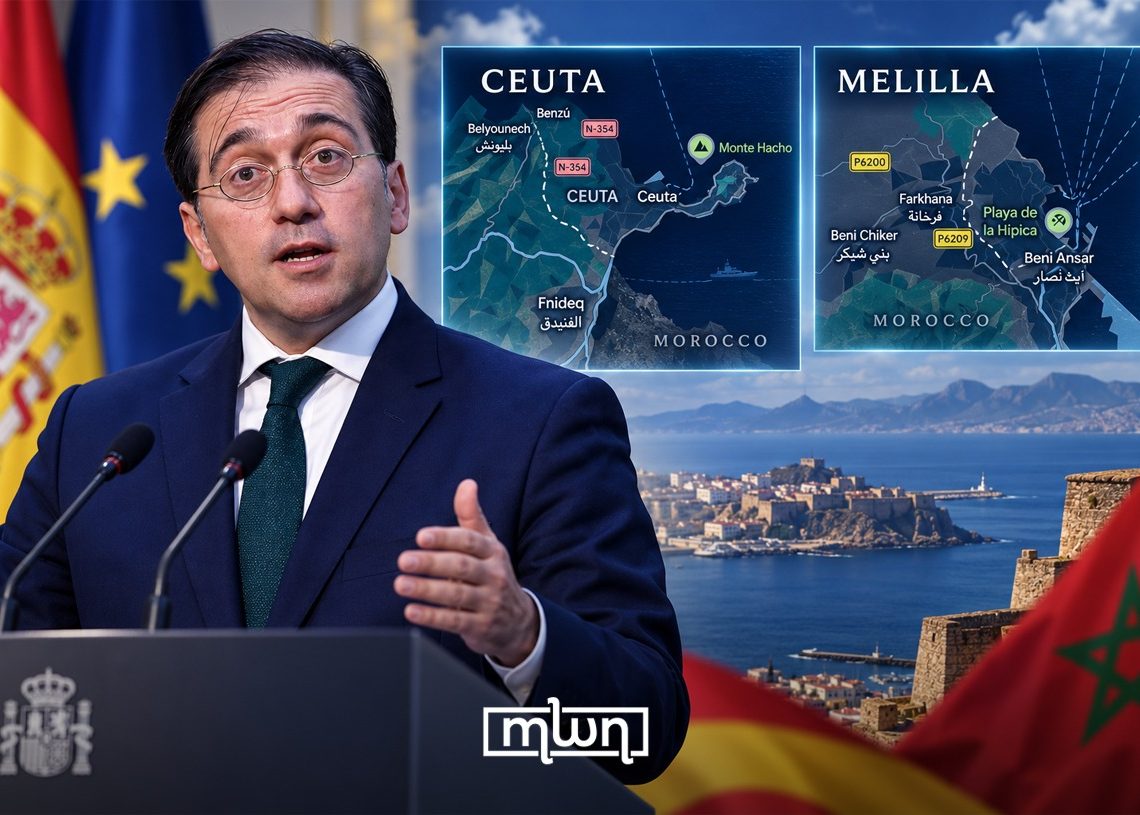
Casablanca – Spanish Foreign Minister José Manuel Albares rejected any discussion with Morocco over the status of the occupied enclaves of Ceuta and Melilla, ruling out the idea of “co-sovereignty” and saying Madrid would not engage in talks with Rabat on Spain’s “territorial integrity.”
Speaking to Spanish broadcaster La Sexta from New York, where he is attending the 81st UN General Assembly, Albares said Spain considers Ceuta and Melilla part of its “territorial integrity” and that his government would not discuss that position with Morocco. He also described the idea of “shared sovereignty” over the two cities as “absurd.”
Albares is due to meet Moroccan Foreign Minister Nasser Bourita in New York. The meeting comes as the two countries continue to cooperate on migration and border security while facing renewed disagreement over the status of the two cities.
The latest dispute follows a series of statements by Moroccan officials in recent weeks. Justice Minister Abdellatif Ouahbi said in August that Morocco would continue to raise the issue with Spain, referring to Morocco’s historical and geographical rights over Ceuta and Melilla and calling for dialogue over their future.
Minister of Endowments and Islamic Affairs Ahmed Toufiq also referred to Ceuta during a religious ceremony chaired by King Mohammed VI in Rabat, recalling scholars from the city and Morocco’s historical efforts to reclaim territories held by foreign powers.
Madrid responded to the Moroccan ministers’ statements by summoning Morocco’s ambassador in August. With Ambassador Karima Benyaich outside the country, the chargé d’affaires attended instead. Albares said that the meeting with the Moroccan diplomatic representative served to communicate Spain’s position that Ceuta and Melilla are “Spanish cities” and part of the European Union (EU).
The dispute has unfolded alongside July’s mass crossing, when more than 80,000 people entered Ceuta, according to figures cited by Albares. Spanish authorities have since worked with Moroccan authorities to prevent further mass crossings and manage the return of people who entered the city.
Albares also addressed comments by former Moroccan senator Yahya Yahya, who warned against a planned visit by Spain’s King Felipe VI to Ceuta and Melilla. Yahya now heads the Committee for the Liberation of Ceuta and Melilla. Albares rejected the warning and said Spanish authorities would decide when and where the king visits.
Morocco’s Foreign Ministry has meanwhile reaffirmed its commitment to its partnership with Spain, citing good-neighborly relations, political understanding, economic cooperation and security coordination as the basis of bilateral ties.


