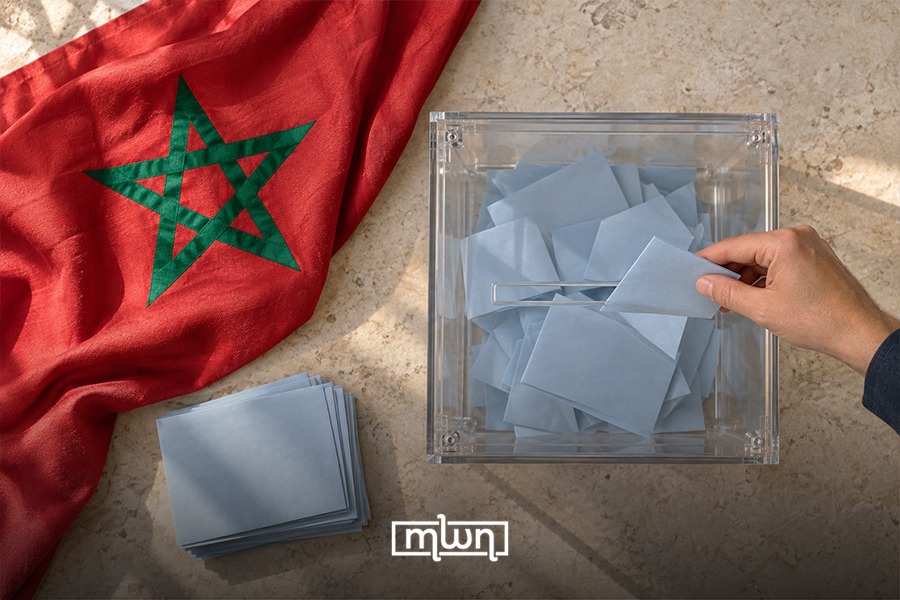
Marrakech – Voters continued to arrive at polling stations across Morocco under normal conditions on Wednesday afternoon to cast their votes in the legislative elections, according to a statement from the Interior Ministry.
The participation rate recorded nationally reached 28.05% as of 5 p.m. Under the legal provisions that set the closing hour, voting will end at all polling stations established across the country at 7 p.m.
Polls opened at 8 a.m. for nearly 15.8 million registered voters. The vote marks the 12th legislative election since independence and the sixth since King Mohammed VI’s accession to the throne in 1999.
A total of 28 parties are competing for the 395 seats of the Chamber of Representatives, with 7,288 candidacies registered nationwide across 1,850 lists. The two-week campaign that opened on September 10 closed at midnight on Tuesday.
The contest unfolds amid debates over employment, the economic situation, public services, and political participation, with youth mobilization among the central issues. The results will determine the party tasked with forming a government for the next five years, one that will inherit files tied to Morocco’s participation in organizing the 2030 World Cup.
Registered voters break down as 54% men and 46% women, and 55% urban against 45% rural, with those aged 60 and above making up more than 29% of the rolls. Among sitting lawmakers, 227 are seeking reelection.
Women account for a notable share of the field, with 2,658 candidates, or about 36.5% of the total. Of these, 1,783 are running on 235 lists in regional constituencies reserved exclusively for women, seats that represent roughly 23% of the chamber.
Younger candidates were drawn in through new incentives, including a sixfold increase in financial support for each seat won by a contender aged 35 or under in local constituencies.
The current cycle also saw fewer disputes. The Public Prosecution recorded 93 election-related complaints between August 21 and September 15, down from 229 in the same period in 2021, with 92% already adjudicated.
Amendments under Laws 53.25 and 55.25 criminalized digital offenses for the first time, among them fake news and fabricated images or statements used to defame candidates or voters through social media or artificial intelligence. Complaints tied to social networks and information systems reached 22, the leading category this year.
Roughly 6 million Moroccans living in more than 100 countries could not vote directly abroad. They cast ballots through proxies in Morocco, using the E-Procuration platform launched by the Ministry of Foreign Affairs in coordination with the Interior Ministry.
Once polls close, members of each bureau will tally the ballots before representatives of the candidate lists, and the Interior Ministry is expected to announce preliminary results in the early hours of Thursday.
Under Article 47 of the Constitution, the King appoints the head of government from the party that finishes first. Forming a government requires an absolute majority of at least 198 seats, a threshold rarely met by any single party under the list-based system, which points to renewed coalition talks.
In the September 2021 elections, the National Rally of Independents (RNI) finished first with 102 seats, ahead of the Authenticity and Modernity Party (PAM) with 86 and Istiqlal with 81, producing a coalition led by RNI leader Aziz Akhannouch.
Read also: What Kind of Political Modernity Does Morocco Want to Build?