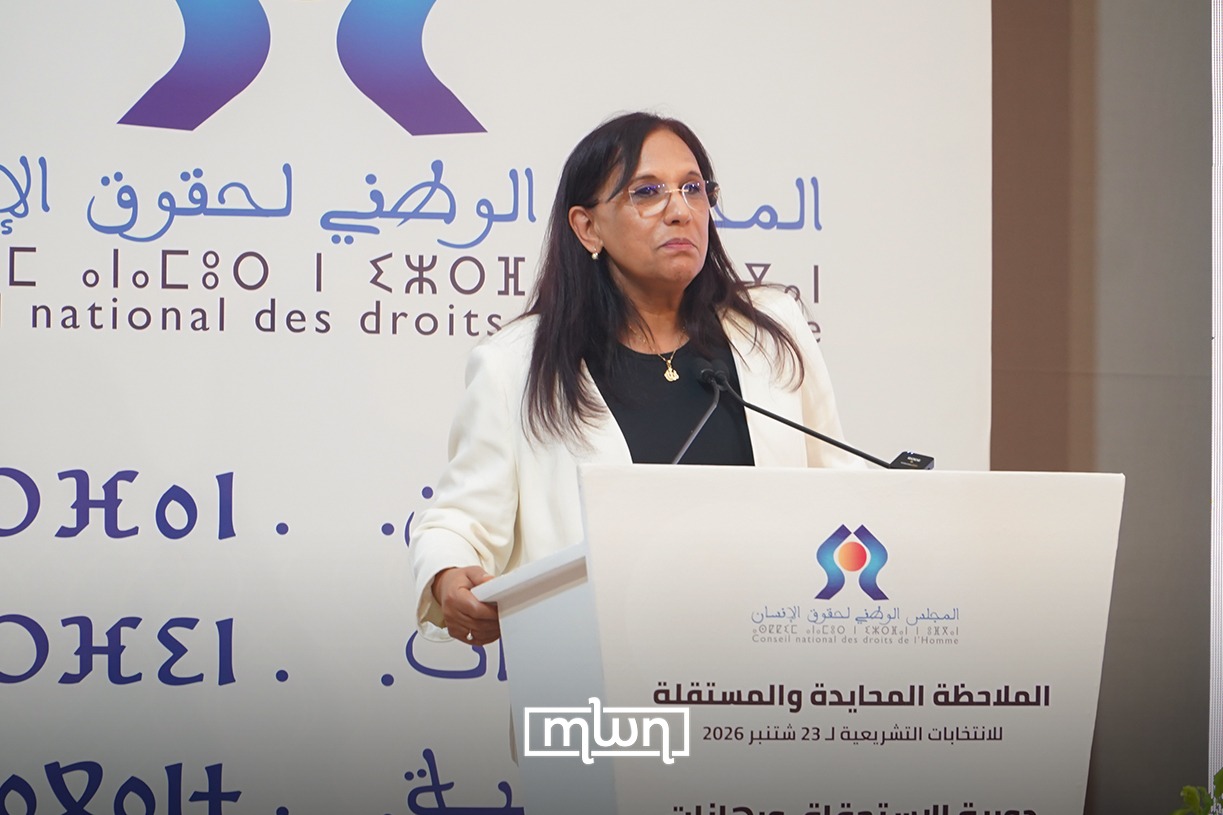
Rabat – The National Human Rights Council (CNDH) presented today its preliminary report on Morocco’s September 23 legislative elections, examining the regularity of the vote and the wider challenges facing political trust and participation.
Morocco’s 2026 legislative elections gave the Authenticity and Modernity Party (PAM) 97 of the 395 seats in the House of Representatives, followed by the National Rally of Independents 5RNI) with 66 and the Istiqlal Party (PI) with 65, according to provisional results announced by the Interior Ministry today.
The Justice and Development Party (PJD) returned to Parliament with 54 seats, compared with 13 in 2021. The Socialist Union of Popular Forces (USFP) won 26 seats, the Popular Movement (MP) 29, the Party of Progress and Socialism (PPS) 19 and the Constitutional Union (UC) 17.
Voter turnout reached 38.02%, down from about 50% in 2021. The figure became a central issue in the Council’s preliminary assessment, which it titled “The Regularity of Elections and the Challenge of Trust and Participation.”
Amina Bouayach, president of the National Human Rights Council, said the turnout rate should prompt elected and executive institutions to examine their relationship with citizens and the issues affecting their daily lives.
“The 38% participation rate in the 2026 legislative elections raises questions for the executive and legislative authorities,” Bouayach said during a press conference.
Voir cette publication sur Instagram
The election took place amid concerns over employment, purchasing power, healthcare, education, public services and territorial inequalities. The Council also pointed to difficulties facing young people in accessing jobs, achieving economic independence and taking part in public life.
The Council said the elections generally followed the legal framework and that tensions observed during voting did not disrupt the process. Its observers identified two cases in Tangier that raised concerns about electoral integrity.
One involved a person found carrying ballot papers, while another involved ballot papers found inside ballot boxes at two polling stations at Al-Quds School. Authorities opened urgent investigations into the cases.
Bouayach said the Council met the heads and members of the two polling offices and prepared a report for the Public Prosecutor’s Office. She called for the investigation results and any measures taken to become public.
The Council deployed 783 observers and covered 733 communes out of 1,538, including 542 rural communes and 191 urban communes or districts. Its minimum election-day sample covered 3,915 polling stations out of roughly 40,700, giving it an 8.9% coverage rate. The Council said this exceeded the international benchmark of between 3% and 5%.
Digital campaigning and political participation
The Council combined field observation with continuous digital monitoring. It analyzed more than 528,000 pieces of online content, including about 200,000 directly linked to the elections. Its digital system included live observation maps, a map of potential violations, a national risk heat map and a central operations dashboard. It also created tools to verify content potentially generated or modified by artificial intelligence.
The Council found 538 electoral advertisements from seven political parties on Meta between August 31 and September 10, with estimated spending between $18,370 and $49,870. Before the official campaign, however, monitoring recorded more than 15,231 advertisements from eight parties since March, with estimated spending exceeding $1.026 million.
The report also raised concerns about the use of religion and religious symbols during campaigning. Observers recorded 44 cases involving religious symbols and six campaign activities inside places of worship. Digital monitors identified more than 2,030 pieces of content involving religion in electoral discourse, including material portraying political competition as a choice between Muslims and those opposed to Islam.
Bouayach described this form of polarization as dangerous for Morocco’s pluralistic society and said the Council had recorded the use of mosques and religious symbols during the campaign.
The Council also found that measures designed to encourage independent youth candidacies did not produce the expected participation. Only two independent lists entered the election, while young candidates under 35 appeared on some party-backed local and regional lists, with major differences between regions.
Read also: CNDH Chief Calls for Protecting Religious Freedom Through Rights, Dialogue
Women’s participation also increased in numerical terms, but the Council said their presence did not consistently translate into equal participation in political communication, campaign leadership or decision-making. It reported similarly weak participation by people with disabilities.
The Council recorded campaign violations including damaged or improperly placed posters, verbal and occasional physical violence, disturbances during marches, use of public property, religious and national symbols, and money or gifts. It said these violations represented less than 3% of the observations it collected and analyzed.
The Council’s recommendations focus on rebuilding trust between elections. It called for easier electoral registration, stronger accessibility at polling stations, greater participation by women and youth in electable positions and list leadership, better regional representation, more detailed electoral data and stronger use of Amazigh in campaign communication. It also urged authorities to inform the public about the outcome of electoral investigations while respecting legal safeguards.
Bouayach said the Council hopes the 2026 turnout will serve as a warning for institutions to review their work and strengthen citizens’ confidence that political participation can influence public affairs.