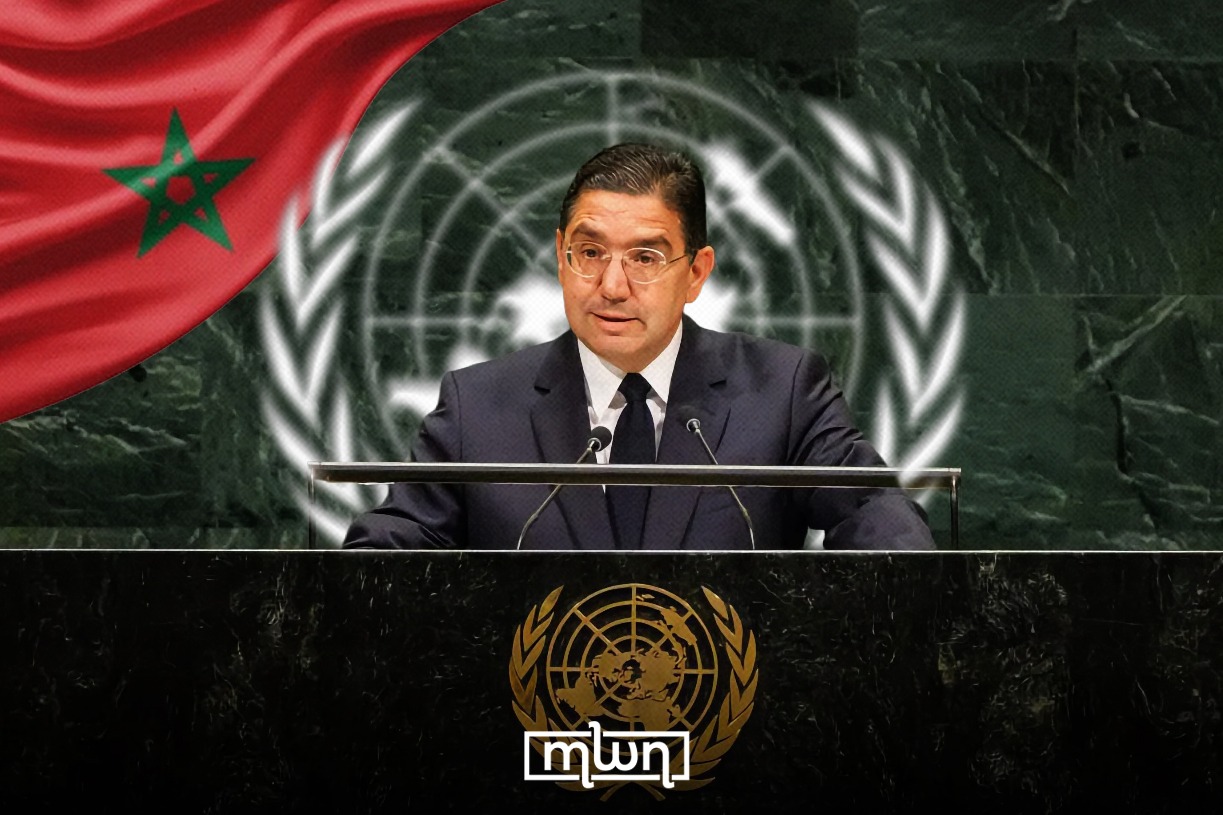
Marrakech – Foreign Minister Nasser Bourita moved through a dense schedule of meetings and high-level sessions in New York this week, further advancing Morocco’s diplomatic footprint in a host of strategic areas on the sidelines of the 81st session of the UN General Assembly.
His engagements ran across climate policy, peacebuilding, counterterrorism, development financing, and a round of bilateral talks with counterparts from several regions.
Bourita called on Thursday for more coherent, united, and science-based international action against the risks tied to rising sea levels. At a high-level meeting on the existential threats of sea-level rise, he welcomed the adoption of the Political Declaration on Sea-Level Rise and pressed for its translation into concrete measures.
“This phenomenon is no longer a distant threat,” he told the session, noting that it already affects territories, economies, and livelihoods, and raises existential questions for some states.
And he recalled that Morocco has consistently advocated climate action built around vulnerability, resilience, and solidarity. Bourita pointed to the kingdom’s support for the Commission of African Island States, launched in 2016 at the COP22 African Action Summit, and to the Atlantic African States Process.
Since 2019, noted the chief of Moroccan diplomacy, Morocco has carried a UN resolution on integrated coastal zone management and serves as a Champion of the “C-SET” Coalition.
Bourita then laid out four priorities: anticipating risks, mobilizing predictable financing, launching structuring partnerships, and protecting affected populations. A clear and predictable international framework, he argued, is now indispensable.
Peacebuilding, terrorism victims, and development
Also on Thursday, Bourita presented the fundamentals of Morocco’s 2026 presidency of the UN Peacebuilding Commission, at a high-level meeting on national ownership and inclusive state institutions.
The session drew UN Deputy Secretary-General Amina J. Mohammed, Papua New Guinea Prime Minister James Marape, Kenya’s Cabinet First Secretary Musalia Mudavadi, and African Development Bank Vice-President Marie-Laure Akin-Olugbade, among others.
Twenty years after the commission’s creation, Bourita observed, it stands at an important stage, shaped by the Pact for the Future and the 2025 review of the peacebuilding architecture.
Durable peace cannot be built in place of the states and societies concerned, he argued, calling for national ownership grounded in sovereignty, shared responsibility, and stronger national capacities.
He proposed institutionalizing “out-of-walls” sessions in concerned countries and developing a National Ownership Diagnostic. The aim, he concluded, is not only more peacebuilding but better peacebuilding.
The minister’s Wednesday agenda was equally full. At a ministerial meeting of the Group of Friends of Victims of Terrorism, he called for stronger international action for those victims, noting that Africa alone accounts for 60% of terrorism victims worldwide.
He recalled the first International Conference on African Victims of Terrorism, held in Rabat in December 2025 with UNOCT, which produced the Rabat Declaration and an online compendium of good practices.
Supported victims, he argued, can become voices against radicalization, while inaction risks worsening conditions in the Sahel and West Africa. He urged a structured, institutionalized mechanism dedicated to terrorism victims.
That same day, Bourita joined the high-level commemoration of the 40th anniversary of the Declaration on the Right to Development, adopted by the General Assembly in December 1986.
He tied Morocco’s economic and social progress to a model built on dignity, equity, and equal opportunity, and reaffirmed the kingdom’s commitment to South-South cooperation.
He called for action on four fronts: national capacity-building, development financing, digital transformation with equitable access to technology and artificial intelligence, and placing Africa at the center of cooperation.
Bourita also opened a high-level event co-organized by Morocco and the UNDP on public-private partnerships for development. Public finances alone cannot close an annual SDG financing gap he put at $4.3 trillion.
Under King Mohammed VI, Morocco aims to raise the private sector’s share to nearly two-thirds of national investment by 2035, drawing on the new Investment Charter and the Mohammed VI Investment Fund. He cited the Noor Ouarzazate solar complex, Tanger Med port, and the Casablanca-Tangier high-speed line as measures of that model.
A parallel round of bilateral talks
For Africa, where infrastructure needs run between $181 and $221 billion a year through 2030, he pointed to initiatives like the African Atlantic Gas Pipeline and the Atlantic Initiative for Sahel States, and proposed reducing regulatory fragmentation, exploring regional co-investment, building guarantee and de-risking platforms, and adopting a financing approach that looks beyond GDP to vulnerabilities such as landlocked status and climate exposure.
His bilateral track ran alongside these sessions. On Wednesday, Bourita met separately with the foreign ministers of Slovenia (Tone Kajzer), Malta (Chris Fearne), Ecuador (Roberto Kury Pesantes), Kuwait (Jarrah Jaber Al-Ahmad Al-Sabah), the Bahamas (Fred Mitchell), and Kenya (Musalia Mudavadi), reviewing bilateral ties and coordination in international forums.
He also held talks with African Union Commission Chairperson Mahmoud Ali Youssouf on continental priorities and integration, and with Madagascar’s Foreign Minister Alice N’Diaye, who welcomed Morocco’s vision for African co-development.
Read also: Morocco Hosts Launch of First African Convention on Child Soldiers