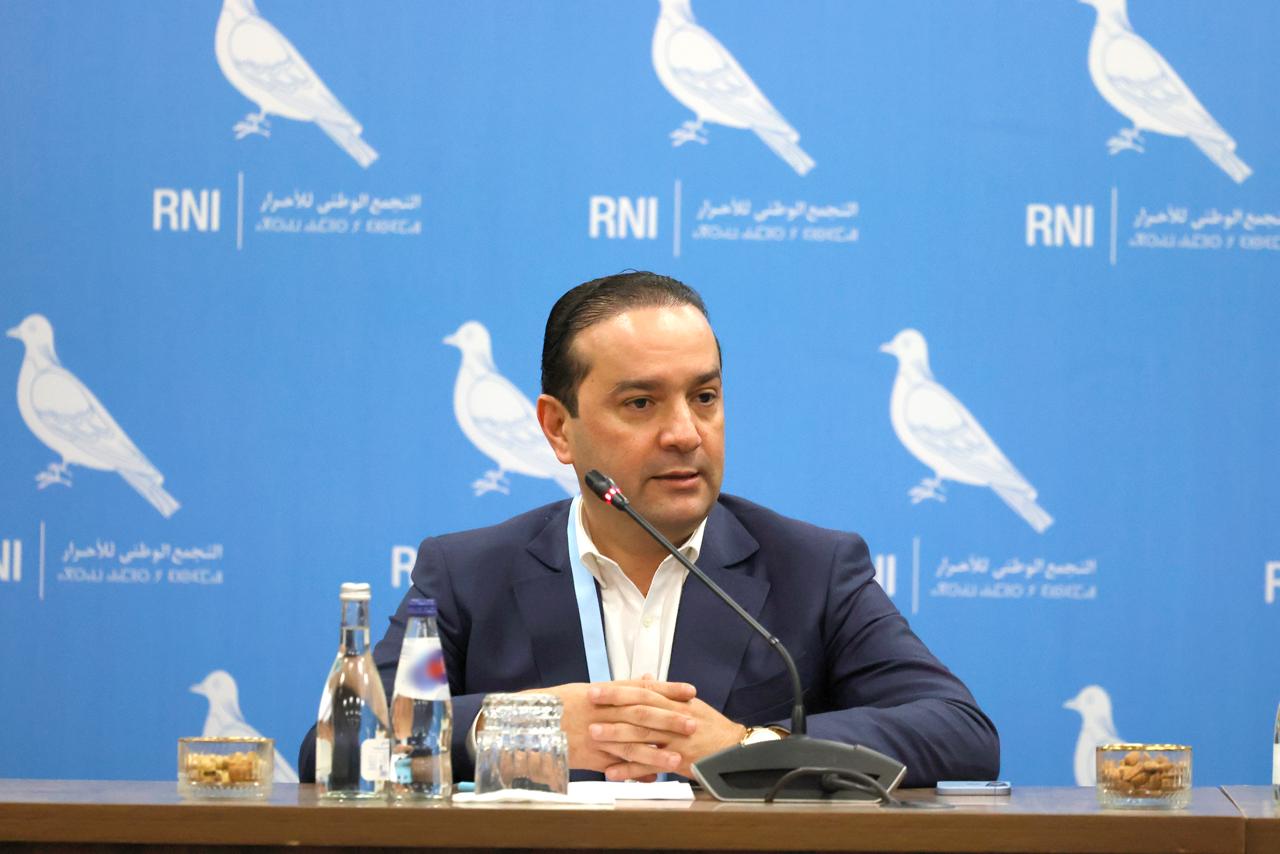
Marrakech – The National Rally of Independents (RNI) conceded a drop in its performance in the September 23 legislative elections while maintaining that it retained a significant political and electoral weight, party president Mohamed Chouki told reporters Thursday evening in Rabat.
Speaking from the RNI’s central headquarters after the Interior Ministry released provisional results overnight Wednesday to Thursday, Chouki addressed an outcome that ranked the party second with 66 seats in the House of Representatives.
The Authenticity and Modernity Party (PAM) topped the vote with 97 seats, and the Istiqlal Party followed the RNI with 65. The same three parties had also emerged as the top three forces in the 2021 elections before forming the governing coalition led by Aziz Akhannouch.
But this year’s results represented a sharp reversal from 2021, when the RNI won 102 seats, meaning the party has lost 36 seats – more than a third of its parliamentary representation.
The decline came after five years in government marked by persistent concerns over purchasing power, unemployment, healthcare and education, issues that also fueled the Gen Z protests and broader social discontent. Observers interpreted the Justice and Development Party (PJD)’s simultaneous comeback as partly a “sanction vote” against the outgoing government.
Chouki did not soften the outcome. The party “does not want to minimize the significance of this decline, nor seek justifications for it,” he stated, treating the result as a message that parties must read closely when their numbers fall, just as they welcome voters’ trust when their numbers rise.
He recalled that the RNI entered the race after five years leading the government, a stretch he described as difficult and marked by successive transformations and challenges at home and abroad.
The party, he noted, presented its record to Moroccans “as it is,” alongside what he called unfinished work and a clear program for the coming phase, leaving voters to judge the experience “with responsibility and freedom.”
The confidence voters placed in the party amounts to “a responsibility and a trust,” he argued. Chouki maintained that the RNI’s standing cannot be reduced to an electoral ranking, pointing to the political, governmental, and organizational experience it accumulated over recent years, along with its elected officials, activists, competencies, and political project.
On the question of government alliances and the next political phase, Chouki declined to take a position in advance. The RNI “will not preempt the decisions of its institutions,” he remarked, explaining that such matters will be examined within the party’s competent bodies, in line with its internal procedures, the national interest, and its own choices. He indicated that the party would inform the public of its official positions once those bodies convene and settle their decisions.
Chouki also drew a line between the campaign and the responsibilities that outlast it. “The electoral competition has ended, but responsibilities toward citizens do not end with the elections,” he told the press, adding that the RNI would remain present in the field as a weighty political force.
He then announced an internal review. The party will not approach the results with self-satisfaction, he affirmed, and will open a “calm and serious” debate within its institutions to evaluate its political, governmental, organizational, and communicational experience “with objectivity and clarity.”
Chouki pledged to “listen more, review what deserves review, and correct what should be corrected.” A party that intends to endure, he maintained, “does not fear criticism nor avoid moments of evaluation.”
He held that the strength of parties is not measured by electoral victory alone, but also by their capacity to understand shifts in society, read citizens’ messages, and renew their ideas, elites, and tools.
He closed by congratulating the PAM and its leadership, wishing them success in the responsibility produced by the ballot boxes, and by thanking the citizens who took part in the vote and those who renewed their trust in the party’s candidates across the kingdom.
The RNI entered the election after an unusual leadership transition. Akhannouch stepped down as party president earlier in 2026 and was replaced by Chouki, while Akhannouch remained head of government and continued campaigning for the party.
Analysts had noted months before the vote that the change complicated the RNI’s electoral strategy, with Chouki facing his first national campaign as leader and remaining comparatively little known to the wider public.