
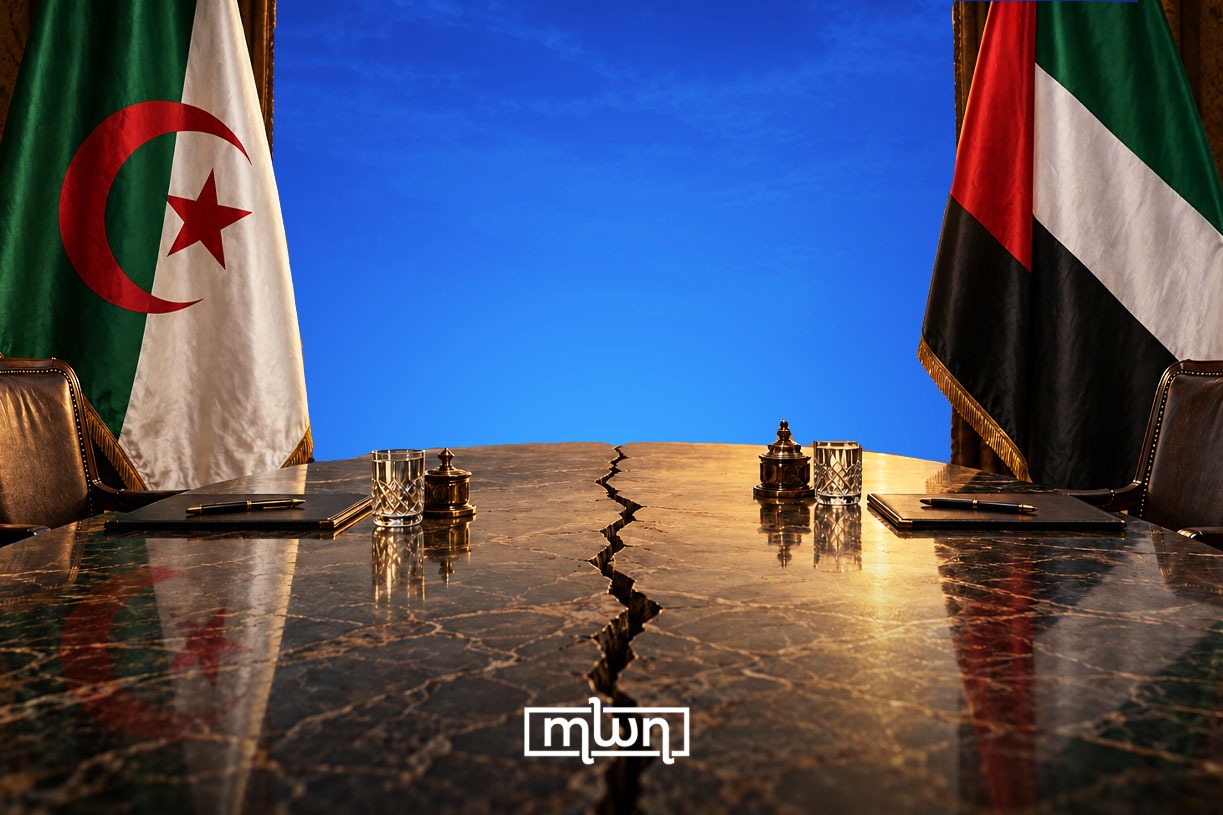
Algeria’s decision to sever diplomatic relations with the United Arab Emirates has created yet another fault line in the Middle East and North Africa, which can ill afford it. Algiers announced the break on September 10, following years of simmering tensions and recent waves of allegations accusing Abu Dhabi of provocative and hostile actions against Algeria.
At first glance, this whole episode is just a bilateral issue in a region used to such moves and rhetoric. Yet this tension has ramifications for several of the most sensitive issues in the region: Morocco and Western Sahara, Israel, influence in Africa and the Sahel, Gulf competition, Iran, and new regional security arrangements.
Algeria and the UAE have come to have divergent strategic perspectives recently. Algeria has always cast itself as a champion of sovereignty, non-intervention, and strategic independence. As part of that ethos, Algiers continues to oppose normalization with Israel while clinging to its support for the separatist dreams of the Polisario Front in the Western Sahara region in southern Morocco.
By comparison, the UAE has normalized relations with Israel, built strong strategic ties with Morocco, and cemented its political and economic presence throughout Africa, especially in the troubled waters of Sudan and Somaliland, the latter of which has led to the collapse of a batch of strategic agreements with Somalia. These disparities were once acceptable, but the regional landscape is now much more competitive.
Western Sahara and Morocco’s diplomatic momentum
This conflict cannot be talked about without taking into account the historical rivalry between Morocco and Algeria. As such, while the Algeria-UAE tensions are not only about Western Sahara, they are certainly part of the bigger regional picture rapidly unfolding now. Algeria has been the diplomatic and political patron of the Polisario Front for decades, while the UAE has aligned itself with Morocco.
What has been different in recent years is the international context of the dispute. Morocco has steadily gained more diplomatic backing for its autonomy plan. Rabat has also considerably improved relations with the United States, Europe, Gulf nations, and the crushing majority of African states.
And the most eloquent illustration of this deepening Moroccan diplomatic foothold was certainly the UN Security Council’s passing of Resolution 2797 in October 2025. The decision has brought the diplomatic process closer to negotiations in line with Morocco’s autonomy proposal, now considered genuine autonomy under Moroccan sovereignty as possibly the most viable option. However, it would be an overstatement to suggest that the resolution fully has fully, already resolved the matter in Morocco’s favor. Self-determination is still part of the UN framework and Algeria and the Polisario are still opposed to any solution that they consider to be excluding it. Politically, however, Morocco has made stupendous, historic progress on the Sahara file over the past decade.
That diplomatic momentum has continued in 2026. Mali most recently withdrew its recognition of the Sahrawi Arab Democratic Republic, Colombia froze relations with the SADR to embrace Moroccan sovereignty over Western Sahara, and Honduras suspended its recognition of the separatist Polisario Front’s self-styled state in southern Morocco. Yet the current, prevailing situation in favor of Morocco’s territorial integrity is not just a result of Algeria’s fading ideological and diplomatic influence. Most fundamentally, it is also the fruit of Rabat’s long-term efforts in cultivating diplomacy, trade, security cooperation, and international partnerships.
Algeria is still a significant African country, however, with substantial energy resources, a strong military, notable influence in the African Union and good ties with Russia, China, Europe and many African governments. The question is not so much whether Algeria is becoming irrelevant but that it has had to swallow a succession of diplomatic results on Western Sahara that are more favorable to Rabat. A certain amount of frustration might thus help explain some of Algeria’s recent decisions, but to limit the UAE-Algeria rupture to Morocco would be to overlook much broader differences between Algiers and Abu Dhabi.
The Predicament of other Muslim countries
The case of Western Sahara is illustrative of how these competing claims can get complex for third countries such as Pakistan. Islamabad did not vote against or in favor of Resolution 2797, but abstained. There are legal and political grounds for that stance, principally Pakistan’s traditional focus on self-determination due to Kashmir. But there is a diplomatic reality as well.
Pakistan has good relations with Morocco and no desire to harm them. Meanwhile, it is keeping vital links with Algeria and has no strategic interest in alienating Algiers either. When two important Muslim states are embroiled in an old dispute, it is not in the interest of countries friendly to both to make it a loyalty test.
This issue is now occurring in other places. Saudi Arabia and the UAE remain close partners, but their interests have grown more divergent over Yemen, regional influence, investment, logistics, and parts of Africa. It does not make them traditional rivals, but it does make an already competitive region even more so.
This situation is even more perilous because of the current conflict between Iran, the United States, and Israel. The UAE has been targeted directly by Iran, while Pakistan and Qatar have sought to maintain diplomatic ties and to mediate between Washington and Tehran. Türkiye has also sought to leave space for dialogue while simultaneously enhancing its security ties.
The Mecca Defence Agreement
This is where the Mecca Joint Defence Agreement between Pakistan, Saudi Arabia and Türkiye comes into the picture. The pact includes a collective-defence clause, which means that an armed attack against one member is considered an attack against all. It potentially brings together Saudi financial and political weight, Pakistan’s military strength and nuclear status, and Türkiye’s defence industry and NATO experience.
Such pledges have already become relevant amid renewed Houthi-Saudi tensions. Pakistani authorities, including Defence Minister Khawaja Asif, have insisted that Pakistan is committed to its defence obligations, and Ankara has done the same in terms of collective security. Islamabad, however, has also been wary of implying that the agreement necessarily means military intervention in all conflicts.
There has been some speculation regarding potential future expansion. Russian Foreign Minister Sergey Lavrov has publicly spoken about a broader regional security architecture that includes countries like Algeria, Egypt, and perhaps Iran. Pakistan has been more cautious and has made it clear that expansion is not on the agenda at this time.
The possibility, however, is important. If Algeria were eventually to join such an arrangement, and Egypt or even Iran followed at some stage, the balance of power in the Muslim world could be drastically altered.
The risk of competing Muslim blocs
The positive prospect is that a wider security architecture may in the long term contribute to lessening the fragmentation of the region by incorporating states with different political orientations into a single structure. The more sinister alternative is that it instead creates rival Muslim factions.
What would happen if Algeria gets closer to one security axis, while the UAE stays out of it? What would happen to Morocco, which has especially close ties with Abu Dhabi and is building ties with Washington? How would Pakistan manage the Saudi obligations and at the same time keep relations with Iran, the UAE, Algeria and Morocco? The questions are getting more difficult as the different disputes are starting to overlap.
That is why the Algeria-UAE split should not be viewed in Morocco as just another challenge for Algiers. Morocco has made significant strides on the diplomatic front on Western Sahara, but Rabat would prefer a stable Maghreb to permanent polarization. The same goes for Algeria.
It is a critical time when a little error can have a lot of impact. Western Sahara, the Morocco-Algeria conflict, the Saudi-UAE competition, Iran, Yemen, and new defence deals all would once seem like separate files but are no longer so.
The biggest threat may thus be the development of a political landscape where Muslim states are continually confronted with the dilemma of choosing one partner over another. Algeria and the UAE could resume talks in the future, and that would be good for the region as a whole. There are enough problems in the Muslim world without adding another permanent division. In today’s world of ever-blurring alliances, wars and defence commitments, the margin for error is getting dangerously thin.