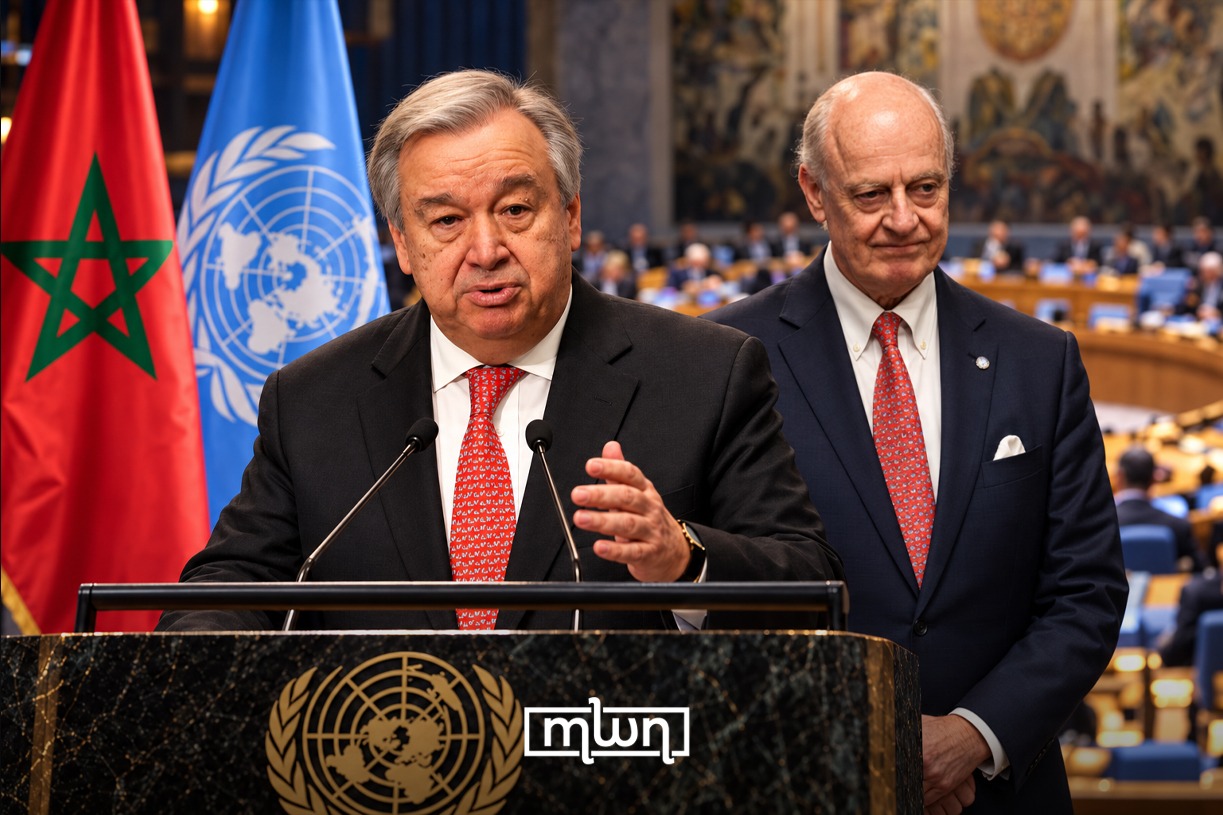
Rabat – The UN Secretary-General, Antonio Guterres, reiterated in his annual report on Western Sahara the importance of the Moroccan Autonomy Plan as the basis for negotiations toward a lasting political solution to the long-standing dispute.
The only feasible solution
A draft report from the UNSG urged all parties to the dispute, including Algeria, Polisario, Mauritania, and Morocco, to engage in “coordinated and good-faith” negotiations to explore the possibility of achieving “genuine autonomy for the people of Western Sahara.”
Guterres said the autonomy initiative could represent the “most feasible outcome,” citing the historic UN Security Council Resolution 2797, which the council adopted last year in October, recognizing the Moroccan proposal as a genuine political solution able to end the dispute over Western Sahara.
The resolution called on all the political parties, including Algeria, to engage in negotiations, with Morocco’s Autonomy Plan serving as the only basis for the talks. In paragraph 61 of the report, Guterres said that “any proposal should be subject to a meaningful consultation process with the people of Western Sahara, allowing them the voluntary freedom to accept or reject it.”
He added that the consultative process is “essential to ensure that the people of Western Sahara are not further deprived of their inalienable right to ‘self-determination.’”
Traditionally, similar paragraphs or recommendations from the UNSG are frequently weaponized and are subject to interpretation from the Polisario Front and its supporter, Algeria’s regime, to push for their claims and outdated narratives, linking self-determination to a “referendum.”
This weaponization of interpretations does not align with the new momentum, especially UN Security Council Resolution 2797, which sees the Autonomy Plan as the most feasible, or only, political solution, with also the backing of the US — the penholder of UN Security Council resolutions and also one of the countries that form a long list of over 130 countries that back the Moroccan Autonomy Plan as the only feasible political solution able to end the dispute.
Morocco has also been consistent and has cleared Polisario’s ambiguity, backed by the Algerian regime, on “self-determination.”
Last year in December, Morocco’s Foreign Affairs Minister Nasser Bourita said the “self-determination” consent rather refers to an expression of will that can take different forms within the framework of Morocco’s Autonomy Plan, unlike what Algeria and Polisario promote.
Bourita stressed that self-determination has never been synonymous with a referendum, an outdated and buried claim Algeria’s regime continues to promote.
Ongoing support for Morocco’s position
Algeria’s regime continues to refuse to shoulder responsibility in the dispute over Western Sahara, despite its direct involvement, as it harbors, finances, supports, and arms the separatist group to challenge Morocco’s territorial integrity and sovereignty over its southern provinces.
Despite the US-facilitated round of talks ending stagnation in the UN process, Algeria’s regime continues to defy UN resolutions, particularly Resolution 2797, which ended the ambiguity Algeria’s regime has long used to define itself as an observer rather than being a main party to the dispute.
The resolution explicitly called on Algeria to participate in talks as a main party and to contribute to finding a mutually acceptable political solution, with the envoy for the UNSG in the Sahara, Staffan de Mistura, also emphasizing the resolution clearly names the parties to the dispute as Algeria, Mauritania, Polisario, and Morocco.
At the UN General Assembly last month, however, Algeria reiterated its unchanged and increasingly irrelevant rejection of the UN-led process.
In his speech, Algeria’s Foreign Affairs Minister Ahmed Attaf reaffirmed Algiers’ “principled support” for Polisario’s outdated claims, including self-determination.
“This is based on our firm conviction that issues of decolonization cannot be resolved ever through imposing a fait accompli or following that logic,” Attaf claimed. “Rather, decolonization ends when people are enabled to exercise their rights guaranteed to them under international law, fully and without any distortion and without any curtailment.”
Guterres’ report, meanwhile, stressed the importance of Resolution 2797, acknowledging that it had revived negotiations and given renewed momentum to the UN-led political process.
The report also recalled the growing number of countries that joined the momentum in support of the Moroccan Autonomy Plan as a credible basis for negotiations, alongside decisions by other countries to suspend or withdraw recognition of the self-proclaimed Sahrawi Arab Democratic Republic, also known as SADR.
Among the countries is Mali, which has aligned itself with Morocco’s position. Guterres also recalled the positions of Honduras and Bolivia, which suspended ties with Polisario.
The report further cited Madagascar, Canada, and Japan, as well as the EU’s support for Morocco’s initiative, with the total number of those who back the Moroccan proposal exceeding 130.
Beyond the countries cited in the report, Peru, Chile, and Panama have recently joined the growing consensus in support of the Moroccan Autonomy Plan. Colombia also withdrew recognition of the self-proclaimed SADR and expressed support for Morocco’s proposal.
Guterres, in his report, said Morocco has provided details of its 2007 Autonomy Plan as requested by the UN, preparing a “Draft Statute for Autonomy.”
The UNSG said the document was shared with both UN envoy Staffan de Mistura and the US, alongside all of the main parties to the regional dispute.