Marrakech – The eighth Marrakech Airshow opened Wednesday at the Royal Moroccan Air Force Base in Marrakech, and by midday on its first day, the event had already assembled an unusually broad line-up of defense and aerospace companies.
Running October 7 to 10, the biennial show gathers nearly 200 exhibitors from 27 countries, with the United Arab Emirates serving as the strategic partner of this edition.
Organizers put turnout at more than 250 high-level civil and military delegations. Exhibition space was announced as sold out before the doors opened. The show is organized by the Association of Space, Aeronautics, and Defense Exhibitions (ASSAD) alongside Morocco’s Ministry of Industry and Trade, the National Defense Administration, the Royal Armed Forces, the Royal Air Force and the Royal Gendarmerie.
Its stated themes this year are industrial sovereignty, resilient supply chains, advanced defense systems, artificial intelligence, and satellite technology.
What distinguishes the 2026 edition is the convergence of industries that rarely share the same floor. American, Chinese, French, Israeli, Turkish, Indian, Korean, and Emirati firms are all present at once.
China appears through CATIC and China Xinxing Xiamen, Turkiye through Baykar, South Korea through Korea Aerospace Industries, and India through Tata Advanced Systems. France fields Thales, Safran, MBDA and Airbus, while Romania brings a national pavilion grouped under OPIA.
The American presence is anchored by Lockheed Martin, a platinum sponsor that has worked with Morocco for more than 50 years, since the first C-130 deliveries in 1974. On October 6, it held an Industry Day with the Industry Ministry to identify Moroccan firms capable of entering its global supply chain.
Its display includes an F-35 cockpit demonstrator, a full-scale Sniper targeting pod, and representations of HIMARS, Javelin, the PAC-3 MSE interceptor, and ER GMLRS. Royal Moroccan Air Force F-16s and a US Air Force C-130J Super Hercules sit on the flight line.
View this post on Instagram
One day before the opening, Lockheed confirmed that the first F-16 Block 72 built for Morocco completed its maiden flight in Greenville, South Carolina, though that aircraft remains in testing in the United States and is not the one displayed in Marrakech. Boeing, RTX, Northrop Grumman, L3Harris, General Atomics, and Textron complete the American roster.
The Israeli line-up is drawing particular attention. Israel Aerospace Industries (IAI) is making its first official appearance at the show, presenting the LORA precision-strike system, the Heron MK II drone, and communications satellites.
Elbit Systems, also participating for the first time, is showing the Hermes 900 drone, the PULS rocket-artillery system and the SkyStriker loitering munition.
Moroccan acquisition of several of these systems has never been officially confirmed, though Israeli reporting ties the PULS – the subject of a $150 million contract with an undisclosed client – to the kingdom. According to SIPRI, Israel has become Morocco’s third-largest arms supplier and now accounts for 11% of its imports. Rafael and firms grouped under SIBAT are also present.
As a strategic partner, the UAE occupies two pavilion spaces backed by its Ministry of Defence and the Tawazun Council, with Secretary-General Nasser Humaid Al Nuaimi heading the delegation. EDGE is presenting surveillance, counter-drone and loitering-munition systems, joined by Generation 5 Holding, Resource Industries and Multi Level Group, whose Advanced Mobility Hub is flying electric vertical-takeoff aircraft.
India’s role expanded on opening day. MKU announced plans to build an electro-optics and armor plant in the SGZID zone in Nouasser, intended as an export base for Africa and Europe, with Vice President Karan Gupta describing the project as a long-term commitment. The company has supplied the Moroccan Armed Forces for five years, though the investment’s size and timeline remain undisclosed. INKAS, a North American manufacturer, is using Marrakech for the first regional presentation of its homeland-security systems.
Civil aviation carries its own headline. Boeing used the show to release an Africa forecast projecting passenger traffic growth of 5.8% a year through 2045 and a continental fleet rising from 755 aircraft in 2025 to 1,625 in 2045.
It values Africa’s aviation-services market at $140 billion over two decades and estimates the continent will need 75,000 new aviation professionals. The projections feed directly into Royal Air Maroc’s plan to reach roughly 200 aircraft by 2037.
View this post on Instagram
Behind the exhibits sits Morocco’s drive to move from buyer to producer. The sector now counts more than 150 companies and around 26,000 skilled jobs, with local integration above 40%.
Aerospace exports reached MAD 29.087 billion ($2.9 billion) in 2025, up about 10% from MAD 26.446 billion ($2.6 billion) a year earlier. Deals from the 2024 edition have advanced since: Trelleborg opened a sealing-systems plant at Midparc in June, representing nearly MAD 130 million ($13 million) and eventually 150 to 200 jobs.
The conference program reflects where the industry is heading. Airbus is presenting on manned-unmanned teaming, Morocco’s Harmattan AI on autonomous swarms under the title “One Human. A Thousand Robots,” and AMDIE director general Ali Seddiki on the case for investing in Morocco.
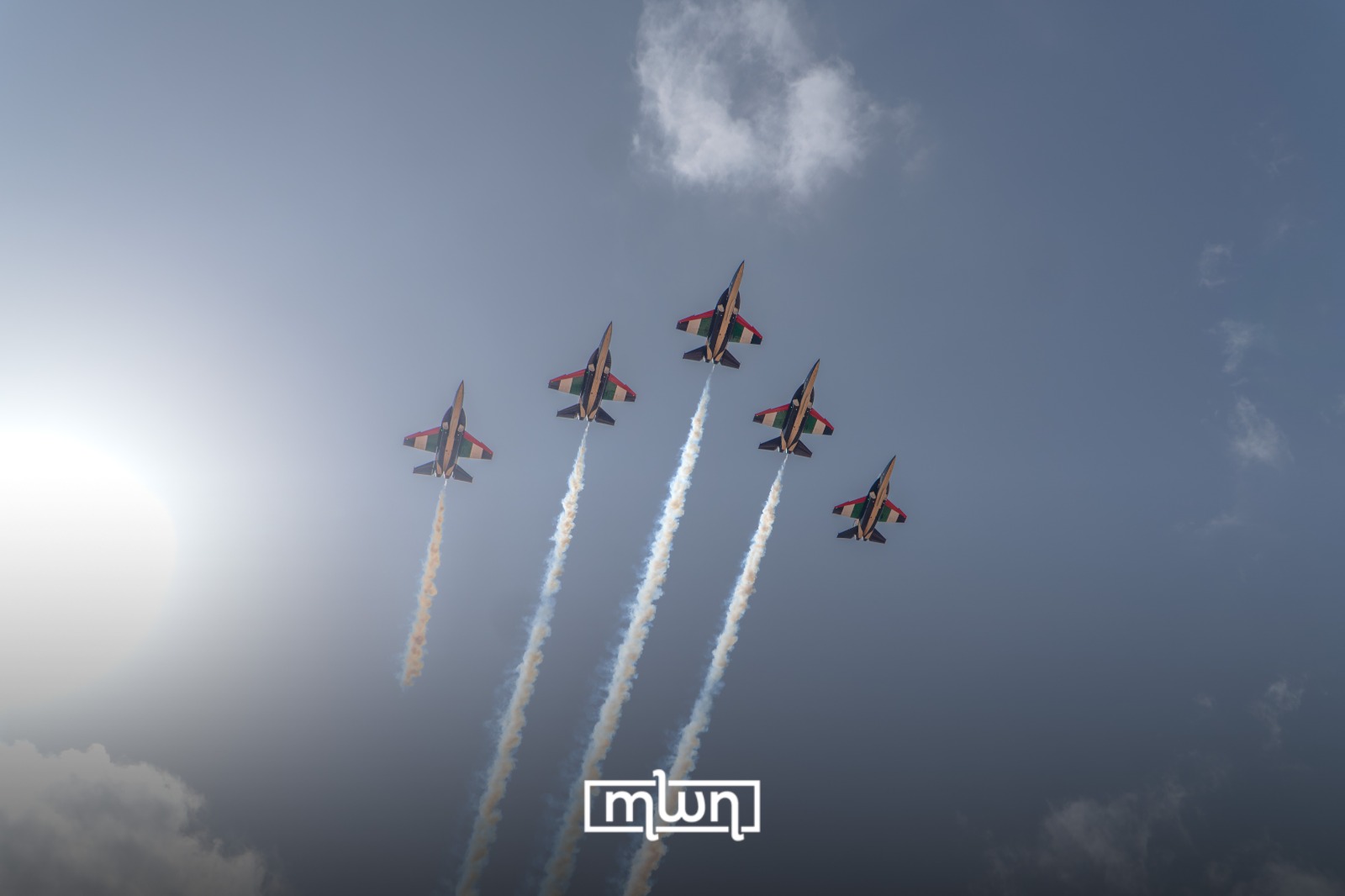
Day 1 followed an opening and signing ceremony, a flying display from 10:30 to 12:15, and a tour of the static exhibition, with a panel on global value chains scheduled for the afternoon. Public visitors are admitted only from 2 p.m. on the opening day.