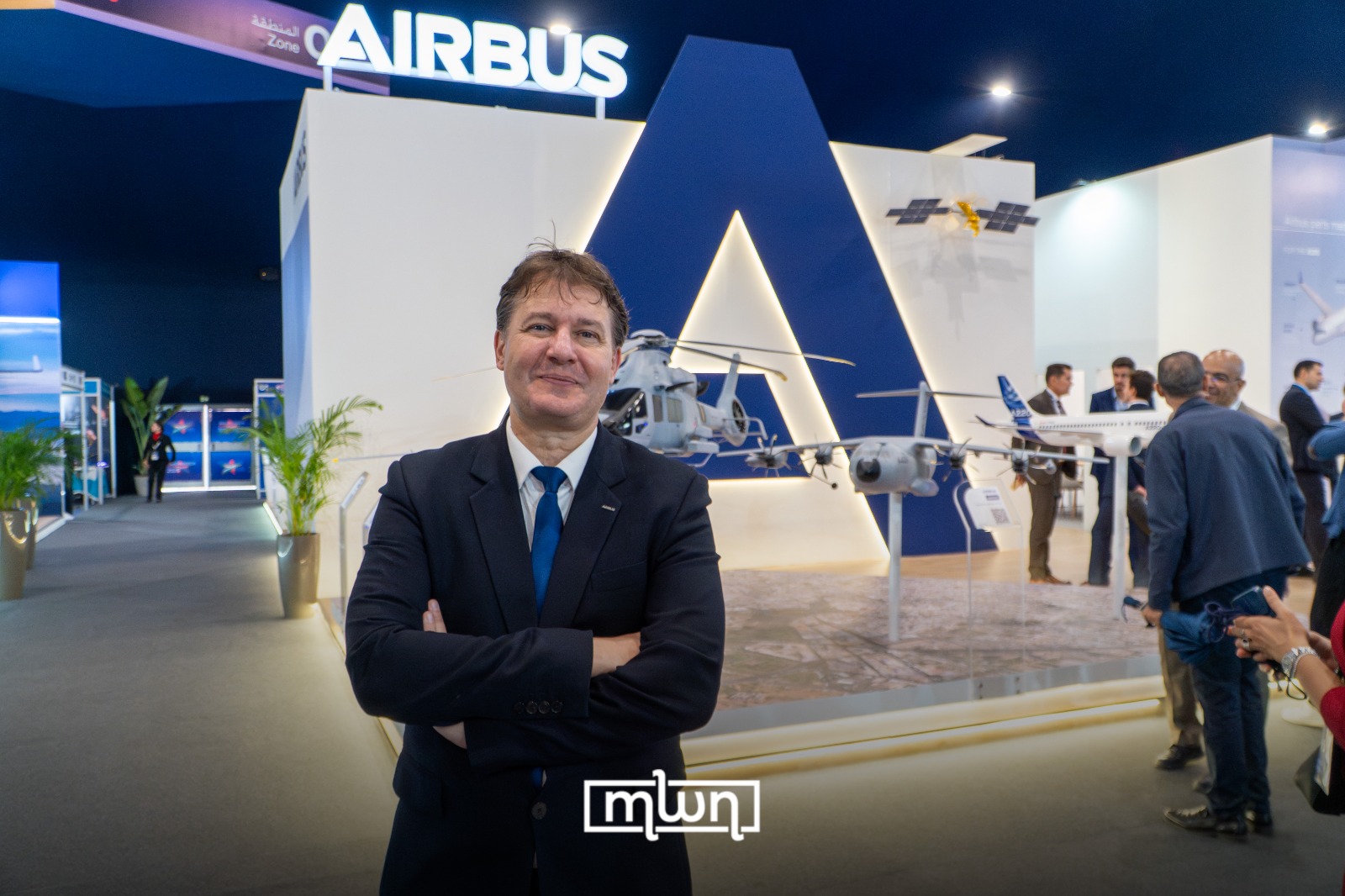
Marrakech – Airbus will open a new subsidiary in Morocco in the coming months, a maintenance, repair, and overhaul (MRO) center for helicopters that is dedicated to the kingdom but built with a wider regional reach in mind.
Mickaël Bertrand, Managing Director of Airbus Helicopters Morocco and the company’s country representative, laid out the plan to Morocco World News (MWN) at the Airbus stand during the Marrakech Air Show 2026.
The center will start with Morocco but is designed to cover all of West Africa, according to Bertrand. He framed the step as part of a longer climb up the value chain. Airbus started “75 years ago with basic parts,” continued with composites, and will now move into maintenance, repair, and overhaul for helicopters, in his account.
Airbus already supports “more than 60 aircraft today, mainly helicopters” in Morocco, Bertrand told MWN. That fleet is operated by the Royal Moroccan Air Force, the Royal Navy, and the Royal Gendarmerie, which places the company inside both the country’s industrial and military organization. Morocco, he added, is “a key player for us” in the supply chain, mainly for civil aviation.
View this post on Instagram
Airbus Helicopters first announced the Moroccan subsidiary in July 2024, presenting it as a base to serve domestic operators and, over time, a regional support center for West Africa. The plan set out three functions: technical and customer support for Morocco’s roughly 60 Airbus helicopters, expanded MRO capacity, and a training center equipped with flight simulators for Moroccan and international pilots.
The maintenance push follows a run of Moroccan helicopter orders. In November 2025, the Royal Moroccan Air Force contracted Airbus for ten H225M helicopters, signed at the Dubai Airshow, to replace Puma aircraft that have flown for more than four decades. The order centers on combat search-and-rescue and pairs the aircraft with services such as maintenance and fleet support.
Airbus confirmed the Moroccan H225M configuration would include dual rescue hoists, a searchlight, a Safran Euroflir 410 electro-optical system, machine-gun capability, and an electronic warfare self-protection suite. The company did not disclose a delivery timetable or a contract value.
Earlier, in July 2022, the Royal Moroccan Air Force agreed at the Farnborough Airshow to order a fleet of H135 light twin-engine helicopters for primary military training, with Moroccan firm Heliconia as a support partner. Airbus did not state how many aircraft were involved.
Bertrand set the helicopter work against a long industrial record. For Airbus, “it’s a long story in Morocco,” one that spans more than 75 years in the ecosystem and started in Casablanca. The company now runs five legal entities in the country – Airbus Atlantic Maroc, Airbus Atlantic Maroc Composites, Airbus Atlantic Maroc Aero, Airbus Defence and Space Maroc, and Airbus Helicopters Maroc – accounting for 1,300 direct jobs and “more or less 10,000 indirect employment,” he told MWN. The best-known activity remains Airbus Atlantic in Casablanca, with defense and space work based in Rabat.
The latest milestone, in his telling, came with Airbus signing the consortium agreement around the African Centre of Manufacturing Excellence (ACME) at the show on October 7. He called it “a splendid opportunity” and presented the agreement as the opening for research, development, and engineering activities in Morocco, with applications for both military and civil programs.
Gabriel Sémelas, Airbus’s president for Africa and the Middle East, signed for the company. The ACME consortium, tied to Mohammed VI Polytechnic University (UM6P), brings together Morocco’s Ministry of Industry and Trade, the National Defense Administration, OCP, Boeing, Lockheed Martin, Safran Nacelles, Airbus, and CETIM Maroc.
Asked whether Airbus could do more for Morocco, up to a final assembly line, Bertrand pointed to the complexity involved. A final assembly line is demanding and “really complex in terms of aircraft,” and “we are not at this stage today,” he told MWN, though the company will keep growing. He cautioned against reducing Airbus to civil aviation alone, pointing to its defense activities and what he called a “systemic approach” built around solutions rather than single products. On that basis, he expects growth across defense, civil, and the value chain.
World Cup and Royal Air Maroc in view
Morocco’s plan to expand its airports ahead of the 2030 World Cup also figures in that thinking. “The World Cup is clearly a target for us,” Bertrand told MWN, linking it to workshops the company wants to run with the government. The offer, as he put it, reaches beyond platforms into urban mobility, security, and safety. Airbus is “really open to drive all the topics with the government,” he added.
On commercial platforms, Bertrand positioned Airbus close to the needs and ambition of Royal Air Maroc (RAM). The carrier plans “to multiply by four all the fleets in 2037,” and Airbus is “ready to share their ambition” and provide its best platforms, he told MWN.
The helicopter plans land alongside a wider industrial message from Airbus at the show. In a separate interview with Morocco’s MAP news agency, Sémelas traced the group’s presence back three-quarters of a century. “It’s been 75 years now that we’ve been present on the Moroccan market,” he told MAP, pointing to three companies producing aerostructures and composites since 1951.
The recently finalized Spirit AeroSystems acquisition, he added, folded work in composites, complex structures, and aircraft electronics into Airbus. “As of today, there are more or less 1,200 employees working directly for Airbus,” he told MAP, within an ecosystem of more than 100 local suppliers that “creates around more than 10,000 qualified jobs.”
Sémelas placed the next phase in technology and research, calling the partnership “an important step” for deepening the relationship and strengthening the supply chain. Airbus intends to keep working with universities and to build partnerships in R&D, innovation, and youth training, with the ACME agreement as a reference point.
The timing matters because Airbus is ramping up the A220, A350, and A330, and “for that, we need suppliers and capabilities like the ones we have here in Morocco,” he told MAP. He described the event as “a very important Airshow for us” and “a meeting point for the industry.”
That Casablanca-based Spirit site, whose acquisition Airbus completed in December 2025, now operates as Airbus Atlantic Maroc Aero and builds components for the A220 and A321. Airbus set compensation for the broader international transaction at MAD 4.39 billion ($439 million), a figure that covers plants in several countries rather than the Moroccan operation alone.
The sector around those plants has been expanding. Moroccan aerospace exports could rise from about MAD 30 billion ($3 billion) a year to MAD 50 billion ($5 billion) within three years, the industry group GIMAS told Reuters on October 8, with roughly 25,000 people employed across some 160 companies.
For now, Airbus has set no firm date beyond the coming months for the helicopter center, and no delivery schedule for the H225M order.