
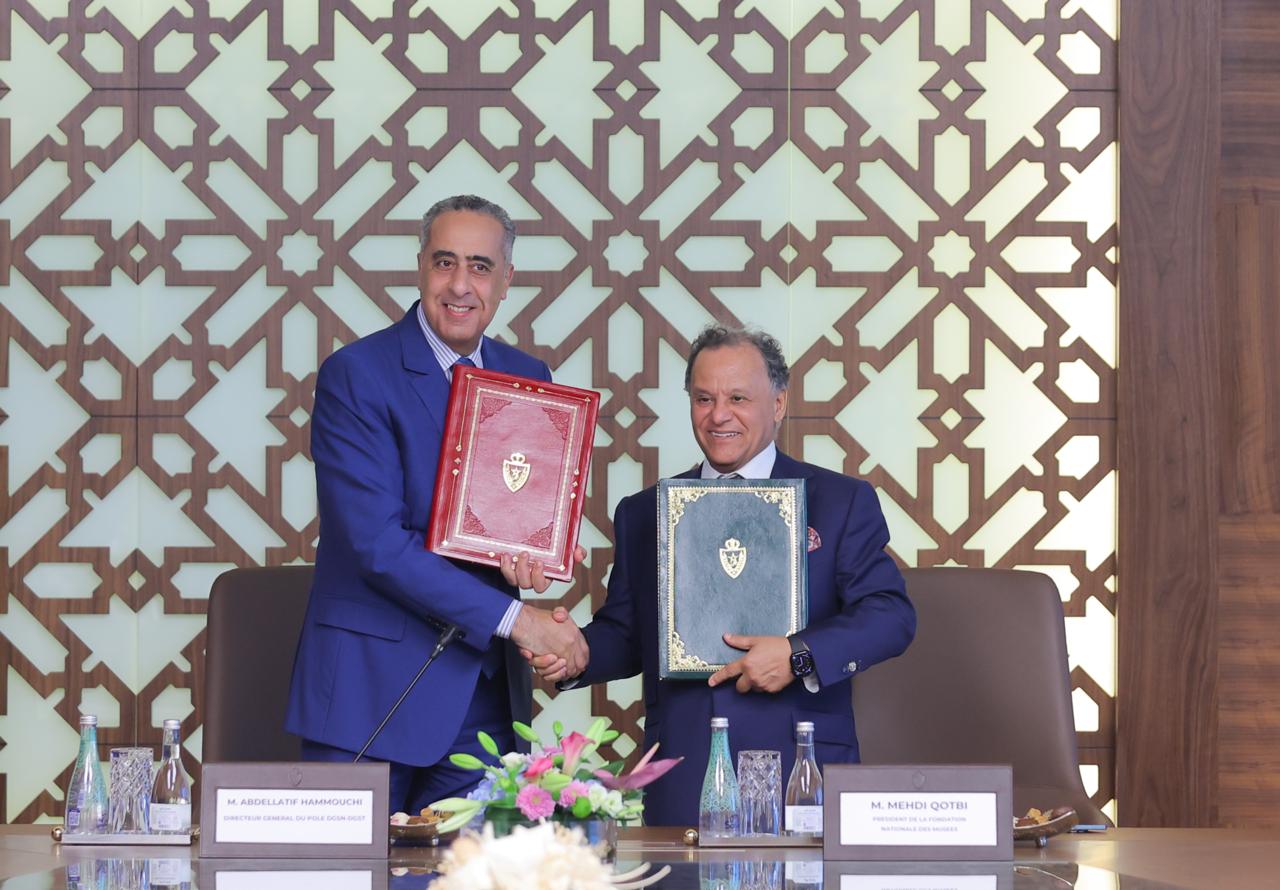
Marrakech – Morocco’s General Directorate for National Security (DGSN) and the National Foundation of Museums (FNM) signed a partnership and cooperation agreement in Rabat on Wednesday to secure the country’s national museums and protect its cultural heritage against theft, forgery, and illicit trafficking.
DGSN Director General Abdellatif Hammouchi and FNM President Mehdi Qotbi signed the accord at DGSN headquarters.
The agreement establishes joint institutional cooperation between the two bodies to monitor, prevent, and combat crimes targeting the national cultural and museum heritage. It gives priority to countering the forgery of archaeological and artistic works and their illicit trafficking.
The text also sets up an organizational and institutional mechanism to guarantee the physical security of national institutions and museums. It provides the security coverage needed to protect the transport of antiquities and archaeological property from potential risks and threats.
On training, the two sides committed to exchanging expertise in handling artistic and archaeological works of historical value, and to tracking the criminal methods used in their forgery, smuggling, and trafficking.
Under the same framework, the FNM will offer technical support to enrich the National Security Museum, a step meant to preserve and document the institution’s memory.
At the signing, Hammouchi and Qotbi affirmed that safeguarding Morocco’s material and historical heritage ranks among their top security priorities. Both framed heritage protection as a shared responsibility that joins security and preventive roles to cultural and museum work.
The agreement builds on earlier Moroccan efforts to shield cultural property from theft and trafficking. Its closest precedent dates to May 18, 2018, when the FNM signed a partnership with the Customs and Indirect Tax Administration (ADII) in Rabat.
That accord established cooperation between museum and customs authorities to combat illicit trafficking in historical and artistic objects and to prevent the illegal export of cultural property.
Morocco widened this cooperation in the years that followed. On January 14, 2021, it signed a bilateral agreement with the United States to curb trafficking in Moroccan archaeological and ethnographic objects, introducing US import restrictions and mechanisms for the return of trafficked artifacts.
The memorandum was signed by then Culture Minister Othmane El Ferdaous and US Ambassador David T. Fischer.
The country also strengthened its legal framework. Morocco deposited its accession to the 1995 UNIDROIT Convention on Stolen or Illegally Exported Cultural Objects on August 3, 2022. The convention entered into force for Morocco on February 1, 2023, strengthening legal mechanisms for recovering stolen cultural objects and securing the return of illegally exported artifacts.
Other partnerships came alongside it. On November 29, 2022, Morocco signed a framework agreement with UNESCO on protecting African heritage, including measures against the illegal trafficking of cultural property.
On July 7, 2025, it signed a memorandum with the World Intellectual Property Organization (WIPO) on the legal protection of Moroccan cultural heritage. The agreement addressed intellectual property rights and the protection of traditional cultural expressions, including efforts to prevent unauthorized appropriation.
The cooperation also drew in heritage foundations. On January 24, 2023, UNESCO signed a five-year agreement with the Foundation for the Safeguarding of the Cultural Heritage of Rabat, chaired by Princess Lalla Hasnaa, covering heritage conservation, professional training, public education, and the protection of cultural and historical sites in Morocco and across Africa.
The new DGSN agreement extends this record into areas the 2018 customs deal did not cover. It makes the physical security of museums an explicit objective, adds security for artifact transport, targets artistic and archaeological forgery directly, and commits police support to the National Security Museum.
The accord comes two days after the inauguration of the Museum of Moroccan Jewish Culture in Fez on Monday. The 1,700-square-meter museum in the city’s Mellah traces more than 2,500 years of Jewish presence in Morocco. Qotbi’s FNM oversaw that project, part of its broader work on the kingdom’s museums and heritage.