
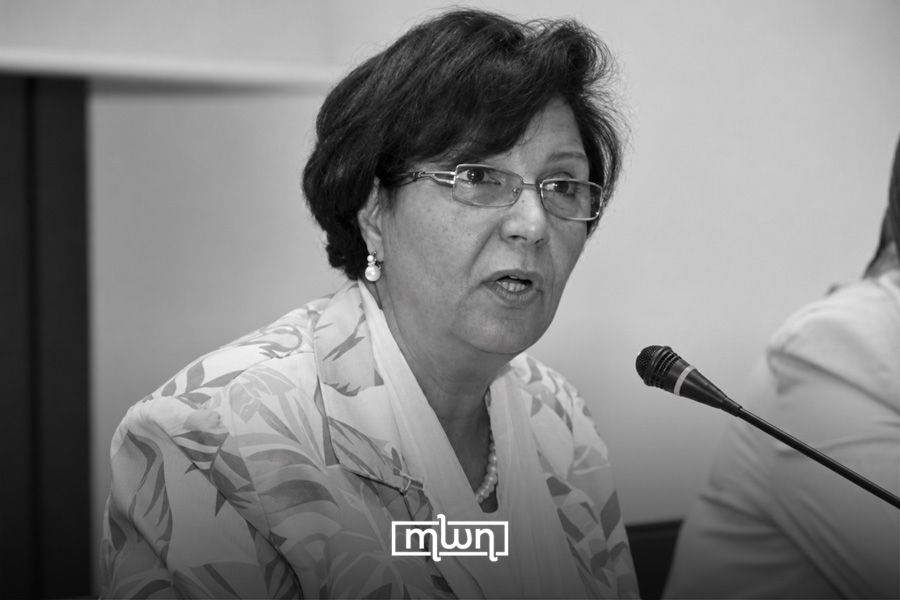
Marrakech – Zhor El Horr, the first woman to serve as a judge in Morocco, died on Friday at nearly 80. She had been ill since the summer and died on Friday morning, closing a career that ran for more than four decades across the courts, legal teaching, and human rights work.
Born in Casablanca in 1947, El Horr began her working life in 1966 as an Arabic language teacher while she studied law. She earned her law degree in 1975 and entered the magistracy in 1979, taking up her post at the Court of First Instance in El Jadida. There she became the first female judge in the country, in a profession where women were then rare.
El Horr moved to Casablanca in 1983 and advanced through a series of judicial posts. She became vice-president of the Court of First Instance of Aïn Chock Hay Hassani in 1989 and a counselor at the Supreme Court in 2000, the body that later became the Court of Cassation.
She presided over the Ben Msik Sidi Othmane court in 2002 and the Al Fida Derb Sultan court in 2003. In 2004, the year the new Family Code took effect, she took charge of the family justice section in Casablanca. She returned to the high court in 2006 as president of a chamber and ended her official judicial career on December 31, 2010.
Her role in reforming the Moudawana made her a national figure. She sat on the royal consultative commission tasked with revising the text, and she joined the committee of experts that drafted the guide to the 2004 Family Code.
She did not overlook its limits. In 2005, she described the family code as no “magic wand” that would solve everything. In later years, she faulted judges for misusing the discretion the law grants them by continuing to permit the marriage of minors, and she called for scrapping articles 20 and 21, which allow it.
After retiring, El Horr joined the Casablanca bar and opened her own practice without leaving human rights work behind. She had sat on the Supreme Council of the Magistracy, and after retirement she joined the National Human Rights Council (CNDH).
From September 2019, she led the National Commission for the Care of Women Victims of Violence. She also presided over the Moroccan Association for Family Support, taught at the Higher Institute of the Magistracy in Rabat, and published a book in 2014, with Hassan Ibrahimi, on the protection of women’s rights in Moroccan jurisprudence.
A wider public knew her from the radio, where she worked as a mediator on “Assolh Khir,” Radio Aswat’s program on family disputes.
Her work drew national and international recognition. She was named a knight of the Ouissam Alaouite in 2000 and raised to the rank of commander in 2003. The King of Bahrain awarded her a second-degree Wissam in 2006, during the second congress of Arab women organized by the Arab Women Organization.
She also received the Amnesty International Morocco prize for human rights defenders. In April 2025, Mohammed V University in Rabat honored her.
In August, former judge Malika Hafid, who had worked alongside El Horr for more than 40 years, described her in an op-ed as a true school of the magistracy, while regretting that many of her former colleagues had stopped checking on her.