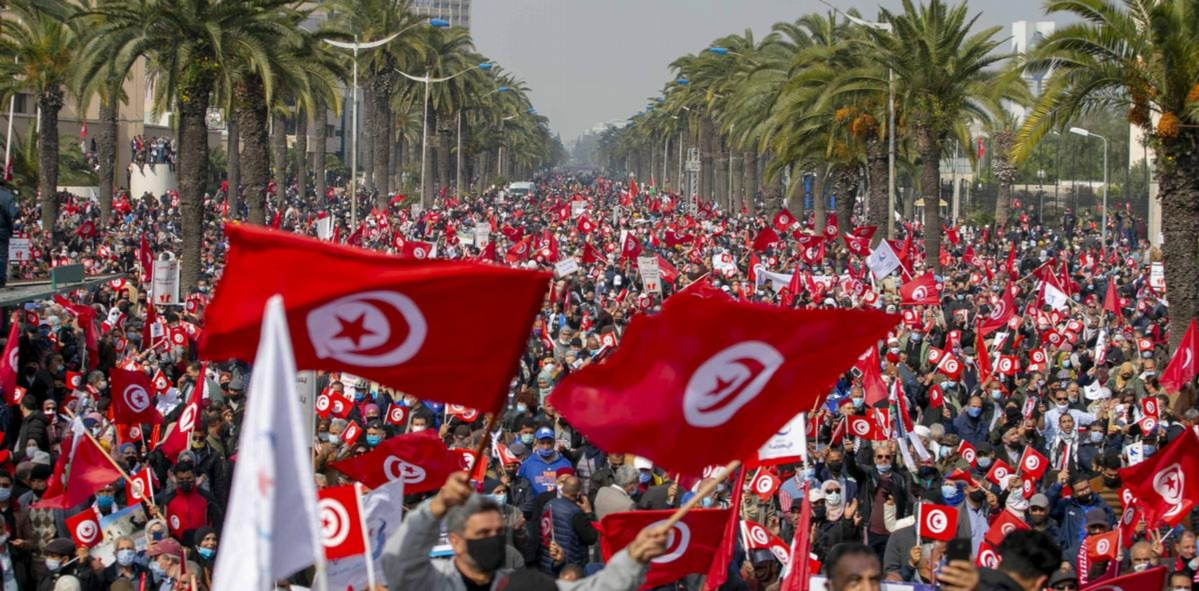
Agadir – Thousands of Tunisians started the largest protest on Saturday against President Kais Saied in years, demanding greater political freedoms, the release of detained critics, and improvements in living conditions.
The demonstration brought together opposition parties, trade unions, journalists, lawyers, doctors, unemployed people, and civil society groups in a rare show of unity against the president.
The Tunisian General Labour Union (UGTT) and civil society organizations led the march along Habib Bourguiba Avenue, a central site of the 2011 protests that led to the removal of longtime President Zine El Abidine Ben Ali. The demonstration reflected growing frustration with the country’s political and economic situation.
Protesters chanted slogans calling for political change and denouncing worsening living conditions. They also demanded the release of government critics and an end to what they described as restrictions on trade union rights.
“Silence will no longer be acceptable … the state cannot be built by concentrating all powers in the hands of one person,” UGTT leader Salah Eddine Salmi told the rally.
Economic hardship fuels public anger
The demonstration comes as Tunisia faces an economic crisis, deteriorating public services, recurring water and electricity cuts, and shortages of medicines and essential goods.
Protesters also voiced frustration over unemployment, poverty, and pollution, reflecting concerns that extend beyond political freedoms. The rally followed other demonstrations over rising prices and shortages, including a protest in Tunis on August 20.
“Enough is enough! The country is collapsing. We suffer from power and water cuts, and one crisis after another,” one of the protesters said.
“I came from Sfax to stand up for my freedom and I’m not about to give up, even if I become the last voice in the country,” the person said.
The rally also pointed to concerns over restrictions on civil society, journalists, and opposition figures.
Rights groups have accused Saied’s government of intensifying pressure on critics, while the president rejects accusations that he is a dictator. He has also accused his opponents of creating crises to provoke public anger.
The protest renewed criticism of Saied’s political decisions since 2021, when he suspended parliament and dismissed the government. He subsequently dissolved parliament, dismissed dozens of judges, and expanded presidential powers through a new constitution in 2022.