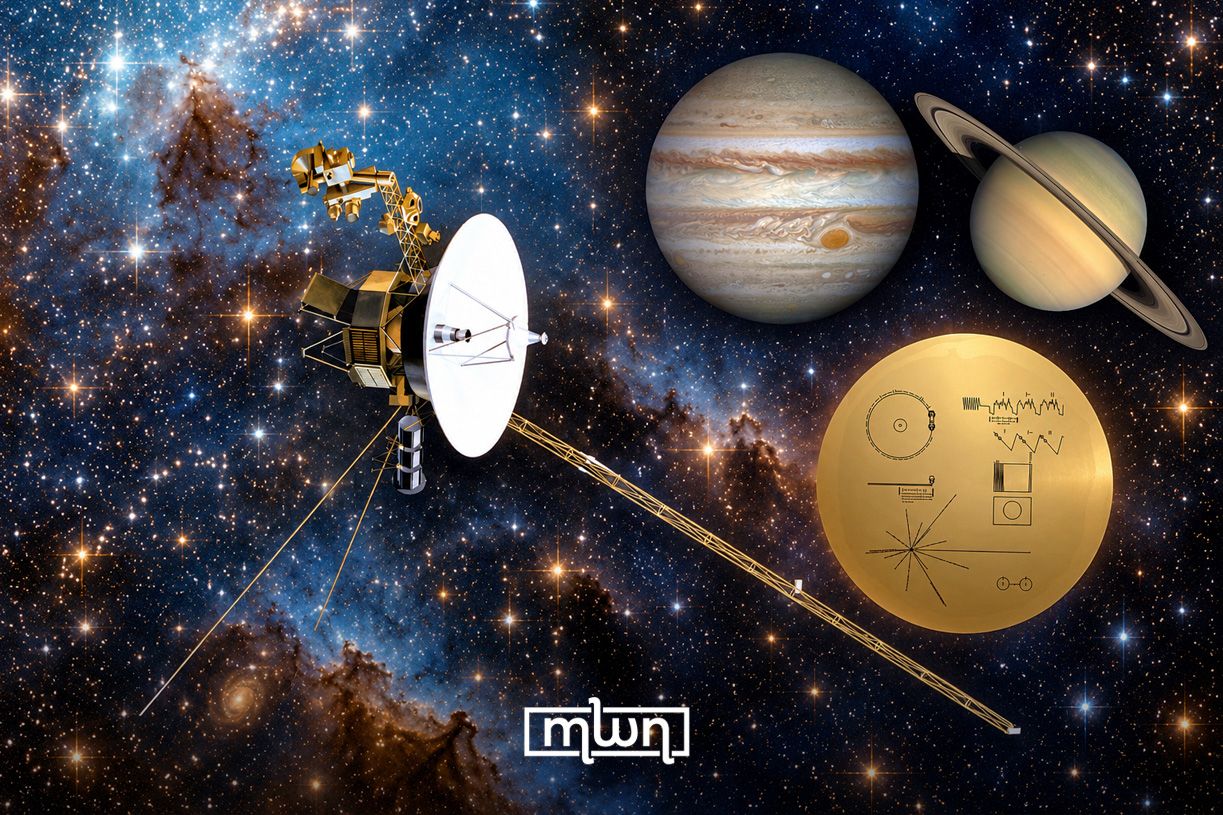
Few technological artifacts have condensed, within a single object, the scientific ambition, engineering prowess, and symbolic reach of a civilization as profoundly as the Voyager 1 probe. Launched on September 5, 1977, from Cape Canaveral, Florida, aboard a Titan-Centaur rocket, this robotic probe of the National Aeronautics and Space Administration (NASA) was initially intended to accomplish a mission lasting only a few years: to fly past Jupiter and Saturn to study their atmospheres, rings, and moons. Nearly half a century later, Voyager 1 continues to transmit scientific data from the outer reaches of the interstellar medium back to Earth, making it the most distant and longest-operating human-made object ever sent into space.
This essay examines Voyager 1 from three complementary perspectives: that of the history of science and technology, which reconstructs the context of its conception and the innovations it made possible; that of astrophysics and heliophysics, which accounts for the empirical discoveries accumulated throughout its journey, from Jupiter to the heliopause; and, finally, that of the philosophy of science and cultural anthropology, which interrogates the symbolic dimension of the Golden Record and the civilizational significance of inscribing, within the very material substance of the probe, a message intended for eternity. The central argument is that Voyager 1 constitutes a paradigmatic case of what may be called “scientific genius”: not the flash of genius of an isolated individual, but the collective capacity of a scientific and technical community to design an artifact whose useful operational lifetime exceeds by several orders of magnitude the temporal horizons normally associated with human action, and whose symbolic significance extends far beyond its original instrumental purpose.
Along the way, it becomes possible to demonstrate that the extraordinary success of this mission was not the result of an isolated stroke of luck, but of a conjunction of structural factors characteristic of the postwar American system of big science: long-term federal funding, organization through federal laboratories such as the Jet Propulsion Laboratory, an engineering culture based on redundancy and safety margins, and an institutional capacity to transmit, across several generations of personnel, the expertise required to operate a technical object that eventually became irreplaceable. This perspective also invites us to reconsider the very notion of scientific success: Voyager 1 did not merely fulfill the objectives assigned to it in 1977; it surpassed them to such an extent that its original designers could not have anticipated either the scale of the discoveries made after its Saturn encounter or the place the probe would occupy, nearly fifty years later, in the collective imagination of a humanity that now knows it to be irretrievably beyond reach.
The Genesis of a program: From planetary alignment to the ‘Grand Tour’
The Voyager project originated in a rare orbital configuration identified by Jet Propulsion Laboratory (JPL) astrodynamicists around the turn of the 1960s and 1970s: an alignment of the giant planets, Jupiter, Saturn, Uranus, and Neptune, that occurs only once every 176 years and makes it possible, through gravitational assistance, to visit several planets successively with a single spacecraft while requiring minimal energy expenditure. Initially conceived as the “Grand Tour,” an ambitious program aimed at visiting all four gas giants, the project was scaled back for budgetary reasons in the early 1970s, giving rise to the Voyager program proper, more modest in financial terms but no less audacious in conception. Two twin probes, Voyager 1 and Voyager 2, were constructed in parallel. Contrary to what their numbering might suggest, Voyager 2 was launched first, on August 20, 1977, while Voyager 1 followed sixteen days later, on September 5, on a faster trajectory that enabled it to overtake its twin and reach Jupiter and subsequently interstellar space before Voyager 2.
This institutional genealogy deserves emphasis because it illustrates a characteristic feature of postwar American big science: the capacity to transform a fleeting astronomical window of opportunity into a long-term engineering program sustained by a public administration, the NASA, capable of mobilizing substantial human, financial, and institutional resources over several decades. The Voyager program thus formed part of NASA’s post-Apollo pivot toward unmanned robotic exploration of the solar system, at a time when the political prestige of the American space program, following the lunar missions, needed new scientific and symbolic outlets.
This decision must also be situated within its geopolitical context. The mid-1970s corresponded to a period of relative détente between the United States and the Soviet Union, marked by the joint Apollo-Soyuz mission of 1975, but also to a period in which NASA’s budget, considerably smaller than it had been during the previous decade, forced JPL engineers to make difficult choices between scientific ambition and financial feasibility. The decision to abandon the full Grand Tour in favor of a program limited to Jupiter and Saturn, while leaving Voyager 2 the possibility of extending the mission toward Uranus and Neptune if its technical condition allowed, illustrates a rational combination of budgetary prudence and maximum scientific ambition within existing constraints. This approach, sometimes characterized by historians of technology as “low-cost, high-yield science,” subsequently became a reference model for numerous later unmanned planetary exploration missions.
An Engineering feat: Designing for eternity
The design of Voyager 1 posed, from the outset, a singular engineering problem: how could one construct a technical object intended to operate autonomously, far beyond any possibility of repair, for a period vastly longer than that of most industrial equipment? The solution developed by JPL engineers rested on several technical choices whose robustness has proved remarkable in retrospect. The probe’s electrical power is supplied by radioisotope thermoelectric generators (RTGs), which convert the heat produced by the radioactive decay of plutonium-238 into electricity. This choice, rather than solar panels, which would become ineffective beyond the orbit of Mars because of insufficient sunlight, enabled Voyager 1 to operate at distances where no solar power source would have remained viable. The trade-off is the gradual and inexorable decline in available power, which has led NASA engineers to switch off scientific instruments one after another in a carefully managed sequence, preserving those considered most important for the study of the interstellar medium. In April 2025, nearly fifty years after launch, another instrument was shut down according to this end-of-life management strategy, leaving the probe with only two operational scientific instruments. The probe’s overall design also rests upon a cardinal principle of aerospace engineering of the period: systematic redundancy of critical subsystems. Each of Voyager 1’s three onboard computers- the computer responsible for navigation and attitude control, the one managing scientific data, and the one controlling the instruments- has a duplicated architecture, allowing partial failures to be compensated for by backup components activated remotely from the JPL control center in Pasadena. This design philosophy, which substantially increased the initial manufacturing cost, proved decisive for the probe’s operational longevity: several anomalies occurring over the decades, including a scientific-data coding problem detected in 2022, could be corrected remotely by engineering teams using software workarounds devised decades after the original system had been designed. Such remote maintenance, carried out on an object located more than twenty light-hours from Earth and beyond any possibility of physical intervention, constitutes in itself a remarkable feat of software engineering that is poorly documented in popular accounts of the mission but extensively discussed in JPL’s internal technical reports.
The second technical challenge concerns telecommunications. At distances of several tens of billions of kilometers, the radio signal emitted by the probe’s 3.7-meter high-gain antenna now takes more than twenty-two hours to reach Earth, while its power, weakened according to the inverse-square law of distance, has declined to a level requiring the largest antennas of NASA’s Deep Space Network (DSN), the network of parabolic antennas operated by NASA in California, Spain, and Australia to maintain continuous communication with distant spacecraft. The third challenge concerns the programmed obsolescence of onboard computing technology: Voyager 1’s three computers, equipped with memory and processing power negligible by contemporary standards, continue, nearly fifty years after their commissioning, to execute code written in an assembly language that only a small number of engineers, now in their eighties or approaching retirement, still master fully, a situation that led NASA during the 2020s to recruit and train a new generation of engineers capable of ensuring the mission’s operational continuity.
The Grand tour of the gas giants: Jupiter and Saturn
Voyager 1’s primary mission, between 1979 and 1980, consisted of close reconnaissance of the Jovian and Saturnian systems (NASA/JPL, n.d.-c). Its flyby of Jupiter in March 1979 enabled the probe to return images of the Great Red Spot at a resolution unprecedented at the time, revealing the giant anticyclonic storm whose internal turbulence has fascinated atmospheric physicists since the seventeenth century. Yet the most consequential scientific discovery of the flyby was made by navigation engineer Linda Morabito, who detected a volcanic plume rising above the limb of Jupiter’s moon Io. Io thus became the first celestial body beyond Earth on which active volcanism was directly observed, overturning the dominant models of geological activity on icy moons. Voyager 1 also discovered several previously unknown Jovian satellites and substantially refined the mapping of Jupiter’s ring system.
The Saturn flyby in November 1980 produced an equally rich harvest of data: a detailed characterization of the complex structure of Saturn’s rings, revealing thousands of individual “ringlets” whose orbital dynamics, governed by gravitational resonances with neighboring moons, remain an active field of study in celestial mechanics; and a close investigation of Titan, Saturn’s largest moon, whose dense nitrogen-and-methane atmosphere provided the first empirical basis for considering the possibility of prebiotic chemistry occurring at extremely low temperatures. It was precisely to enable this privileged encounter with Titan that mission planners selected a trajectory that permanently removed Voyager 1 from the plane of the ecliptic, thereby sacrificing any possibility of subsequently visiting Uranus and Neptune, a scientific trade-off from which Voyager 2, which remained within the ecliptic plane, was instead able to benefit by extending the Grand Tour toward the outermost regions of the solar system.
The threshold of the heliopause: A long-term discovery
The most scientifically significant episode in Voyager 1’s career is arguably its crossing of the heliopause, the tenuous boundary separating the solar plasma bubble, the heliosphere, from the interstellar medium proper. This crossing, long debated among heliophysicists because of the ambiguity of the available data, exemplifies the manner in which science progresses through the accumulation of converging evidence rather than through a single, instantaneous observation. In December 2004, the probe crossed the termination shock and entered the heliosheath, a transitional region characterized by a dramatic deceleration of the solar wind . Then, beginning in mid-2012, several indicators changed abruptly: a sudden decline in the intensity of charged particles originating from the Sun, combined with a spectacular increase in the flux of galactic cosmic rays, led several research teams to conclude that the probe had left the Sun’s direct sphere of influence. Definitive confirmation, however, came a year later through an unexpected instrumental channel. Voyager 1’s plasma-wave instrument, originally developed at the University of Iowa under the direction of Donald Gurnett, detected on April 9, 2013, local electron oscillations at a frequency of approximately 2.6 kilohertz, a signature whose conversion into electron density yielded a value close to 0.08 particles per cubic centimeter, substantially higher than expected in the outer heliosphere and, by contrast, consistent with theoretical models of the interstellar medium . Gurnett’s team was therefore able, by extrapolating between this event and a similar episode that had occurred in the autumn of 2012, to establish that the actual crossing of the heliopause had probably taken place on August 25, 2012, nearly a year before the scientific community obtained formal confirmation. A complementary study conducted by Leonard Burlaga and his colleagues using magnetometer data corroborated this dating by identifying a 40 percent increase in the intensity of the local magnetic field, consistent with the passage of a shock wave associated with an earlier solar eruption that had eventually caught up with the probe in interstellar space.
This episode has methodological significance extending beyond the specific case of Voyager 1. It demonstrates how a scientific instrument designed during the 1970s for observational purposes having little to do with the measurement of interstellar plasma density can, decades later, become decisive in resolving a major scientific controversy, provided that the spacecraft carrying it remains operational long enough for the opportunity to arise. As Kurth, co-author of the 2013 study, observed, interstellar space, far from being the homogeneous vacuum sometimes imagined, appears to be a dynamic and structured region whose in situ exploration has only begun. Having crossed the heliopause at a distance of approximately 122 astronomical units from the Sun, roughly eighteen billion kilometers, Voyager 1 remains the only source of in situ data from this region, alongside its twin probe, which reached the interstellar medium in November 2018.
The Golden Record: Science in the service of a civilizational message
Beyond its scientific instrumentation, Voyager 1 carries an artifact with no direct scientific function but with considerable symbolic significance: the Voyager Golden Record, a thirty-centimeter-diameter gold-plated copper phonograph record designed to resist cosmic erosion over geological timescales. Entrusted by NASA to a committee chaired by astronomer Carl Sagan, with the participation of Frank Drake, Ann Druyan, Timothy Ferris, Jon Lomberg, and Linda Salzman, the record contains 115 encoded images, approximately ninety minutes of music representing the diversity of human cultures, natural sounds from Earth, wind, thunder, bird songs, whale vocalizations, as well as greetings spoken in fifty-five human languages . The committee had less than six weeks to assemble what Sagan himself famously described as a “message in a bottle” launched into the cosmic ocean.
The analysis of this artifact belongs less to the history of science than to symbolic anthropology: the Golden Record is not addressed to any specific recipient but projects, into a future that might exceed the very existence of the human species, a deliberately selected and idealized image of terrestrial civilization. In the collective volume Murmurs of Earth, which documents the project’s genesis, Sagan emphasized that the probability of an extraterrestrial civilization actually intercepting the spacecraft and deciphering its message was infinitesimal, whereas the certainty that the message would eventually be received by the inhabitants of Earth themselves, through publication of the book, was absolute. This seemingly paradoxical observation reveals the true function of the Golden Record: not so much a device for interstellar communication in the technical sense as the realization of a reflexive project through which a civilization presents itself with a unified and pacified representation of its own diversity, at the height of a Cold War that structured the geopolitical field of the period. In this sense, the Golden Record constitutes, even more than the probe’s scientific instruments, a document of major historical importance concerning the way in which the scientific elites of 1970s America conceived the universality of the human condition and the aspiration to transcend it through knowledge.
The Golden Record and the search for extraterrestrial intelligence
The Golden Record cannot be fully understood without relating it to the broader scientific program devoted to the search for extraterrestrial intelligence (SETI), several of whose architects, beginning with Frank Drake, were also pioneers in the creation of the record. It was Drake who, in 1961, formulated the famous equation bearing his name, designed to estimate the number of technologically communicative civilizations potentially existing in our galaxy, and who, in 1974, conceived the Arecibo message, a binary transmission sent toward the globular cluster M13 from the radio telescope in Puerto Rico. The Golden Record directly inherited this intellectual tradition while distinguishing itself through its physical medium: whereas the Arecibo message was an ephemeral radio transmission encoded in an abstract binary form, the Voyager record is a durable physical object carrying a multisensory message, sounds, images, and music, whose deciphering would require a hypothetical recipient to reconstruct a phonographic playback device from the instructions engraved on the record’s protective cover.
This difference in medium is not epistemologically insignificant: it reflects a shift, within the SETI community of the 1970s itself, from a strictly mathematical and logical conception of interstellar communication, the approach prevailing among pioneers such as Giuseppe Cocconi and Philip Morrison, to a more anthropological conception in which the message no longer seeks merely to demonstrate the existence of intelligence but to convey the sensory and cultural texture of human experience. Sagan, whose popular scientific work consistently sought to reconcile the rigor of scientific method with the demand for universal intelligibility, thus appears as a synthesis between these two traditions: the technical tradition of radio astronomy and signal detection, and the humanistic tradition of translating human experience into a language presumed accessible to every form of intelligence, human or otherwise.
Voyager 1 as an epistemological paradigm
The study of Voyager 1 invites a reconsideration of several conventional categories within the philosophy of science. The probe first illustrates what might be termed a scientific temporality of very long duration, radically different from the funding and evaluation cycles that ordinarily structure contemporary research. Designed for a mission lasting only a few years, it became, through the force of technical circumstances and the management decisions of its operators, a continuous observational instrument spanning nearly half a century, a period during which several generations of engineers, program directors, and even NASA administrators succeeded one another without interrupting the project’s scientific continuity. This institutional persistence deserves to be analyzed as a specific form of organizational rationality: the capacity of a scientific bureaucracy to preserve, over decades, the technical expertise necessary to operate an instrument that has in many respects become obsolete in its design but irreplaceable in its position.
Voyager 1 also illustrates a mode of scientific knowledge production based on instrumental serendipity: the plasma-wave instrument, originally designed to study radio emissions from Jupiter and Saturn, became decades later the only means of establishing with confidence that the probe had crossed the heliopause, an application its original designers had never anticipated. This characteristic calls for a qualification of strictly teleological conceptions of scientific instrumentation, according to which each measuring device is designed to test a hypothesis formulated in advance. The history of Voyager 1 demonstrates instead that the latent versatility of a well-designed instrument can, under unforeseen circumstances, become the very condition of possibility for a major discovery.
A third epistemological lesson concerns the profoundly incremental and collective nature of scientific discovery, as illustrated by the controversy surrounding the precise date on which the heliopause was crossed. Far from the image of an instantaneous and unequivocal discovery often conveyed by popular science, establishing that Voyager 1 had indeed left the heliosphere required the convergence of several independent research teams employing different instruments, energetic particles, magnetic fields, and plasma waves, and publishing over more than a year a series of papers which, taken individually, each left some degree of uncertainty, but whose convergence eventually convinced the scientific community. This method of validation through instrumental triangulation, characteristic of observational sciences in which controlled experimentation is impossible, deserves recognition as a methodological model in its own right, distinct from the classical hypothetico-deductive model derived from laboratory-based experimental sciences.
Finally, the mission invites reflection upon the boundary between science and culture. The Golden Record, as a reflexive gesture of civilizational self-representation carried by a scientific infrastructure, demonstrates the extent to which the American space enterprise during the final third of the twentieth century succeeded in articulating, within a single artifact, the ambition of objective knowledge of the cosmos and the more properly hermeneutic ambition of constructing collective meaning in the face of the immensity of the universe. This articulation, far from being incidental, helps explain the singular place occupied by Voyager 1 in the contemporary imagination, well beyond the restricted circle of specialists in plasma physics or celestial mechanics.
At the conclusion of this journey, it is necessary to return to the question posed at the beginning: in what sense can Voyager 1 be described as an expression of “American scientific genius”? The analysis developed here suggests rejecting any heroic and individualizing interpretation of this notion in favor of an institutional and processual one. The success of Voyager 1 did not result from the isolated inspiration of a single scientist but from the long-term convergence of several structural conditions: an astronomical window of opportunity correctly identified and exploited; an engineering culture based on redundancy and safety margins that allowed the technical object to survive far beyond its nominal operational lifetime; a data-reception and processing infrastructure, the Deep Space Network, that was itself maintained and modernized over several decades; and an organizational capacity to transmit from one generation of engineers to the next the expertise required to operate a system that simultaneously became technologically obsolete and scientifically irreplaceable.
At the end of this analysis, Voyager 1 emerges as an exemplary case of what American scientific genius in the second half of the twentieth century was capable of producing at its most accomplished: a technical artifact designed with sufficient robustness to survive across decades, carrying an instrumental payload that enabled major discoveries ranging from the active volcanoes of Io to the density of interstellar plasma, while simultaneously carrying a cultural message that projects a selected image of humanity into cosmic eternity. According to NASA engineers’ estimates, the probe will continue transmitting scientific data into the mid-2020s, after which the gradual depletion of its radioisotope generators will eventually silence its remaining instruments. It will nevertheless continue along its trajectory through the interstellar medium long after its transmitters have fallen silent, drifting for periods that exceed the timescale of every known human civilization, before passing, in approximately forty thousand years, through the vicinity of another star. In this sense, Voyager 1 embodies not so much the conquest of space as humanity’s uniquely human capacity to project itself, through the mediation of science and technology, into a temporal dimension infinitely larger than that of its own creators, propelling, in the striking phrase that inspired this essay, humanity into sidereal space for eternity.