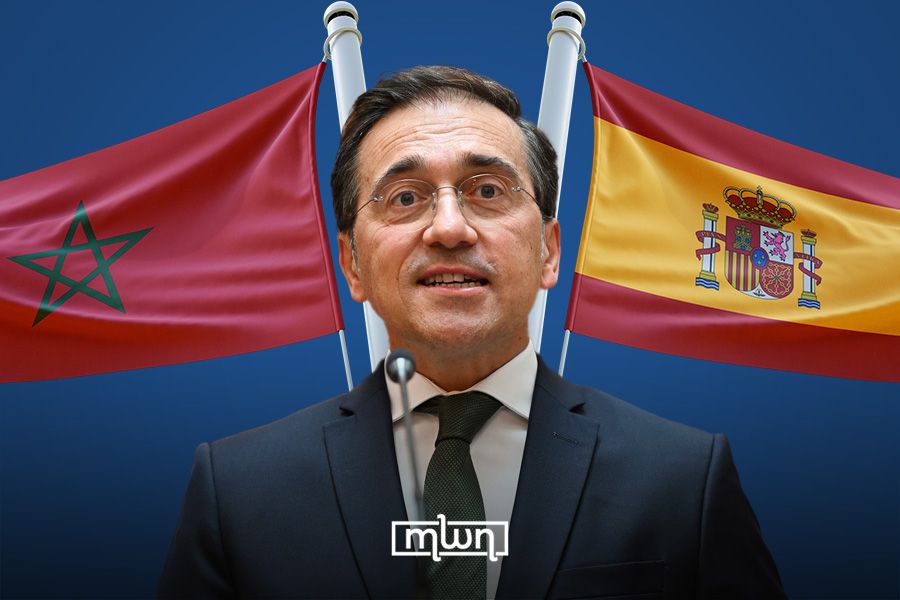
Rabat – Spanish Foreign Minister José Manuel Albares stated that the Spanish and Moroccan navies are in dialogue to avoid “misunderstandings” that could lead to an “undesired situation.”
Albares made his remarks in an interview with Telecinco, raising questions over what he meant by “undesired situation” and whether it was intended as a “warning” or as diplomatic language to ease tensions.
The remarks come amid heightened tensions marked by controversial visits by Spanish politicians, as well as King Felipe VI, who recently visited the occupied cities of Ceuta and Melilla to reaffirm Spain’s claims over the two enclaves.
Throughout the visit, Spanish media and politicians were also incensed by Moroccan media’s use of the terms “occupied” and “colonized territories,” which the Spanish government frames in terms of what it describes as its “territorial integrity.”
Albares’s remarks specifically referred to the alleged Moroccan naval presence in waters Spain claims as its own in July, which coincided with one of the largest irregular migration crises. The month marked the arrival of over 70,000 irregular migrants in the occupied city, sparking frustration among Spaniards, including the far right and the PP, which weaponized the situation to push their anti-Moroccan rhetoric and use it as an influence in the run-up to the next elections.
Spanish Prime Minister Pedro Sánchez, amid the challenges, dissolved the government and called for elections in November, with the far right gearing up to place the migration crisis at the heart of its electoral program.
The far right and the PP have also urged the Spanish government to deploy the military in the waters and called for Morocco’s ambassador to be summoned and Spain’s ambassador in Rabat to be called back for consultations.
A claim, not a fact
In a recently published opinion piece, Moroccan author and analyst Samir Bennis challenged the Spanish narrative surrounding the alleged presence of Moroccan warships near occupied Ceuta, questioning claims that the vessels violated Spanish sovereignty.
The analyst argued that Spain is presenting its claim over the surrounding waters as an established legal fact, even though the maritime boundary between Morocco and Spain has not been formally delimited.
Bennis argued that Spain’s claim to a 12-nautical-mile territorial sea around Ceuta cannot simply be assumed to extend in every direction, given the enclave’s proximity to Morocco’s coast and the absence of a bilateral maritime delimitation agreement.
He also invoked Article 15 of the UN Convention on the Law of the Sea (UNCLOS), which addresses the delimitation of territorial seas between states with opposite or adjacent coasts.
This means Spain cannot establish a definitive maritime boundary merely by asserting its sovereignty over the waters, Bennis argued, emphasizing that Morocco does not recognize Spanish sovereignty over the enclave, which Rabat considers a remnant of colonization.
The naval allegations continue to make the rounds online, with surveys continuing to shape Spaniards’ narratives and how they view Morocco as a threat.
A recent poll by Politico said 58% of respondents in Spain believe tensions over occupied Ceuta and Melilla could trigger a war between Morocco and Spain.
Independent pollster PF Global conducted the poll between September 13 and 15, surveying 2,066 people in Spain.
Some 89.77% of respondents also said they would vote for Vox in the next elections, while 85.3% said they would vote for the PP in the next election.