
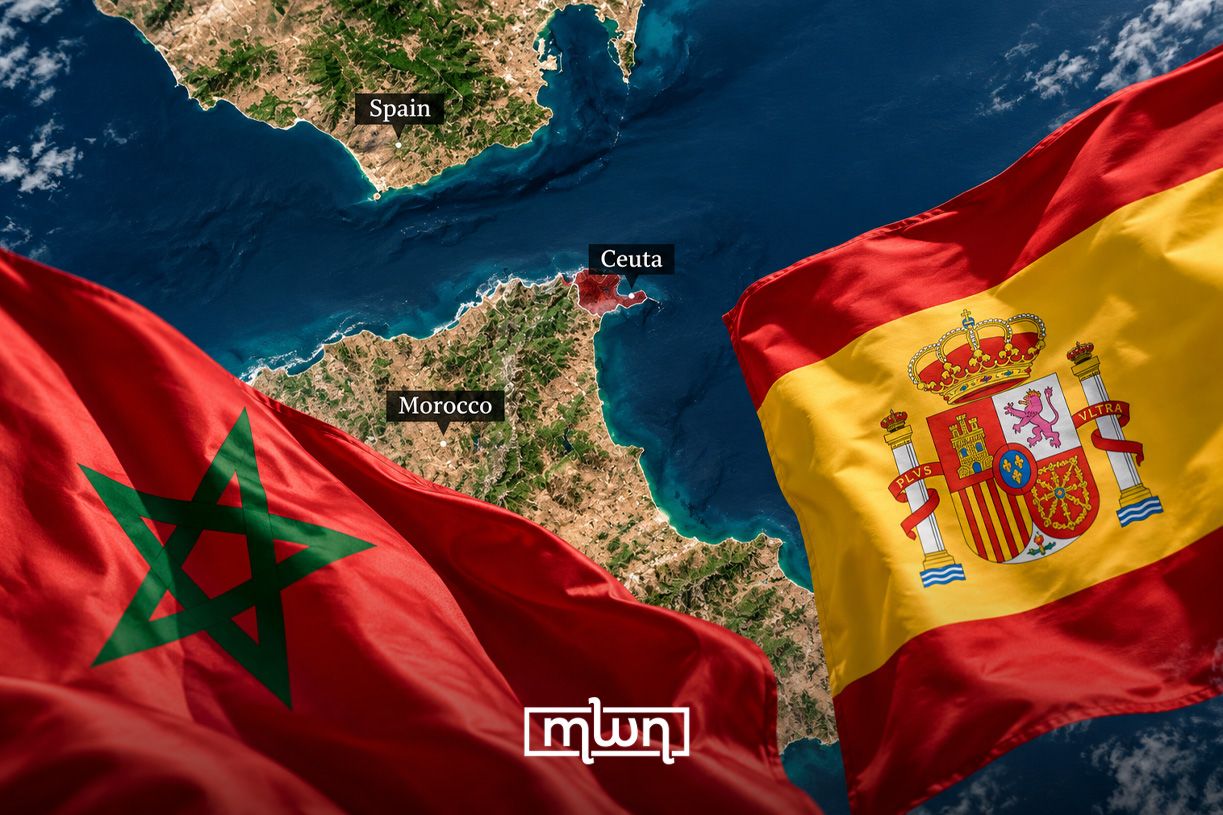
Since El País reported on October 12 that Moroccan warships had reportedly entered the waters off Ceuta during the late-July migration crisis, Spanish commentators, analysts and politicians have been quick to once again describe the episode as a violation of Spanish sovereignty, and in some cases as an outright “invasion.” Few of these accounts, however, have taken time to dutifully explore the legal and diplomatic complexities the episode raises.
The usual assumptions behind the ‘invasion’ narrative
Most of these sweeping interpretations rest on four assumptions. The first is that Ceuta has a 12-nautical-mile territorial sea (roughly 22 kilometers) in the Mediterranean. The second is that international law fully recognizes that territorial sea. The third is that Morocco, an independent state that regards the enclave as a remnant of Spanish colonialism, has no valid basis for asserting maritime claims of its own in the area. The fourth, and perhaps the most consequential, is that Morocco has therefore violated Spanish sovereignty.
Of course, not a single one of these assumptions is supported by strong, robust evidence. What these analyses have yet to show is that their reading of events rests on a rigorous assessment of international law and the rules governing such cases. Most approach the issue almost entirely from Spain’s perspective, giving little weight to Morocco’s position or to the legal consequences of an unresolved sovereignty dispute. Even Prime Minister Pedro Sánchez, while confirming that the vessels had entered waters Spain regards as its own, described the incidents as isolated and stressed the importance of relations with Rabat. That is a far cry from the alarm that has dominated much of the commentary, and no wonder why the far-right politicians and their sympathizers or diehard enablers in the media and intellectual class have been calling Sanchez all sorts of names.
A lopsided vision of maritime boundaries
Most critically perhaps, these analyses have decisively failed to reckon with a basic legal reality: until Morocco and Spain agree on the delimitation of their respective territorial seas, the reach of any Spanish territorial sea around Ceuta cannot simply be assumed to extend 12 nautical miles in every direction.
Under Article 15 of the United Nations Convention on the Law of the Sea (UNCLOS), where two states have opposite or adjacent coasts and have reached no agreement, neither is generally entitled to extend its territorial sea beyond the median line. That is, unless a historic title or other special circumstances justify a different delimitation. As such, even if Morocco recognized Spanish sovereignty over Ceuta, the enclave’s territorial sea would still be constrained by the proximity of the Moroccan coast. Morocco’s own legislation reflects the same principle. Namely, the kingdom’s 1973 law on territorial waters provides that, absent a specific agreement, Moroccan territorial waters shall not extend beyond the median line.
But Morocco does not recognize Spanish sovereignty over Ceuta. From Rabat’s perspective, the enclave cannot generate a Spanish territorial sea that is opposable to Moroccan claims. Madrid may reject that position, but no serious legal assessment can simply ignore it.
Indeed, Spain has acknowledged that very gap. “It must be noted that there is no agreement or convention with Morocco delimiting the maritime spaces of the two nations,” the Spanish Ministry of Defense noted in a 2016 statement. It went on to concede that Spain had not drawn straight baselines around Ceuta and Melilla, relying instead on the normal baseline to delimit the waters over which it exercises sovereignty or jurisdiction.
But Ceuta is not the only unresolved front in this wild, deranged saga of Moroccan-Spanish confrontation that the usual suspects in Madrid are eager to invoke when seeking to score political points in a context of their own making. The two countries also lack an agreed boundary in the Atlantic, where Morocco’s 2020 maritime laws prompted Madrid to acknowledge Rabat’s right to delimit its waters while insisting on negotiation. Thus, the one real and consistent pattern here is that where boundaries remain undrawn, claims remain claims.
Drawn and deferred baselines
To be clear, Spain’s use of the normal baseline is consistent with international law. To Madrid’s credit, Article 5 of UNCLOS does state that “except where otherwise provided in this Convention, the normal baseline for measuring the breadth of the territorial sea is the low-water line along the coast as marked on large-scale charts officially recognized by the coastal State.”
Yet, the normal baseline does not settle where Spanish waters end and Moroccan waters begin. And the reason Spain never went further is telling. In a non-legislative motion published in the Official Gazette of the Spanish Parliament on March 1, 2022, the far-right party VOX called for the “drawing of straight baselines in the areas where Ceuta and Melilla are located, in order to correctly delimit our waters under sovereignty or jurisdiction, particularly for fishing purposes.” Although Royal Decree 2510/1977 had established straight baselines along Spain’s coasts, the motion noted, the lines for Ceuta and Melilla had been left pending “so as not to cause a diplomatic conflict with Morocco.”
In other words, Spain deliberately left its maritime claims around the enclaves undefined for nearly half a century, precisely to avoid the kind of confrontation some commentators now insist has taken place.
By contrast, Morocco acted clearly and purposefully where Spain deferred and equivocated. Under Decree No. 2-75-311 of July 21, 1975, the kingdom established straight baselines along sections of its Mediterranean coast. These lines enclose maritime areas that Spain associates with Ceuta and Melilla but that Morocco claims as its own internal waters. VOX acknowledged as much on page 99 of its 2022 motion. “Furthermore, unlike our country, Morocco did draw straight baselines through Moroccan Decree No. 2-75-311 of July 21, 1975, on Straight Baselines, enclosing Ceuta and Melilla, the Chafarinas Islands and the offshore islets within Moroccan internal waters,” the far-right party deplored.
The decree’s coordinates appear in official UN documentation on Moroccan maritime legislation, although their inclusion there does not ipso facto establish that Morocco formally deposited them with the UN Secretary-General. Spain, for its part, has communicated coordinates for some of its maritime areas to the UN, including its Mediterranean fishing protection zone.
This is well-documented and easily accessible for anyone who would bother to actually do their research homework before pontificating on what Morocco’s coastal actions would mean for Spanish sovereignty. Everything I have so far said or suggested about Madrid’s legal action or inaction in this delicate file is all recorded in Spain’s official profile with the UN Division for Ocean Affairs and the Law of the Sea. Again, it is of utmost importance to keep in mind that Spain has not drawn straight baselines for Ceuta and Melilla.
Of course, Spain does have its counterarguments. One of them, which VOX has often invoked, is Article 7(6) of UNCLOS. This article prohibits a state from applying straight baselines in a way that cuts off another state’s territorial sea from the high seas or an exclusive economic zone. As such, and more fundamentally, Madrid maintains that both enclaves generate Spanish maritime zones. But my point here is not that either side’s position is beyond dispute. Instead, what I am trying to demonstrate is that any legally robust or politically serious assessment of these two countries’ competing maritime claims must begin with the dispute rather than skip or sweep over it with nationalistic claims and unevidenced patriotic sentiments.
But between Morocco and Spain, the disagreement runs deeper than the line; it extends to the sovereignty from which any line would be drawn. And that is what makes Article 15 especially difficult to apply here
The burden of proof
This is not to say that Spain has no valid maritime claim, or that a violation of its territorial sea could not have occurred. But while Spain’s claim only serves to determine the extent of the maritime area to which it is entitled under international law, the immediate, most critical legal question it raises is narrower and harder to untangle. And that question, simply put, can be formulated as such: were the Moroccan vessels operating within a territorial sea that Spain can lawfully claim in these circumstances, given the applicable rules of delimitation and the competing positions of the two states? Measuring from the low-water line does not answer this question. As I pointed out in an earlier analysis for Morocco World News, even the El País report of October 12 conceded that Ceuta’s waters have never been delimited by agreement with Morocco. Which brings us back to the central question of the legal and factual grounds on which Spanish journalists, analysts and politicians have concluded that Morocco violated Spanish territorial waters, let alone that its warships “invaded” Ceuta’s territorial sea.
To sustain such an accusation, one would need to identify the maritime boundary or legal basis being invoked, establish the vessels’ precise coordinates and activities, and assess the circumstances of their passage. One would also need to consider whether these vessels’ navigation qualified as innocent passage under Articles 17 to 19 of UNCLOS, insofar as those provisions apply. Here, the emphasis placed on the vessels having sailed “without authorization” carries less weight than readers of Spanish media are led to believe. Article 17 grants ships of all states the right of innocent passage, and the Convention does not make that right conditional on prior permission, even if some states contest its application to warships.
Without that evidence and analysis, the claim that Moroccan vessels unequivocally violated Spanish sovereignty goes beyond what the available facts can support. In fact, Spain’s own official documents acknowledge that the maritime delimitation remains unresolved. While that does not settle the dispute in Morocco’s favor, it makes a mockery of the nationalistic grandstanding most Spanish commentators and analysts are drawn to when tackling this question. And, perhaps more fundamentally, it means that the burden of proof- not of wild, passionate assumptions and patriotic accusations- for substantiating any allegation of violation in this case lies entirely with Madrid.
Samir Bennis is the co-founder and publisher of Morocco World News. You can follow him on Twitter @SamirBennis.