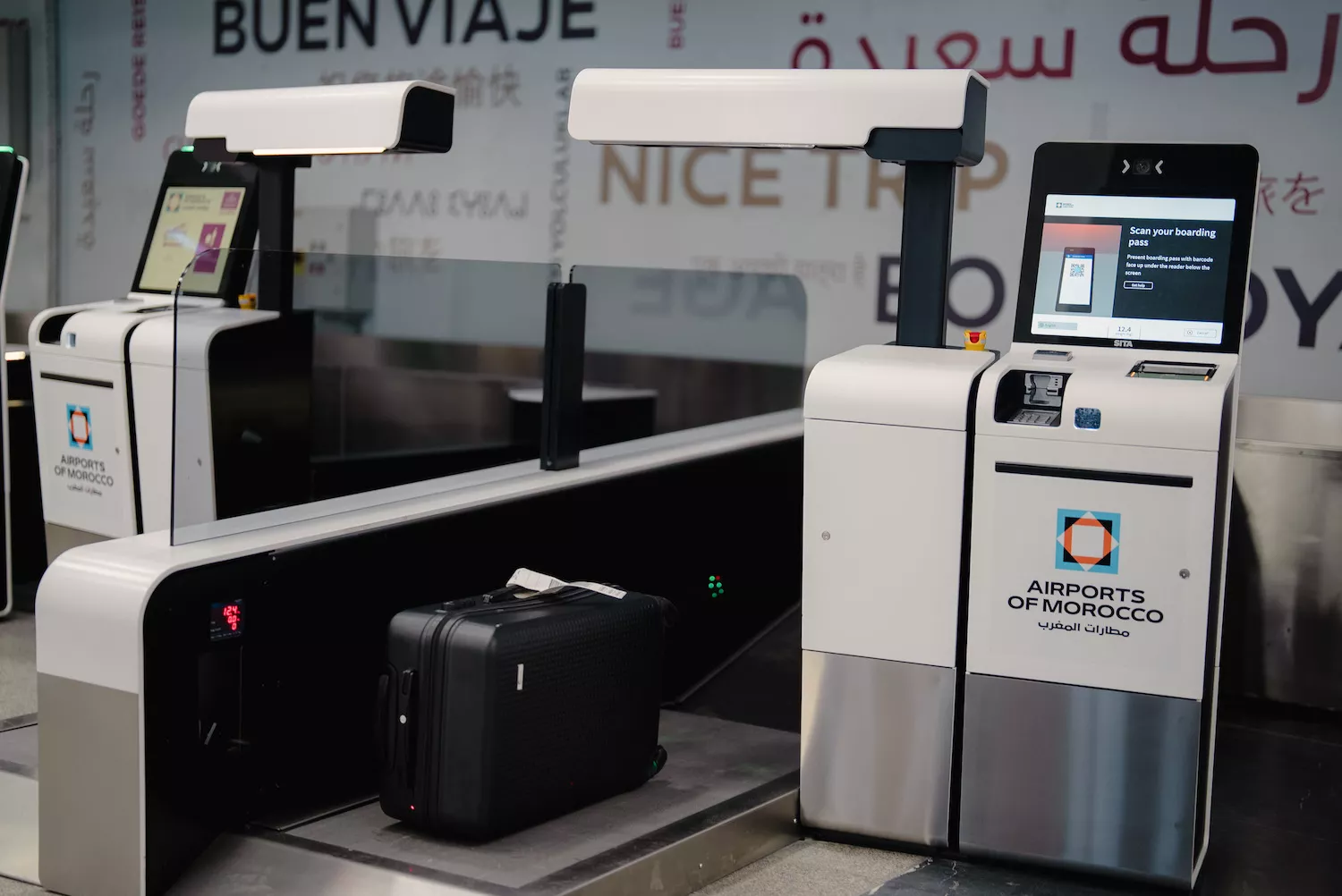
Marrakech – Airports of Morocco, the operator formerly known as the National Airports Office (ONDA), announced Friday that Rabat-Sale Airport has been equipped with automated “Self Bag Drop” baggage systems, opening the way for a gradual rollout across all of the kingdom’s airports.
The technology first entered service with Royal Air Maroc (RAM) at Mohammed V Airport in Casablanca. That initial deployment has now moved into a new, nationwide phase. The operator wants to progressively generalize the system to reduce wait times, optimize baggage handling, and give travelers more autonomy.
Rabat-Sale marks the first step in that generalization. Six self-service baggage-drop kiosks have just been installed at Terminal 2 for passengers of the airline Ryanair. According to the operator, the installation signals a shift toward broader deployment, one meant to durably transform check-in operations at Moroccan airports.
The process rests on a simple principle. After checking in, travelers can drop their own hold baggage through a guided and fully automated path. Operational estimates point to potential time savings of 50 to 75%.
Nearly two-thirds of passenger flows at Morocco’s airports are now covered by this change to the airport journey. That proportion reflects both the scale of the system’s potential and the weight of extending it across the national network.
Self Bag Drop also complements other measures already underway. These include the progressive rollout of the mobile boarding pass and the Pax Check system, which together aim to simplify each stage of the journey, from airport access to boarding.
The operator casts digitalization as a tool for performance, service quality, and an improved experience for the millions of travelers who use the country’s airports each year.
The push comes as Moroccan airports absorb rising traffic. Between January and August, they received 26,040,927 passengers, up 8.81% from the same period in 2025. International traffic rose 8.82% to 23,228,711 passengers, while domestic traffic grew 8.76% to 2,812,216.
Casablanca Mohammed V led with 8,252,410 passengers, followed by Marrakech-Menara with 7,235,705, Agadir-Al Massira with 2,498,637, Tangier Ibn Battouta with 2,058,606, and Rabat-Sale with 1,695,890.
The European market remained the top source, with 19,268,771 travelers, a gain of 9.22%. Aircraft movements rose 9.72% to 190,342, and air freight increased 13.82% to 74,714 tonnes.
These gains build on a record year. ONDA reported 36.3 million passengers in 2025, the highest annual volume on record.
The modernization effort fits into a wider program ahead of the 2030 FIFA World Cup. Morocco’s Ministry of Transport confirmed a national target of 80 million passengers a year in April 2025, and in July, the government and ONDA signed a MAD 38 billion ($3.8 billion) agreement covering 2025 to 2030.
The program directs MAD 25 billion (2.5 billion) to expand capacity in Marrakech, Agadir, Tangier, and Fez, along with a new hub terminal and runway at Casablanca, and MAD 13 billion ($1.3 billion) to maintenance and supporting infrastructure.
The Casablanca terminal, whose main construction contract went to the consortium SGTM-TGCC for MAD 12.8 billion (1.28 billion), is targeted for completion in mid-2029.
In September, Morocco and the African Development Bank (AfDB) signed a €270 million loan for airport expansion and modernization, with work planned at Marrakech, Agadir, Fez, and Tangier.