
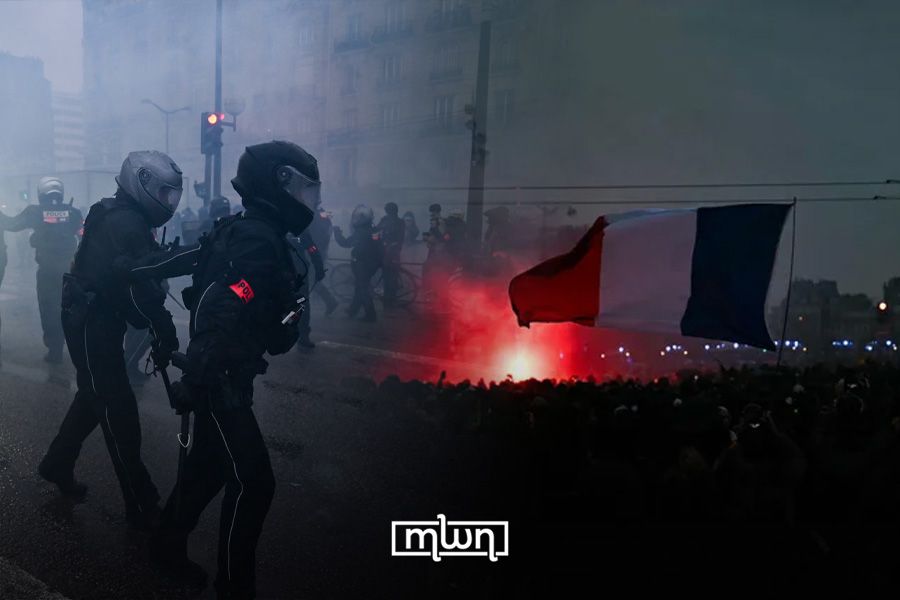
Rabat – French trade unions and protest movements have called for new demonstrations and a nationwide strike in November, despite a heavy police presence that helped contain unrest during Saturday’s rallies.
The renewed calls reflect mounting frustration over wages, the cost of living, and public services, which has spread beyond the student groups that first took to the streets last month.
The French Interior Ministry reported that 410,000 people joined demonstrations nationwide on Saturday, October 24. Authorities mobilized 70,000 police officers to prevent a repeat of the looting and vandalism that struck several cities a week earlier.
Despite the security operation, protest organizers showed little willingness to back down. Trade union leaders called for another day of demonstrations on October 31, followed by a nationwide strike on November 5.
For the Solidaires trade union federation, the latest protests reflect a broader convergence of social grievances rather than an isolated student movement.
“We see an aggregation of anger,” Murielle Guilbert, the federation’s co-leader, told French broadcaster BFM TV. She pointed to shared frustrations among students, workers, firefighters, and other groups.
Guilbert urged the public to join the next round of demonstrations, while the SUD Education teaching union confirmed its participation. The General Confederation of Labour (CGT), one of France’s largest unions, said it would decide on its position later this week.
Yellow vests return to the protest front
The latest calls have also drawn support from the Yellow Vests, the grassroots movement that shook Macron’s presidency in 2018 with protests against fuel taxes and broader economic inequalities.
The movement has urged supporters to take part in mass rallies on October 31, with plans for sit-ins outside town halls and the National Assembly.
Activist Azelma Sigaux described the discontent as a nationwide problem that reaches far beyond university campuses.
“There is anger in this country. It’s growing in schools and universities, on roundabouts, in neighbourhoods, on farms and in workplaces,” she told reporters.
The return of the Yellow Vests adds another layer to the pressure on the government. The movement first gained momentum among people who felt that economic policies placed a disproportionate burden on ordinary households, particularly those who depend on cars for work and daily life.
This time, trade unions and student representatives have also voiced concerns about purchasing power, salaries, and the quality of public services.
Macron has less room to ease public discontent
The government faces a difficult task as it seeks to prevent further unrest without the financial flexibility it had during the Yellow Vests crisis.
In 2019, Macron responded to the protests with measures that included relief on fuel costs. France now faces tighter public finances, which limit the government’s ability to offer similar concessions.
His political position has also weakened. The centrist camp no longer holds a parliamentary majority, which makes it harder to pass major legislation without support from other political groups.
The government has launched talks with trade unions and student representatives in an effort to ease tensions. Protest organizers, however, say the discussions have yet to produce meaningful results.
“We have received no response at all from this government,” Guilbert said.
The next demonstrations will test whether the various groups can sustain a common front and turn widespread dissatisfaction into a more coordinated challenge to the government.
Police question how long they can sustain the operation
Saturday’s rallies placed significant demands on security forces, even though the police presence helped limit the scale of the disorder.
The Interior Ministry reported 1,314 arrests, about half the number recorded during the previous week’s protests. Around 50 police officers sustained injuries, compared with more than 1,000 reported injuries among officers during the earlier unrest.
Clashes still broke out in several cities, including Paris and Marseille. Police unions warned on Sunday that staffing shortages would make it difficult to maintain such a large deployment over an extended period.
The unrest in France also forms part of a broader wave of anti-government protests across Europe, although each country faces its own political and economic grievances.
In Brussels, Belgian police used tear gas and pepper spray during clashes with demonstrators on Saturday. Albania has also faced violent unrest this month after protests that began peacefully in late May, while several Italian cities have experienced a second consecutive week of clashes.
With further demonstrations planned in France, the government’s ability to address protesters’ demands without a major financial package or a stronger parliamentary base remains uncertain.