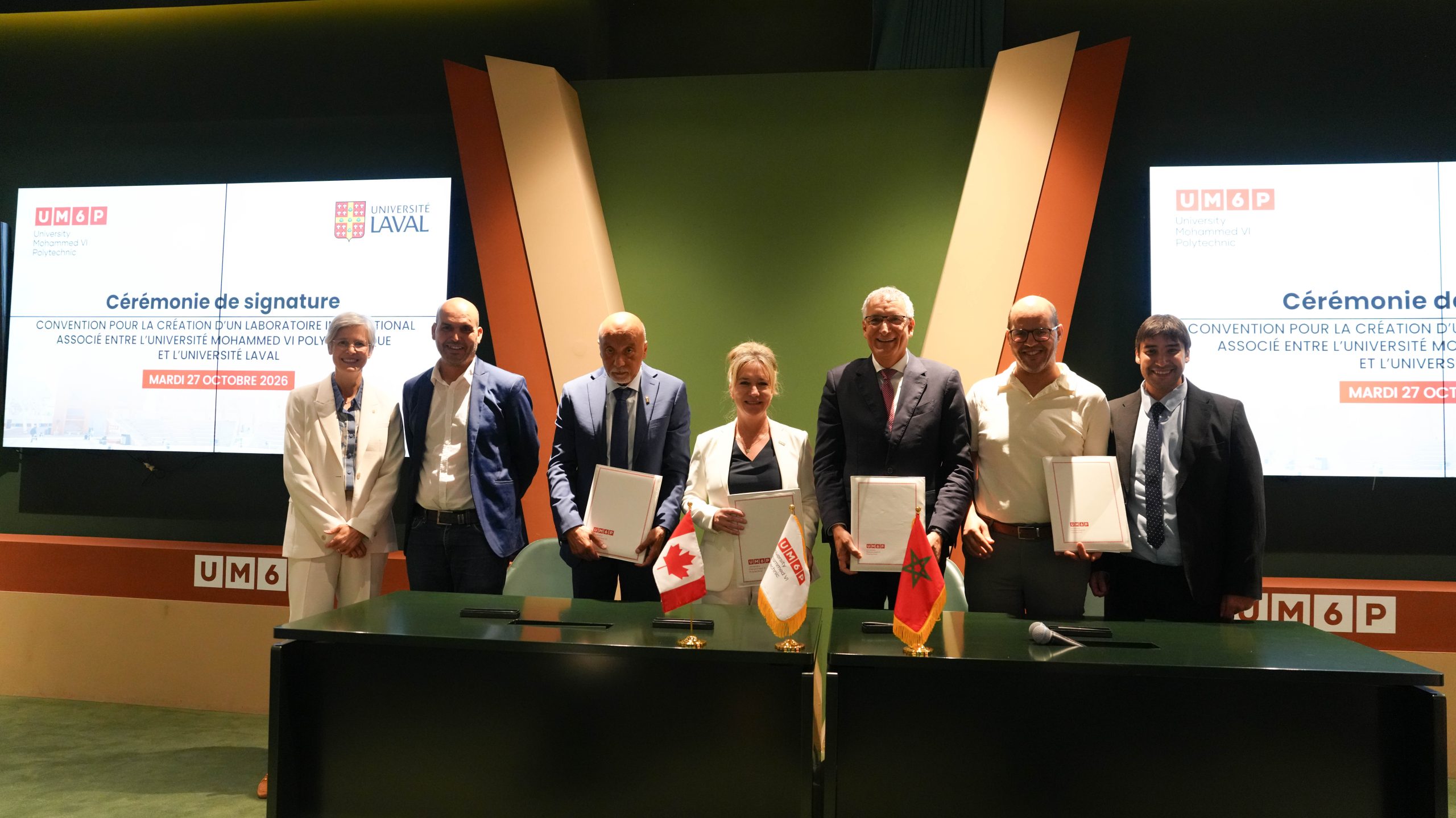
Rabat – Mohammed VI Polytechnic University (UM6P) announced today the signing of two agreements with Laval University to strengthen academic and scientific cooperation between the two institutions.
According to a statement from UM6P, the agreements were signed on Tuesday at UM6P’s campus in Benguerir, building on a partnership that began with Laval University in 2018.
The signing ceremony coincided with the visit of Sophie D’Amours, Rector of Laval University.
The first agreement between the two universities seeks to expand and structure cooperation across several fields, including science and engineering, as well as other key sectors such as agriculture, health, education, and the humanities and social sciences.
The agreement also aims to strengthen academic mobility, promote joint academic programs, and support collaborative research projects.
As for the second agreement, it concerns the establishment of an Associated International Laboratory (LIA). The laboratory will be dedicated to multidisciplinary research at the intersection of physics, optics, electrophysiology, and medical biology, with a particular focus on developing new diagnostic and therapeutic approaches in neuroscience and oncology.
The laboratory will also place significant emphasis on gene therapy and innovative strategies to modulate the molecular and cellular mechanisms involved in diseases.
The LIA will bring together researchers from UM6P’s College of Physics and Engineering (CPSE) and Faculty of Medical Sciences (FMS), as well as Laval’s University Center for Optics, Photonics and Lasers (COPL) and CERVO Research Center.
UM6P stressed that by combining complementary expertise in physical sciences, optical technologies, cellular and molecular electrophysiology, and medical biology, the partner teams will be able to better understand the pathophysiological mechanisms of diseases and develop advanced tools for their diagnosis and treatment.
The collaboration also aims to accelerate the development of innovative solutions in precision medicine through the integration of advanced imaging and functional characterization technologies.
The LIA seeks to advance new therapeutic approaches to address patients’ needs, particularly in neuroscience and oncology, UM6P said in its press release.
The university also highlighted the support of UM6P Global Hubs Canada for the Canada-Africa Scientific Corridor, which strives to bring the research ecosystems of the two continents closer together, strengthen exchanges between researchers, and foster joint scientific projects addressing shared health and development challenges.