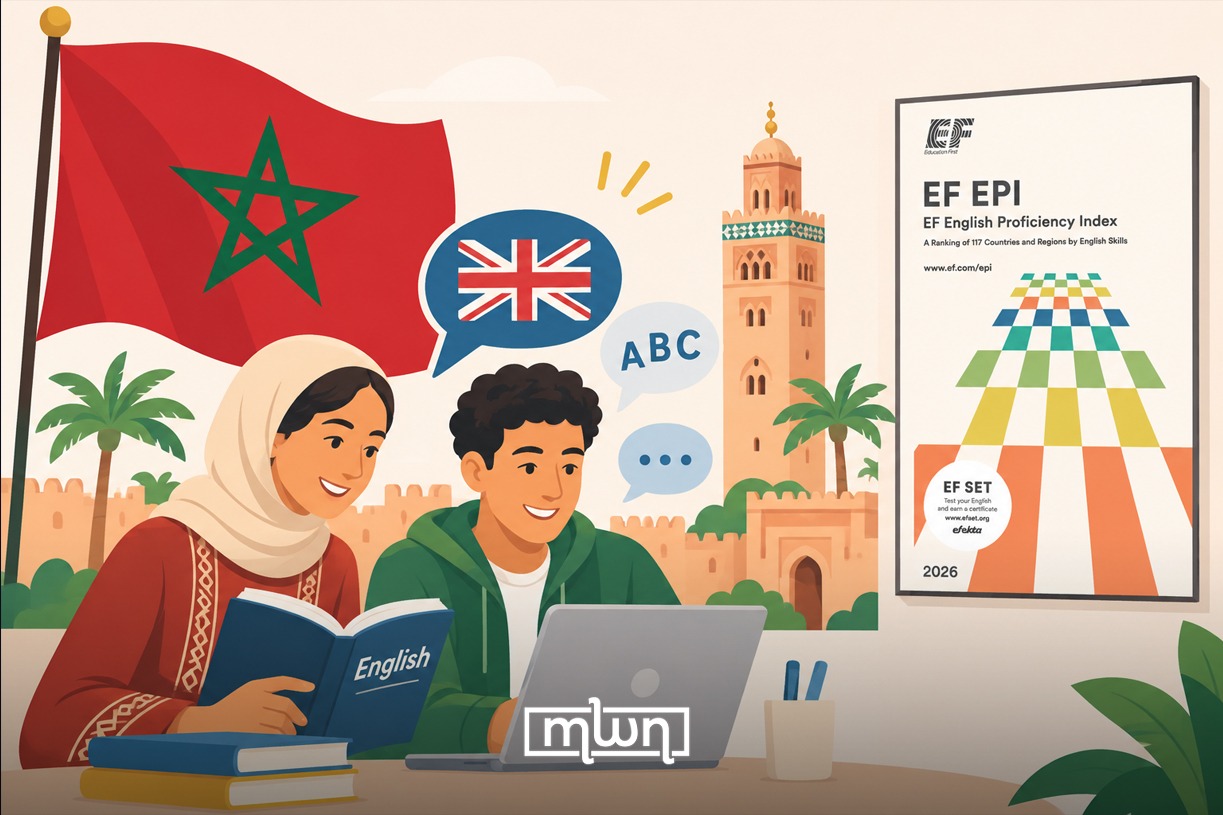
Rabat – Morocco has climbed eight places in the 2026 EF English Proficiency Index, ranking 60th globally out of 117 countries with a score of 492, compared with 68th last year.
Morocco also ranked eighth among African countries, ahead of Tunisia (61st), Tanzania (70th), and Algeria (76th).
Africa remains the continent with the widest disparities in proficiency levels between countries, identifying Morocco, Algeria, and Rwanda as countries where English skills are improving rapidly among younger generations.
The index cites significant changes in English-language education and the emergence of a more proficient future workforce.
Moroccans scored highest in reading, with a score of 521 , and writing, with a score of 494. Moroccans, however, trailed in listening, with a score of 468, and speaking, with 458.
Men slightly outperformed women, with an average score of 498 compared to 486, while young adults aged 21 to 25 led all age cohorts with an average score of 512.
Regionally, Fez-Meknes topped the national chart with a score of 504, with Fez and Rabat tied as the highest-performing cities at 518.
English has been expanding in Morocco, especially in major cities, where youth now use the language or terms from it in their everyday conversations, mixing Darija with French and English.
Despite the ongoing trend, the index shows Morocco still lagging behind countries in the Moderate or High Proficiency categories.
The Moroccan government has repeatedly pledged plans to strengthen English-language teaching.
In 2023, Morocco announced a plan to strengthen English-language teaching in middle schools, challenging the longstanding dominance of French.
The Education Ministry particularly announced the gradual expansion across Moroccan middle schools, starting from the first year, or seventh grade.
The initiative began in the 2023-2024 academic year.
According to the plan, each middle school English teacher will teach a total of 24 hours per week, assuming 12 classes.
The ministry envisioned expansion with a coverage rate of up to 50% in seventh grade and 100% in eighth grade by the 2024-2025 academic year.
By the 2025-2026 academic year, the ministry pledged that English-language teaching would be fully implemented in the first year of middle school.