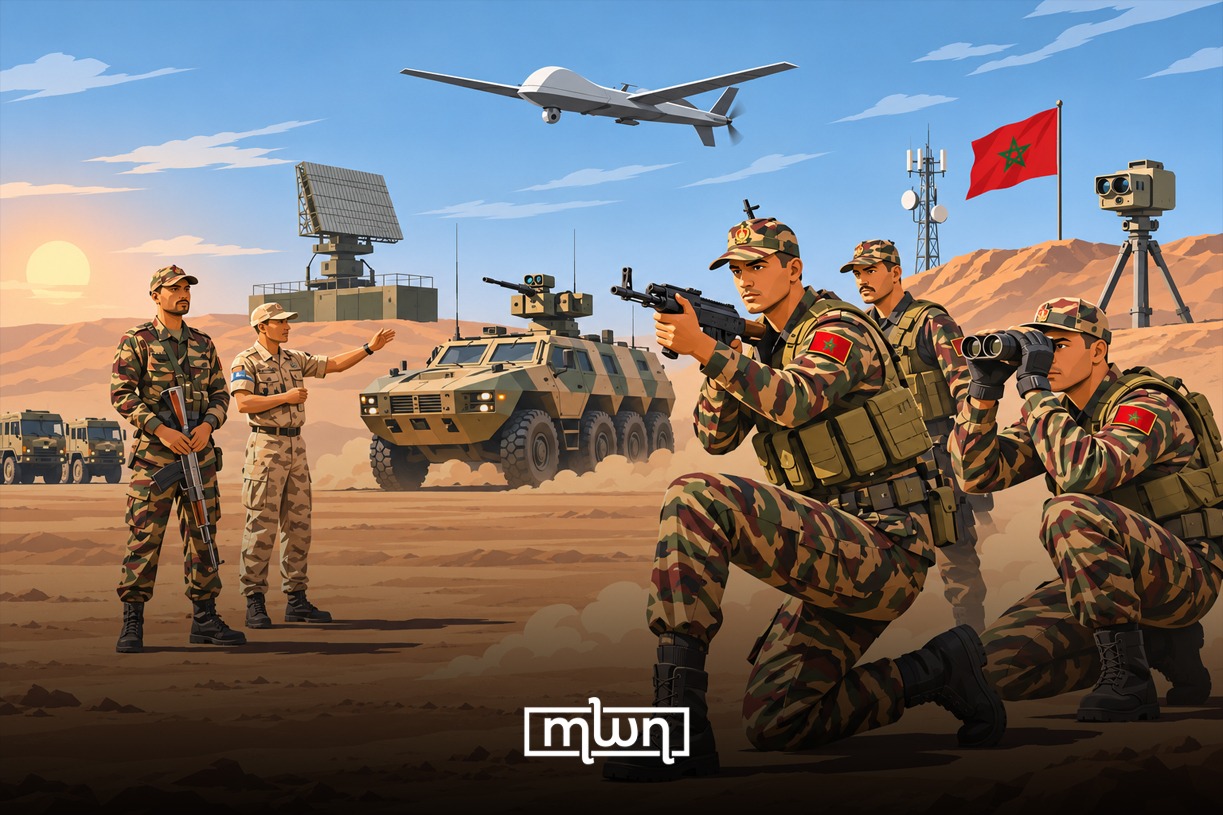
King Mohammed VI has identified the defense industry as one of the sectors Morocco is counting on to strengthen its sovereignty and broaden its industrial base. At a working session he chaired at the Royal Palace in Rabat on November 18, accompanied by Crown Prince Moulay El Hassan, the Morocco Offer for developing a national defense and security industry was presented.
The plan aims to meet 40% of the needs of the Royal Armed Forces and security services, generate more than 65% of the sector’s revenues from exports, and create 50,000 direct and indirect jobs by 2035. These targets show how the project combines meeting part of the country’s needs with building an industry that can grow in foreign markets.
The royal approach draws on Morocco’s experience in aerospace, automotive manufacturing, and electronics to develop higher-value industrial activities. Companies in these sectors have gained experience making components to exact specifications and working within international supply networks.
The roadmap allows some of that expertise to be applied to defense and security needs and brings Moroccan suppliers into work ranging from manufacturing to testing and maintenance. As their role expands, Moroccan engineers and technicians will have more opportunities to work on product development, and the country can retain a greater share of the value generated by its defense investments.
The King gave this approach a technological dimension in his 2022 military address, calling on Moroccan universities and research centers to help develop equipment that meets the needs of the Royal Armed Forces. He then linked domestic military manufacturing to defense autonomy in his 2025 military address.
The practical impact of this approach becomes clear after institutions take delivery of their equipment. The ability to inspect and maintain equipment locally and secure spare parts improves readiness when supplies are delayed. Experience gained during use and maintenance also helps research teams understand what needs further development. This explains why the roadmap covers design, production, testing, maintenance, and storage.
Morocco seeks to turn defense needs into industrial opportunities
With Law No. 10.20 providing a framework for manufacturing in the sector, the initiative has entered a phase that requires coordination across investment, training, and research. A planned specialist agency will implement the strategy and support investors. A holding company will structure industrial investments and mobilize public and private capital, while a specialist academy will provide training tailored to the industry’s needs.
Two additional zones in Benguerir and Benslimane, alongside those in Nouaceur and Sidi Yahya, will create more scope for locating projects and building supplier networks across several regions. The King made establishing the bodies that will oversee the roadmap, drawing up a financing plan, and simplifying investment procedures priorities for implementation. He also directed the Hassan II Fund for Economic and Social Development to contribute MAD 4 billion to the initiative.
The Royal Cabinet’s statement sets out the international dimension of this policy. Morocco aims to take its place more quickly among the small group of countries that produce defense and security equipment and software. Domestic demand guides manufacturers toward what Moroccan institutions need, while foreign markets allow them to expand production and spread research and development costs over larger orders.
If companies operating in Morocco can meet specifications, deliver on time, and provide after-sales maintenance, the nature of the country’s partnerships could change. Morocco would have products, expertise, and services to offer and more room to negotiate what it imports and what it develops with its partners.
The effects would extend to the wider Moroccan economy as local companies find opportunities in engineering, testing, and maintenance, and universities find industrial partners that can turn research findings into usable products.
The expertise engineers and technicians gain in fields such as electronics, software, and cybersecurity can also benefit civilian sectors. In his July 2026 Throne Day speech, the King placed the defense industry and cybersecurity within a policy that brings together securing supply chains, strengthening national sovereignty, and creating new opportunities for development.
The Rabat session fell on the 71st anniversary of Independence Day, seven decades after the late King Mohammed V founded the Royal Armed Forces. That timing puts the roadmap in the context of Morocco’s needs since it regained independence.
The country built institutions to defend its sovereignty and unity and is now expanding its ability to supply them through its own factories and research centers. The more Morocco can produce, maintain, and develop domestically, the greater its freedom to make its own defense decisions and the stronger its position as an industrial partner abroad.