


































































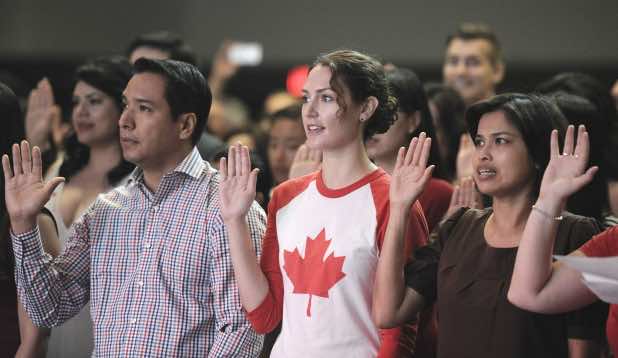
Toronto – A sharp increase in the fees involved in obtaining Canadian citizenship, put in place before Justin Trudeau and his Liberals took office a little more than a year ago, has resulted in an equally sharp decline in the number of applications being processed, according to a report by the CBC.
In a trend that seems to be at odds with Canada’s reputation as a welcoming country for immigrants and refugees alike, a recent report has revealed that the first 9 months of 2016 recorded a nearly 50% drop in the number of people applying for Canadian citizenship from the same period the year before. On paper 56,446 applications might look robust but it’s a worrying trend for both immigrants and immigration attorneys and workers alike.
Are we becoming a country that only welcomes those who can afford the processing fees? It’s a valid question in light of the Senate’s social affairs, science and technology committee hearings regarding amendments to Bill C-6. This is a piece of legislation the Liberals are introducing to make changes to the current Citizenship Act. The hearings are to take place on Wednesday and Thursday.
For Arthur Griffith, who prepared the report, the trend in declining citizenship applications is alarming. From 2014-2015, fees jumped from $100 to $530 per person and that figure doesn’t include the additional $100 “right of citizenship” fee.
“If you’re a professional doing reasonably well, you may not like it,” says Griffith, “but you pay it. It’s important to you. But if you are a struggling immigrant or refugee, suddenly $630 may become prohibitive, and especially if you’re talking about a family or four or more.” On top of this there is language testing to endure.
Bill C-6, as it has been presented thus far, proposes to reduce wait times that permanents citizens have to live in Canada before they can become citizens, counting time for work, and student in residency requirements. It is also proposing to reduce language proficiency requirements for young and old immigrants.
Griffith would like to see the reforms go further. He would like to see the total fees cut to $300 and the “right of citizenship” fee abolished altogether. He is also recommending a complete waiver for refugees and low-income immigrants. He warns that if something is not done to facilitate more immigrants and refugees from applying for full Canadian citizenship, marginalization could occur. This would be a huge barrio to integration.
“We’ve always prided ourselves where we have a model where we don’t just encourage immigration, but we encourage immigrants to become citizens so they will be fully part of society. They can take part in political discussions, they can vote and do all the things that are part of it,” Griffith explains.
According to the same source, Bernie Derible, spokesperson for Immigration Minister, Ahmed Hussen, is rationalizing that Canada’s citizenship fees are still lower than those in other countries such as the U.K., Australia and New Zealand.
Meanwhile, immigration workers are seeing plenty of people delaying their immigration plans entirely, based on the increasing fees involved in citizenship. So far at least, it doesn’t appear that the government is prepared to reduce the hiked fees any time soon.
That has Dory Jade, CEO of the Canadian Association of Professional Immigration Consultants, questioning the wisdom of making it harder for immigrants to become citizens, not easier. “If we want to bring immigrants, especially under a Liberal government, which believes in nation builders, making it accessible and easy to become members of your society is a big, big issue.”