
 Join on WhatsApp
 Join on Telegram
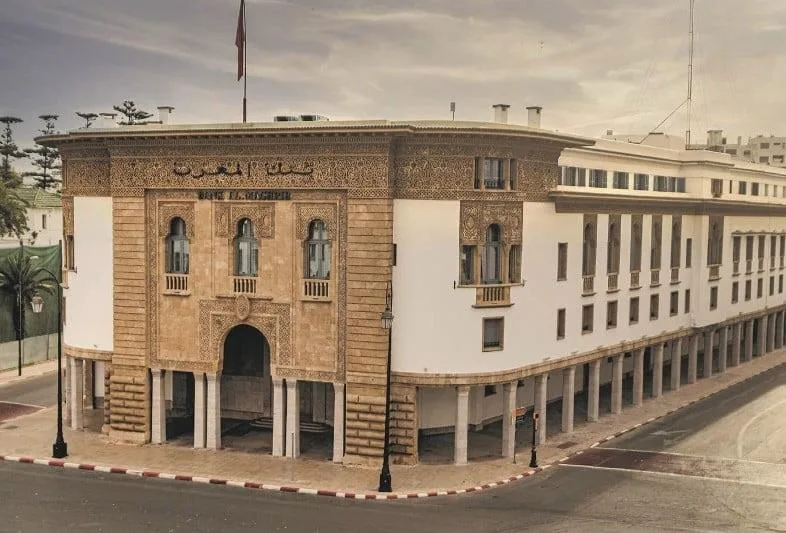
Doha – Bank Al-Maghrib (BAM), Morocco’s central bank, announced Tuesday a 25 basis point reduction in its key interest rate to 2.25%, marking its second consecutive cut and third since June 2024, as inflation remains under control and economic growth needs support.
“Considering the projected evolution of inflation at levels in line with the price stability objective and to strengthen support for economic activity and employment, the Council has decided to reduce the key rate by 25 basis points to 2.25%,” BAM stated in its press release following its first quarterly meeting of 2025.
Inflation to remain moderate while growth accelerates
The central bank reported that inflation significantly slowed in 2024, averaging 0.9%, down from higher levels in the previous two years. According to BAM’s projections, inflation is expected to accelerate moderately, fluctuating around 2% over the next two years.
“The core inflation component stood at 2.2% in 2024 and would also evolve around 2% in the medium term,” the bank noted, adding that financial sector experts anticipate average rates of 2.2% for the 8-quarter horizon and 2.4% for the 12-quarter horizon.
Non-agricultural growth reached 4.2% in 2024 and is expected to maintain this level in the medium term, driven primarily by infrastructure investment. However, the agricultural sector faces challenges, with value-added declining by 4.7% in 2024.
“The national economy growth stood at 3.2% in 2024 and should gradually accelerate to reach 3.9% this year and 4.2% in 2026,” BAM projected.
When it comes to employment, data for 2024 shows continued impact from agricultural sector contraction, with 137,000 jobs lost in agriculture.
However, non-agricultural employment showed recovery with 160,000 new positions in services, 46,000 in industry, and 13,000 in construction. The unemployment rate rose to 13.3% nationally, with 16.9% in urban areas and 6.8% in rural zones.
External trade dynamics and monetary conditions show resilience
The current account deficit is forecasted to widen to 2.9% of GDP in 2025 before easing to 2% in 2026. Foreign direct investment receipts are expected to improve, approaching 3% of GDP in 2025 and 3.3% in 2026, up from 2.8% in 2024.
“Official reserve assets would strengthen to MAD 391.8 billion ($39.18 billion) at the end of 2025 and then to 408 billion ($40.8 billion) at the end of 2026, representing the equivalent of 5 months and 5 days of imports,” the bank stated.
Exports are expected to be driven by phosphate and derivatives sales, projected to increase by 15.2% this year and 8.6% in 2026 to MAD 108.6 billion ($10.86 billion), while automotive sector exports should reach MAD 195 billion ($19.5 billion) in 2026.
Tourism revenues are expected to expand to nearly MAD 125 billion ($12.5 billion) in 2026, with remittances from Moroccans living abroad consolidating at around MAD 123 billion ($12.3 billion).
The banking sector’s liquidity needs decreased to MAD 128.7 billion ($12.87 billion) on average in January and February 2025. Credit to the non-financial sector is expected to accelerate significantly, “rising from 2.6% in 2024 to 5.9% in 2025 and then to 6% in 2026,” according to BAM’s forecasts.
Additionally, BAM announced a new support program for bank financing of very small enterprises (VSEs), offering participating banks refinancing at a preferential rate equal to the key rate minus 25 basis points.
“This mechanism and the commitment expressed by the banking sector should improve access to financing for this category of companies and strengthen its contribution to job creation,” the bank explained.
Global outlook and fiscal consolidation path
On the international front, BAM noted that “despite geopolitical tensions and restrictive monetary conditions, the global economy showed overall relative resilience in 2024, albeit with divergent trajectories across countries.”
The bank pointed out that global inflation is expected to continue its deceleration, falling from 3.7% in 2024 to 3.2% in both 2025 and 2026. In major advanced economies, inflation is projected at 2.4% in 2025 and 2.1% in 2026 for the eurozone, while remaining around 3% in the United States during this period.
Regarding public finances, ordinary revenues improved by 15.3% in 2024, driven by strong tax collection performance. Overall expenditure increased by 6.5%, reflecting higher spending on goods, services, and investment.
“The budget deficit, excluding state shareholding disposal proceeds, should gradually ease from 4.1% of GDP in 2024 to 3.9% in 2025 and 3.6% in 2026,” BAM projected.
With the dirham’s nominal appreciation being offset by the inflation differential between Morocco and its main trading partners and competitors, the real effective exchange rate is expected to appreciate by 0.8% in 2025 before stabilizing in 2026.