


 Join on WhatsApp
  Join on Telegram
 Marrakech – Morocco will dispatch 320 religious scholars to accompany Moroccan communities abroad during Ramadan 2026, continuing what has become an annual tradition since 1992.
The Hassan II Foundation for Moroccans Living Abroad announced that the delegation will depart February 16 to provide religious and spiritual guidance throughout the holy month.
The carefully structured delegation includes 39 university professors, 50 preachers holding doctoral degrees, 60 preachers with master’s degrees, and 75 preachers with bachelor’s degrees.
Additionally, 66 preachers will deliver sermons and lead Tarawih prayers, while 30 imams will focus exclusively on directing these evening prayers.
France will receive the largest contingent with 82 scholars, followed by Germany and Spain with 51 each. Belgium will host 42 delegates, the Netherlands 35, Italy 26, Canada 14, and the United States 6. Sweden will receive 5 scholars, England 3, while Hungary, Norway, Austria, Finland, and Iceland will each welcome one delegate.
According to the foundation, this annual Ramadan mission promotes Morocco’s religious constants while diffusing messages of peace, solidarity, and social cohesion aligned with principles of coexistence.
It also stresses that this religious accompaniment carries major religious, social, and symbolic significance for Moroccan expatriates.
A look into Morocco’s religious diplomacy
Morocco’s religious diplomacy is often read almost exclusively through its African projection – imam training, Sufi networks, and the Maliki-Ashʿari model exported southward. However, that reading is incomplete.
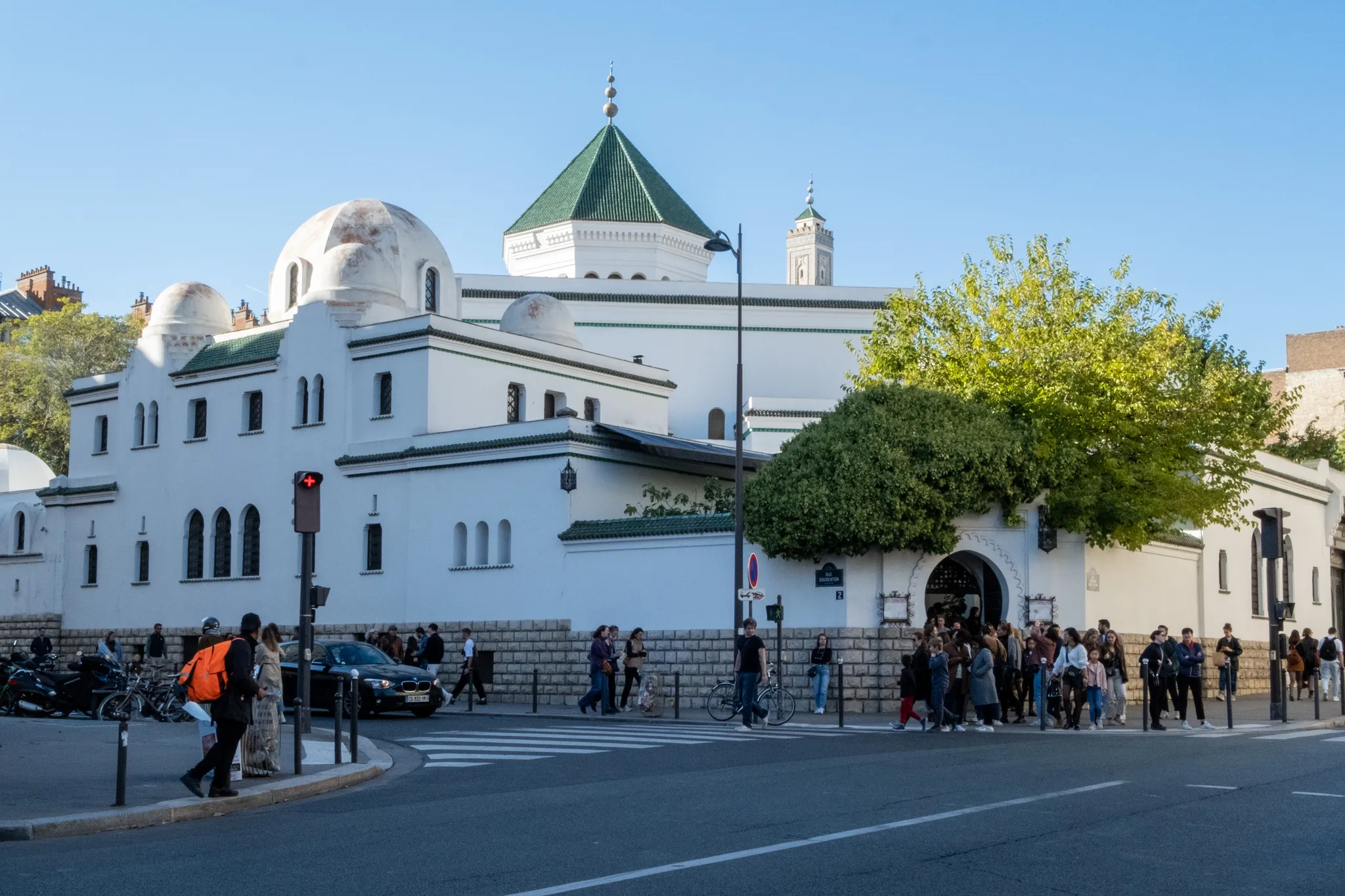
From an early stage, Rabat grasped that Europe was an equally central theater for influence, especially France. This understanding traces back to 1926 when Sultan Moulay Youssef inaugurated the Great Mosque of Paris. This was not symbolic charity to Muslims abroad; it was strategic statecraft.
The mosque emerged as a diplomatic artifact at the intersection of colonial gratitude (toward Muslim soldiers of World War I), Franco-Moroccan entanglement, and Morocco’s ambition to position itself as a legitimate religious reference for Islam in Europe.
From the outset, Paris was not merely hosting Islam – it was hosting a Moroccan-inflected Islam, embedded in Maliki jurisprudence and a monarchy that asserted religious legitimacy through history rather than ideology. In other words, Europe entered Morocco’s religious map not as a periphery, but as a domain to be shaped.
That logic has only intensified under King Mohammed VI, whose religious diplomacy rests on a dual objective: stabilizing Muslim practice in Europe while reinforcing Morocco’s geopolitical credibility as a moderating power.
The strategy is subtle but consistent – supporting mosque governance, clerical training, and religious discourse that counters both Salafi radicalism and populist European fears of political Islam.
Unlike Turkiye’s overt state-Islam export or Gulf funding networks, Morocco’s approach is relational and historical: it leverages diaspora ties, Franco-Moroccan memory, and institutional continuity. Europe, particularly France, becomes a testing ground where religious authority translates into soft power, security cooperation, and diplomatic trust.
In this sense, Moroccan religious diplomacy is not just about faith – it is about managing Islam as a geopolitical variable inside Europe itself, positioning Rabat as an indispensable interlocutor between European states and their Muslim citizens.


