

 Join on WhatsApp
 Join on Telegram
Fez — UPF University marked its 20th anniversary in Fez with a ceremony that looked back on two decades of academic growth while setting the tone for a new development phase centered on artificial intelligence, research, employability, and international cooperation.
The event opened with remarks from UPF University President Lahlou, who presented the institution’s journey from its early foundations to its current position as a recognized private university with campuses in Fez and Rabat, 30 academic entities, more than 4,000 graduates, and more than 1,280 socio-economic and academic partners.
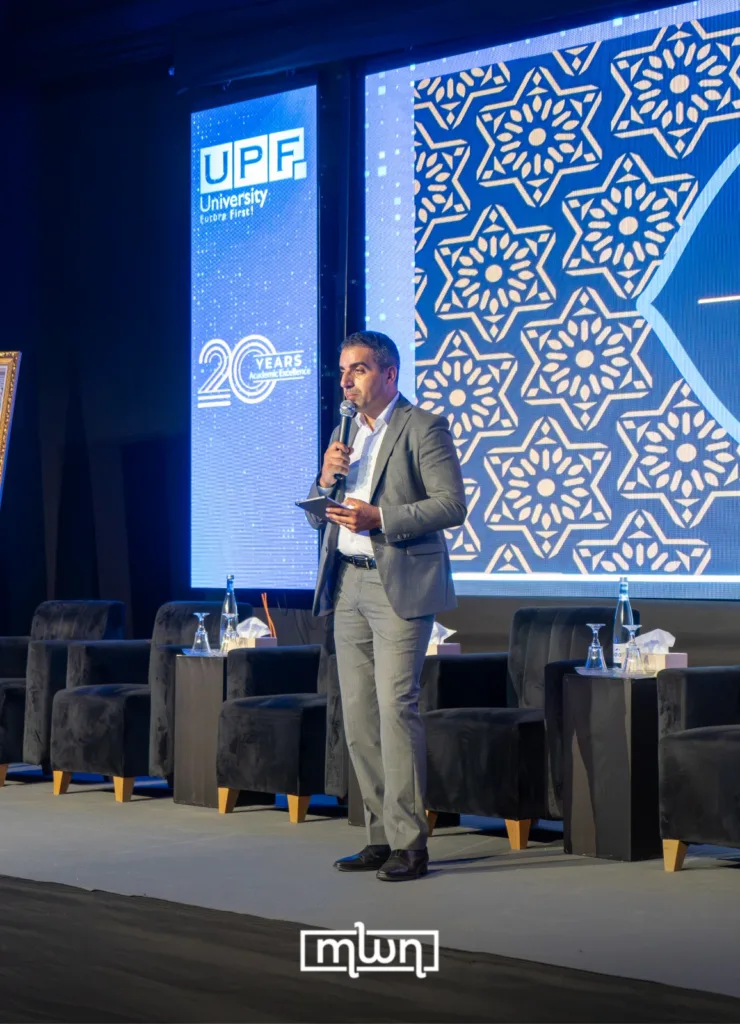
Ouadih Dada served as master of ceremonies and moderated the panel discussions, guiding exchanges on higher education, artificial intelligence, research, innovation, and the university of tomorrow.
From founding vision to expansion
Lahlou framed the anniversary as both a commemoration and a responsibility, paying tribute to the founders, teachers, administrative and technical teams, partners, parents, students, and graduates who helped shape the university.
“When we founded this university, we dreamed of a structure where every student would receive quality training for successful professional integration,” he said.
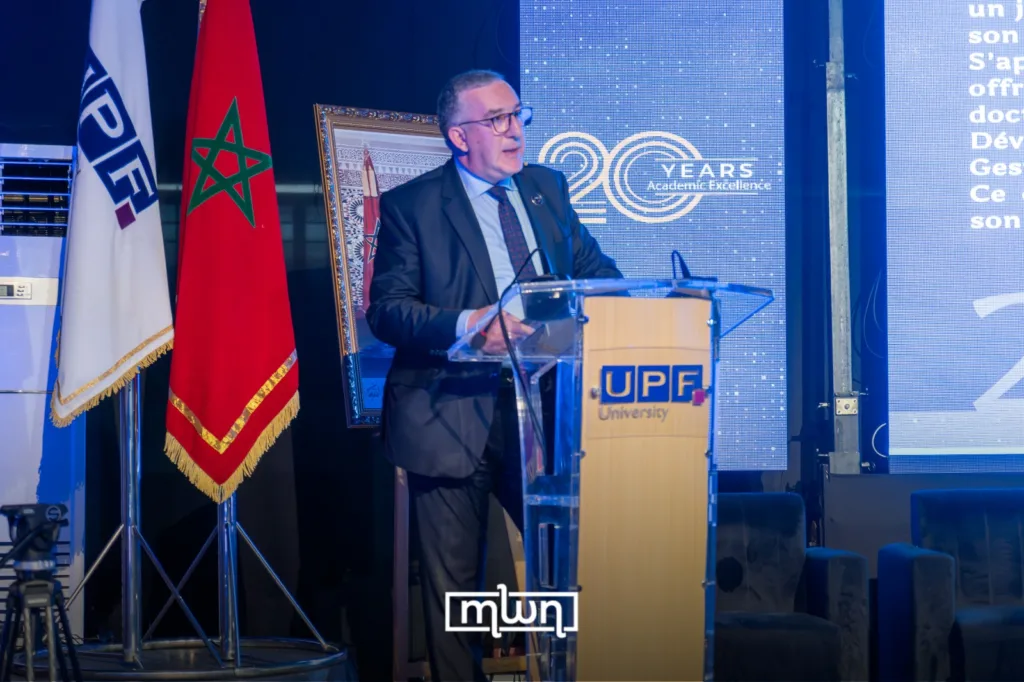
He described UPF’s evolution through six major phases: genesis from 1999 to 2005, foundation from 2006 to 2010, structuring from 2011 to 2015, recognition from 2016 to 2018, expansion from 2019 to 2022, and internationalization from 2023 to 2026.
The timeline included the first students in 2006, the development of the campus, the first graduating class in 2009, the first recruitment forum in 2010, accreditation of academic programs, the structuring of the alumni network, recognition by the state, the creation of an incubator, the launch of a batteries excellence center, the creation of a scientific council, doctoral studies, dental medicine, architecture, the Rabat campus, EDGE certification, and the partnership with Cintana Education.
“Today, we celebrate 20 years of this beautiful journey, but celebrating is not only about looking back. It is above all about turning toward the future,” Lahlou said.
He added that the university has remained faithful to its founding values of excellence, openness, innovation, ethics, and respect for society.
“Our excellence yesterday makes us responsible for tomorrow,” he said, adding that UPF’s “ambition is infinite.”
AI and the future of higher education
The first panel focused on higher education and artificial intelligence, with contributions from Ryad Mezzour, Morocco’s Minister of Industry and Trade; Abdelmajid Fassi Fihri, Vice President of the House of Representatives; Saad Charif D’Ouazzane, former president of Hassan II University; Mohammed Regragui, professor at Mohammed V University in Rabat, and Mohammed Saad, Deputy General Director of the Casablanca Stock Exchange.

Mezzour placed artificial intelligence at the center of a global transformation in research, innovation, and production. He argued that development costs have fallen sharply and that research, innovation, and even patents have become more accessible.
“The rules have completely changed. R&D, innovation, including patents, have become completely accessible,” he said.
The minister warned that universities must move ahead of this transformation rather than follow it.
“We cannot work today with yesterday’s methods,” Mezzour said.
Governance, teachers, and critical thinking
Fassi Fihri linked the discussion to Morocco’s institutional readiness, recalling the work of a parliamentary commission on artificial intelligence. He said the commission heard from experts, academics, and Moroccan administrations to assess the country’s level of preparation.
“There was a huge contrast between what experts and academics told us and where Moroccan administrations stood on artificial intelligence,” he said.
Fassi Fihri described AI as an opportunity for Morocco, while stressing the need to generalize access to digital tools across regions and cities.
“I consider artificial intelligence a great opportunity for Morocco, and we have no choice but to seize it,” he said.
For universities, Fassi Fihri said teachers will not disappear, but their role must evolve. He argued that AI cannot replace the human relationship between teachers and students, especially when students need guidance, confidence, advice, or redirection.
“The best artificial intelligence will never replace the relationship between a teacher and a student,” he said.
He said universities must move beyond simply transmitting knowledge and focus on teaching students how to think critically, especially as AI can produce convincing but false answers.
“Today, we may move to another stage: not only knowledge, but knowing how to think,” he said.
Employability and national development
Regragui praised UPF’s academic model, saying its programs at bachelor’s, master’s, and research levels are supported by centers aligned with major global challenges, including batteries and artificial intelligence.
“UPF’s excellence is proven by the fact that 95% of its graduates integrate into the professional world very smoothly,” he said.
He linked higher education to Morocco’s economic and social development, arguing that trained skills are essential for implementing the country’s major structuring projects.
Regragui said artificial intelligence rests on three foundations: infrastructure, data, and algorithms. He stressed that Morocco needs professors and graduates capable of accompanying this transformation.
“The digital revolution and artificial intelligence are based on thinking minds with skills that can generate economic and social value,” he said.
He added that the teacher’s role must change, moving away from simple knowledge transmission toward guidance and support for self-training.
“We are no longer in a simple transfer of knowledge,” he said.

Universities, innovation, and value creation
Mohammed Saad focused on the missing bridge between universities, institutions, and economic value creation. He recalled a visit to Silicon Valley and the example of Cisco, which emerged from research at Stanford University, as a sign of how academic work can become a global industrial force.
“I found that there is a missing link in the chain between our institutions and universities,” he said.
He described UPF as an institution he had seen rise from the ground, calling it the result of “a comet of knowledge and learning.”
Saad said AI should push universities to reinvent education. He argued that the old model, inherited from the industrial revolution, focused too heavily on memorization and the scarcity of information.
“Today, artificial intelligence is the repository of information. No teacher can compete with this mass of information or this computing power,” he said.
He said teachers must become more focused on questioning, dialogue, debate, and the challenge of ideas.
“Today’s and tomorrow’s teacher must give birth to minds,” he said.
AI as a tool for training and research
Saad Charif D’Ouazzane treated artificial intelligence as a working tool that universities must learn to frame, evaluate, and use responsibly.
“Artificial intelligence is a working tool, quite simply,” he said.
He compared AI to earlier tools that were initially resisted, including calculators, search engines, and social media, before becoming part of normal academic and professional life.
He argued that teachers must adapt to AI and accept it, while institutions must introduce supervision, ethics, legal frameworks, and evaluation systems.
“The teacher must also adapt and accept it,” he said.
He warned that AI does not always provide correct answers and described it as a technology that is still learning.
“Artificial intelligence is still learning; it is a baby,” he said.
Research, innovation, and international openness
The second panel turned to the university of tomorrow, with a focus on AI, research, innovation, and openness to the international environment.
The session brought together Omar Tajmouati, President of CGEM (General Confederation of Moroccan Enterprises Fez-Meknes Region), Rajaa Cherkaoui El Morsli, professor at Mohammed V University in Rabat, Benito Agueda, Chief Academic Officer at Cintana Education, Rachid Yazami, President of UPF University’s Scientific Council and pioneering co-inventor of the graphite anode used in lithium-ion batteries, Adnane Remmal, professor at Sidi Mohamed Ben Abdellah University in Fez, Mohammed Ammouri, President of the Regional Council of Chartered Accountants for Fez, Meknes, and Oriental, and Nawfal Jabri, President of Cnexia Group.
The panel extended the first discussion by placing AI within a broader ecosystem of scientific research, entrepreneurship, business needs, academic partnerships, and international cooperation.
Its composition reflected UPF’s development direction: connecting higher education with regional business actors, scientific expertise, global academic networks, and Morocco’s innovation needs.
A university preparing for the next decade
Mohamed Lazraq, Executive Vice President of the Private University of Fez, said the ceremony was not only a commemoration of past achievements.
“This celebration is not limited to looking back at the past and its achievements. It is also a key moment to look ahead to the future and its requirements,” Lazraq told Morocco World News (MWN).
Mustapha Akalay Nasser, Director of the School of Architecture and Urban Planning, also described the anniversary as a moment of pride for the institution.
“Our university today is a reference, our university ranks among the best,” Akalay Nasser told Morocco World News (MWN).
He credited UPF’s progress to its professional and administrative staff, saying the university has helped train current and future generations while preparing graduates for the job market.
Mohamed Lazraq, Executive Vice President of the Private University of Fez, said the university’s 20th anniversary was not only an opportunity to revisit its past achievements, but also a turning point for preparing its future.
He stressed that the institution is looking ahead to global transformations in education, knowledge, and technology, framing the commemoration as part of a broader development vision.
“This celebration is not limited to looking back at the past and its achievements. It is also a key moment to look ahead to the future and its requirements,” Lazraq told Morocco World News (MWN).
The anniversary also featured the announcement of the creation of the Center of Excellence in Artificial Intelligence, a new step in the university’s 2026–2030 development vision.
The ceremony also included a recognition segment highlighting UPF’s academic and institutional community.
The university honored Saâd Daoudi, Rector of the Private University of Fez, alongside researchers and key actors who played a role in the university’s success over the 2 decades.
Hassan Qjidaa, a leading figure in UPF’s research ecosystem, was also honored for being among Morocco’s top 5 computer science researchers.
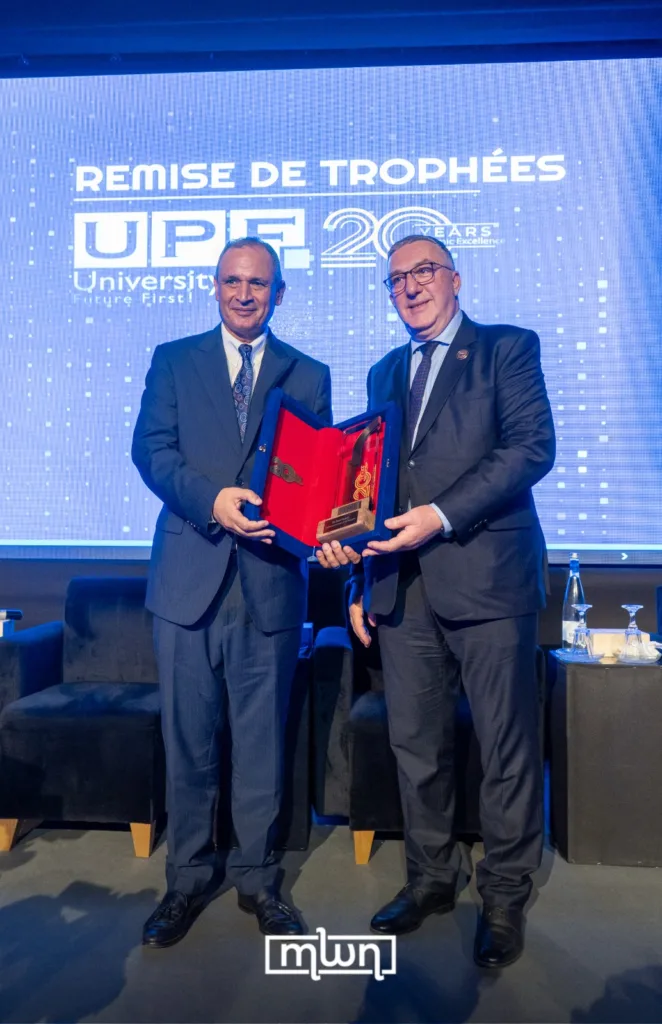
The tribute segment concluded with a trophy presented to the minister, Ryad Mezzour, in recognition of his presence and contribution to the anniversary ceremony.