 Join on WhatsApp
 Join on Telegram
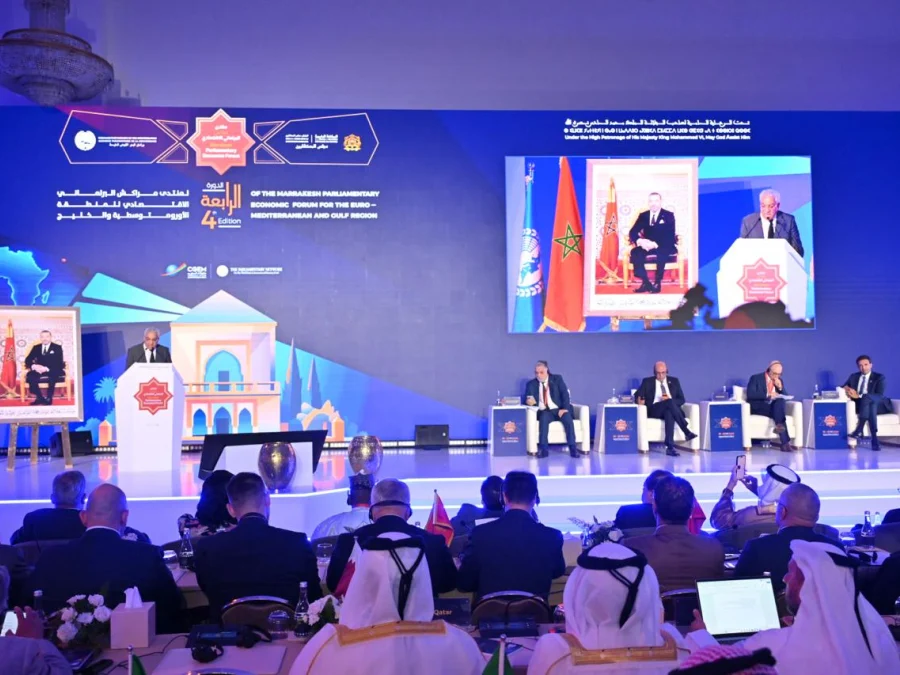
Agadir – Marrakech is hosting the Fourth Edition of the Marrakech Economic Parliamentary Forum, held on 19-20 June. The event convened parliamentary and economic stakeholders from across the Euro-Mediterranean and Gulf regions to address pressing global and regional challenges.
According to the Parliamentary Assembly of the Mediterranean (PAM), the Forum will be held “under the High Patronage of His Majesty King Mohammed VI” and organized jointly with the House of Councillors of Morocco, in partnership with the Parliamentary Network of the World Bank and the International Monetary Fund (IMF).
PAM describes the Forum as “the leading regional platform for parliamentary dialogue in the Euro-Mediterranean and Gulf regions on economic growth and integration.”
Four thematic pillars of discussion
The discussions will be structured around four main thematic areas: global public debt and trade barriers, investment in artificial intelligence and the creation of a Euro-Mediterranean and Gulf AI hub, job creation through regional incubators and the blue economy, and the impact of climate change on food security.
PAM states that the objective is to strengthen cooperation between parliaments in order to “translate parliamentary engagement into tangible action, paving the way for a stable, technologically advanced, and resilient future for the Euro-Mediterranean and Gulf regions.”
Economic pressures and global fragmentation
The Forum takes place against a backdrop of mounting global economic pressures. Citing UN Trade and Development data indicating that median public debt-to-GDP reached 54% in 2024, PAM notes that rising public debt, particularly in developing economies, is “intensifying fiscal pressures, further exacerbating structural inequities.”
The statement also refers to widening trade tensions and instability, as well as “the erosion of multilateralism,” which it says may weaken coordinated responses to shared challenges.
In this context, the Forum is expected to examine regional cooperation models and alternatives to fragmented global governance frameworks.
It will also explore initiatives inspired by agreements such as the African Continental Free Trade Area (AfCFTA), CETA, and the EU-Mercosur agreement, alongside broader South-South cooperation frameworks. A special focus will be placed on strengthening Euro-Mediterranean and Gulf integration as a pathway toward more resilient economic systems.
Artificial intelligence will be another central pillar of discussion. PAM notes that AI development remains concentrated in a limited number of regions, while others face constraints linked to financing gaps, regulatory fragmentation, and limited computing infrastructure.
The Forum will therefore examine ways to build a “Euro-Mediterranean and Gulf AI community grounded in ethical governance, agile regulation, and sustainable tools,” including the reinforcement of public-private partnerships and investment in high-performance computing infrastructure.
Blue economy and sustainable growth
The blue economy will also feature prominently. PAM cites European Commission estimates placing the sector at nearly €890 billion in turnover and €250.7 billion in value added, while the World Bank estimates that it supports nearly 50 million jobs in Africa, potentially rising to 78 million by 2063. The Forum will explore its role in driving sustainable growth, food security, biodiversity protection, and climate resilience.
Energy transition and climate change will be addressed through proposals such as a Parliamentary Energy Community for the Euro-Mediterranean and Gulf regions. PAM emphasizes the need to expand renewable energy use in order to support both environmental goals and the growing energy demands of digital transformation.
Financing mechanisms will also be on the agenda, including the exploration of a possible Mediterranean Development Bank aimed at supporting infrastructure, SMEs, and investment flows, while reducing development gaps and strengthening private sector participation.