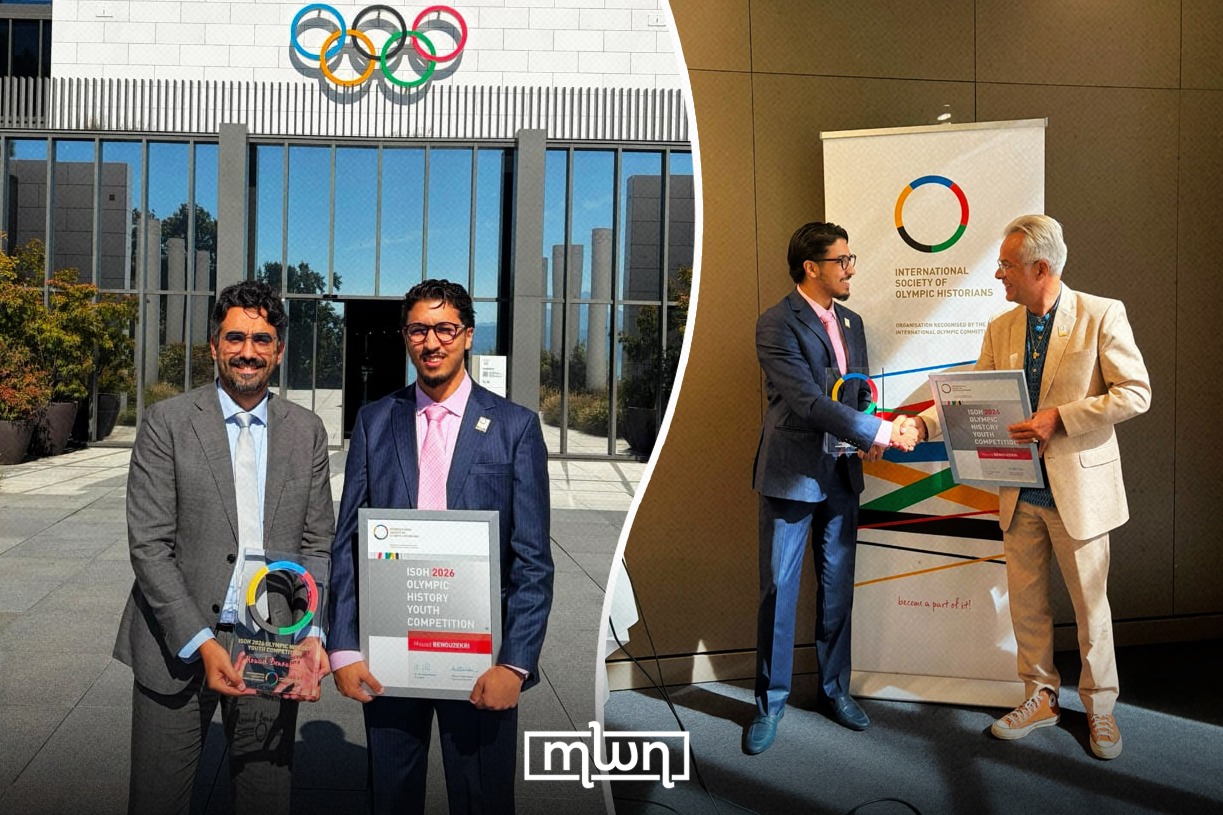
Fez — Moroccan researcher Mouad Benouzekri has received an international award for his work examining Morocco’s history within the Olympic Movement, bringing the country’s sporting heritage to an audience of historians in Lausanne.
Benouzekri received the distinction at the Olympic Museum on September 19 during the General Assembly of the International Society of Olympic Historians (ISOH), where he also delivered a 30-minute presentation titled “Morocco and the Olympic Movement.”
ISOH had previously named Benouzekri the winner of its 2026 Olympic History poster competition. The Moroccan National Olympic Committee also confirmed his first-place finish earlier this year.
For Benouzekri, however, the project was never meant to become a simple catalogue of Moroccan medals.
“I wanted to move beyond a list of medals and famous names,” he told Morocco World News (MWN). “Morocco’s Olympic story is also about international recognition after independence, women’s participation, the development of sporting institutions and Moroccan contributions to international leadership.”
His research organizes that story around three themes: recognition, reputation, and influence.
The first examines Morocco’s emergence within the Olympic Movement after independence. The second looks at how athletes built the country’s sporting reputation, while the third considers Moroccan participation in institutions shaping international sport.
“I wanted the presentation to communicate pride without overlooking setbacks or difficult questions,” Benouzekri said. “A meaningful sporting history should help us understand not only how champions win, but also the opportunities, pressures and institutions surrounding them.”
The medal that opened Morocco’s Olympic story
One of the moments Benouzekri most wanted his Lausanne audience to remember came at the 1960 Rome Olympics.
Morocco was making its first appearance at the Games when Abdeslam Radi won silver in the marathon behind Ethiopian legend Abebe Bikila.
“I opened the historical narrative with Abdeslam Radi’s silver medal in the Rome 1960 marathon, at Morocco’s first Olympic participation,” Benouzekri said.
“That race is rightly remembered for Abebe Bikila’s extraordinary victory, but looking at it from a Moroccan perspective brings another important story into view: a recently independent country reaching an Olympic podium.”
The Moroccan National Olympic Committee describes Benouzekri’s winning research as tracing the development of Moroccan Olympism from the establishment of the committee in 1959 and the Rome Games through later generations of national champions.
The study also gives significant attention to Nawal El Moutawakel. Her victory in the 400-meter hurdles at Los Angeles 1984 made her one of the defining figures of Moroccan and African Olympic history. She later moved into international sports administration and became an IOC member.
Benouzekri said that progression is central to understanding the idea of influence in his research. “I wanted to show the significance of Nawal El Moutawakel’s journey, from Olympic champion to international sports leadership,” he said. “Her story connects achievement on the track with women’s representation and participation in decision-making.”
He added that his “central message was that Moroccan athletes have not simply appeared in Olympic history; they have helped shape it.”
El Guerrouj changed how he understood success
Hicham El Guerrouj’s Olympic career carries a more personal meaning for Benouzekri.
He remembers watching the Moroccan middle-distance legend as a young spectator and experiencing the national emotions surrounding his races.
El Guerrouj’s Olympic journey was far from straightforward. He fell during the 1,500-meter final in Atlanta in 1996, took silver in Sydney four years later, and finally won Olympic gold in Athens in 2004.
He then added the 5,000-meter title, completing a rare Olympic double. An IOC historical account records how El Guerrouj overcame his previous Olympic disappointments before winning both races in Athens.
“Hicham El Guerrouj’s journey has a particular meaning for me,” Benouzekri said.
“His fall at Atlanta 1996, his silver medal at Sydney 2000 and his victories in both the 1,500 and 5,000 metres at Athens 2004 form a remarkable story of perseverance.”
Researching that journey changed the way Benouzekri now interprets sporting achievement.
“As a young spectator, I mainly saw the result and shared the emotion,” he said. “Revisiting that journey as a researcher, I became more attentive to the years of preparation, the pressure of public expectations and the support an athlete needs after disappointment. A medal is the visible moment, but the history behind it is much longer.”
For Benouzekri, that lesson extends beyond sport. “It also reminded me that an athlete’s worth should never depend entirely on the outcome of one race,” he said. “That is a lesson I find valuable in both research and teaching.”
A year of international Olympic recognition
The Lausanne award adds to a year in which Benouzekri and Ibn Tofail University have strengthened their presence in international Olympic studies.
In March, an Ibn Tofail University team supervised by Benouzekri won the master’s category of the fifth International Olympic Case Study Competition.
The university reported that the students secured first place during the March 24 final at the Olympic Museum in Lausanne.
The IOC Olympic Studies Centre said the competition involved a record 36 universities, with ten finalist teams traveling to Lausanne.
Benouzekri said the Moroccan team became the first African and first non-European team to win the competition’s master’s category.
In June, he also represented Morocco at the International Olympic Academy’s 66th Session for Young Olympic Ambassadors in Olympia, Greece.
The Moroccan Olympic Committee reported that he received the ISOH award for best poster during the session.
Returning to Lausanne in September gave the researcher an opportunity to present the wider work behind that winning project to the international community of Olympic historians.
“Receiving this recognition at the Olympic Museum in Lausanne was deeply meaningful,” Benouzekri said.
“It was an opportunity to bring Morocco’s Olympic history before an international community of historians and to see that work recognised.”
He described the award as part of a wider academic journey rather than an endpoint.
“Moving forward, I want to deepen the research, help preserve the documents and testimonies behind these achievements, and make this history more accessible to students and wider audiences,” he said.
He also hopes more Moroccan researchers will enter the field of Olympic studies.
His advice to them is simple. “Do not rule yourself out before trying,” Benouzekri said. “International research and academic competitions are spaces in which Moroccan young people belong. Our sporting heritage offers important questions to explore and stories worth sharing,” he concluded.
The institutions behind the milestone
Benouzekri also framed the award as the result of institutional support rather than a purely individual achievement.
He credited Ibn Tofail University, particularly its presidency, for backing his research and academic work in Olympic studies.
He also acknowledged the Moroccan National Olympic Committee, the International Society of Olympic Historians, the International Olympic Academy, and the IOC Olympic Studies Centre for the opportunities and support that helped shape his work.
The Moroccan researcher also highlighted the presence of Morocco’s diplomatic representation in Switzerland during the Lausanne ceremony.
He thanked Morocco’s ambassador to Switzerland and members of the embassy team, including Amine, for attending the event and supporting his participation.