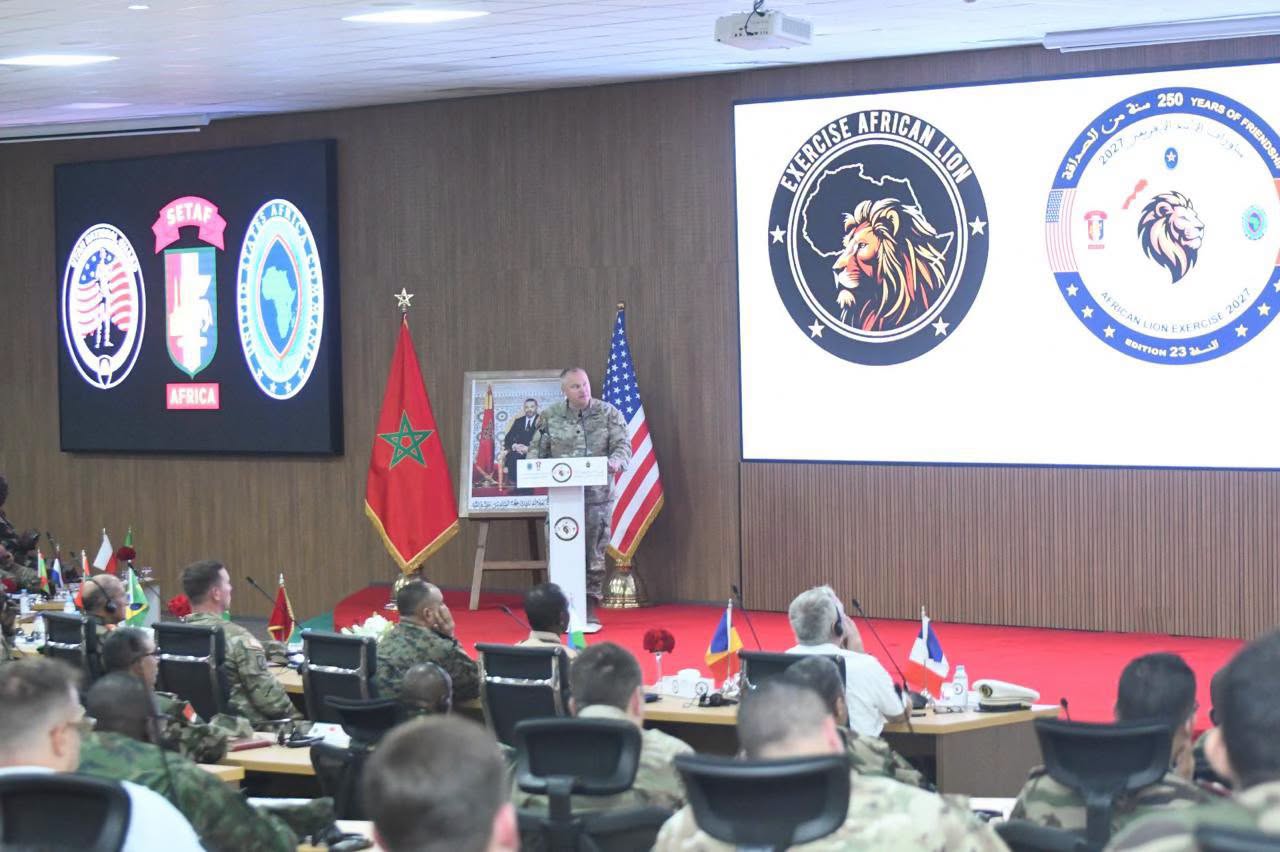
Marrakech – Morocco’s Royal Armed Forces (FAR) opened the first planning meeting for African Lion 2027 this week, bringing Moroccan and American delegations together at the Southern Zone command in Agadir.
The command has hosted the talks since September 21, and the work runs through September 25. Delegations from Morocco, the United States, and other participating countries are laying the groundwork for next year’s multinational exercise.
According to the FAR, the meeting aims to strengthen coordination among the participating nations and to encourage the exchange of expertise. The delegations are planning the exercise’s stages and setting the training objectives tied to each scheduled activity.
Participants are also developing the operational and logistical concepts for activities across the land, air, and maritime domains. Special operations feature among the subjects under discussion.
African Lion 2027 will run from April 25 to May 7, 2027. The exercise will unfold across Agadir, Tan-Tan, Guelmim, Benguerir, Kenitra, and Dakhla.
The framework is meant to reinforce interoperability and cooperation among the participating forces. It also aims to support operational readiness and to build the armies’ capacity to conduct joint and integrated operations, notably through modern technologies. These objectives align with regional security and stability.
The planning session follows a 2026 edition that marked a shift in the exercise’s character. That edition concluded on May 8 after nearly three weeks of activity across Morocco, Ghana, Senegal, and Tunisia.
It was the 22nd iteration of what US Africa Command (AFRICOM) describes as its largest annual joint military exercise. More than 5,600 personnel from over 40 countries took part, with Morocco hosting roughly 5,000 of them.
The US Army’s Southern European Task Force-Africa (SETAF-AF) led the drills alongside the FAR. Activity stretched from the Southern Zone headquarters in Agadir to Ben Guerir Air Base, Cap Draa near Tan-Tan, Tifnit, and Kenitra, along with humanitarian medical sites at El Faid in Taroudant and, for the first time, Dakhla.
The 2026 edition turned Morocco into a testing ground for AI-assisted command, drones, counter-drone systems, autonomous platforms, and long-range precision weapons.
More than 30 US industry partners embedded their systems with military units under operational conditions. The exercise also launched its first multinational drone academy, training personnel from Morocco, Ghana, Nigeria, and the US.
Before the field phase, US and Moroccan forces completed the first interoperability test of secure encrypted communications and tactical data links with an African partner nation, connecting Moroccan equipment to the US Link 16 network.
The edition was also marked by tragedy, as two US Army soldiers, 1st Lt. Kendrick Lamont Key Jr., 27, and Spc. Mariyah Symone Collington, 19, died near the Cap Draa Training Area.
The 2026 exercise did not stand alone. It followed the 2026-2036 US-Morocco Defense Cooperation Roadmap, signed in Washington weeks earlier, which sets the terms for the next decade of bilateral defense work.
The exercise then fed into a more permanent project: the emerging Africa Multidomain Training and Experimentation Center (AMTEC) near Tan-Tan, where US and Moroccan forces continued testing weapons systems into August. US Secretary of War Pete Hegseth, in a recorded address in Agadir, said there was “no better partner” than Morocco to host African Lion.
Next year’s edition will carry added weight. Morocco was the first nation to recognize the US in 1777, making 2027 the 250th anniversary of that recognition. The 1786 Treaty of Peace and Friendship remains the oldest unbroken treaty in US history. US officials returned to that shared history throughout the 2026 exercise.