Marrakech – King Mohammed VI on Tuesday named Fatima Ezzahra El Mansouri Head of Government and charged her with forming the next cabinet, according to a statement from the Ministry of the Royal Household, Protocol, and Chancellery.
The King received her at the Royal Palace in Rabat and appointed her under Article 47 of the Constitution. She becomes the first woman to lead a Moroccan government.
The appointment follows the September 23 legislative elections, in which her Authenticity and Modernity Party (PAM) finished first with 97 of the 395 seats in the House of Representatives. The National Rally of Independents (RNI) came second with 66 seats, followed by the Istiqlal Party with 65 and the Justice and Development Party (PJD) with 54.
Article 47 requires the monarch to appoint the head of government from the party that wins the most seats, a practice maintained since the 2011 Constitution.
El Mansouri succeeds Aziz Akhannouch of the RNI, whom she had served as minister. Across the Arab world, she becomes only the second woman to head a government, after Tunisia’s Najla Bouden.
Who is Fatima Ezzahra El Mansouri?
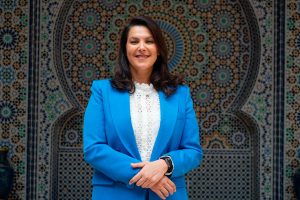
She was born in Marrakech on January 3, 1976, into a prominent legal family. Her father, Abderrahman El Mansouri, was a lawyer and former head of the bar who served as pacha of Marrakech and later as Morocco’s ambassador to the United Arab Emirates.
She holds a degree in Anglo-Saxon law from Pace University in New York, a postgraduate diploma in business contract law from the University of Montpellier, and a bachelor’s (licence) in private law from Mohammed V University in Rabat. She has practiced at the Marrakech Bar since 2005, specializing in real estate law.
A jurist with no party affiliation until her thirties, El Mansouri entered politics through the Movement for All Democrats in 2007 before becoming a founding member of PAM in 2008. The party had been created that year by royal adviser Fouad Ali El Himma.
She was elected mayor of Marrakech in 2009, the first woman to hold the post, and led the city council until 2015. She sat in Parliament from 2011 to 2016 and again from 2016 to 2021, chaired PAM’s National Council between 2015 and 2024, and returned to the Marrakech mayoralty after the 2021 elections. That year she also joined Akhannouch’s government as minister of national territorial planning, urban planning, housing, and city policy.
Her standing rose in February 2024, when the fifth national congress in Bouznika elected her coordinator of PAM’s collective leadership, alongside Mohamed Mehdi Bensaid and Fatima Saadi, a team tasked with turning the page on the leadership of Abdellatif Ouahbi.
In 2014, Forbes placed her at the top of its list of Africa’s 20 most influential young women, and she was named a Young Global Leader the same year. She is married and a mother of two.
El Mansouri has rejected the “iron woman” label, describing herself instead as a “free activist,” and has cast her career as one built through party politics and local government rather than gender. After the vote, she told a news conference that the result reflected “the valuable trust citizens have placed in us, a trust born of 18 years of relentless struggle,” and called the prospect of leading the government a “great honor.”
What comes next now turns on coalition talks. PAM fell short of the 198 seats needed for a majority, so El Mansouri must assemble a governing bloc. Together, PAM, the RNI and Istiqlal hold 228 seats, though she noted that negotiations had not yet begun and that there was “no party with which we refuse to sit down.”
Other PAM figures had been floated for the post, including budget minister Fouzi Lekjaa, who heads the Royal Moroccan Football Federation (FRMF) and joined the party before the election, and Bensaid, the outgoing youth, culture, and communications minister.
The incoming government will steer billions of dollars in investment as Morocco prepares to co-host the 2030 World Cup with Spain and Portugal, work that has led some to describe it as the “World Cup government.”
The palace, meanwhile, retains control over strategic portfolios, including defense and foreign affairs. PAM has pledged average annual growth of 5%, inflation of 2%, and at least 1 million new jobs over its five-year term.
The election unfolded against wide public frustration. Turnout reached 38%, the lowest since 2007, when it stood at 36.8%. The vote came a year after Gen Z-led protests demanded better hospitals and schools, with demonstrators chanting “We want hospitals, not just stadiums,” and weeks after a mass migration attempt into the occupied enclave of Ceuta left dozens dead.
The PJD staged the sharpest comeback, rising from 13 seats in 2021 to 54 on a platform opposing Morocco’s deepening ties with Israel, formalized through the 2020 Abraham Accords.
Party chief and former head of government Abdelilah Benkirane claimed a “victory” but ruled out joining a PAM-led coalition, which he called “tainted by fraud.” Observers called the outcome fairly predictable, noting that PAM did not achieve a landslide victory despite the significant resources deployed.