
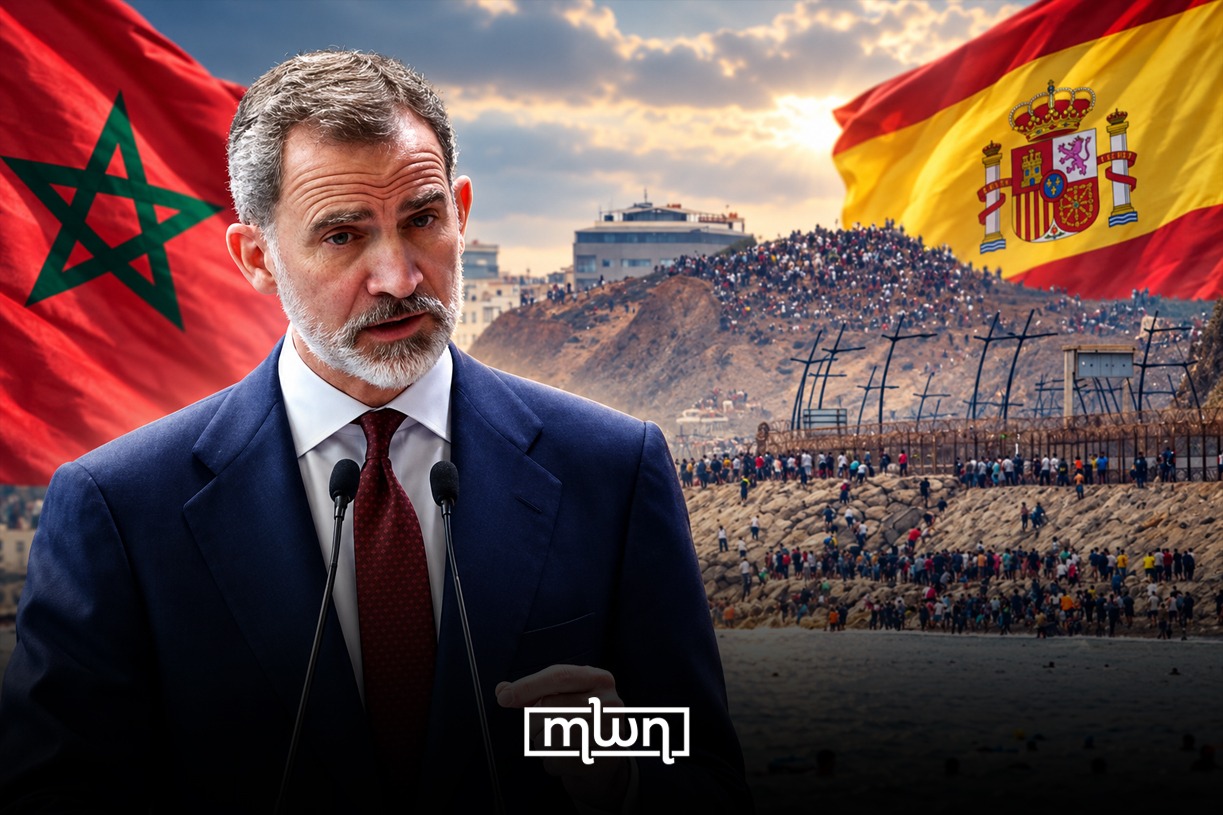
More than three days have passed since Spain announced that King Felipe VI would visit Ceuta and Melilla on October 13 and 14, his first trip to the two enclaves since he acceded to the throne in 2014. There has so far been no reaction from Morocco: no communiqué from the Ministry of Foreign Affairs, no statement from the government, no gesture from the Royal Palace.
From Rabat, such an attitude stands in sharp contrast to the speed with which Moroccan diplomacy – from the Royal Palace to the Ministry of Foreign Affairs – responded in November 2007 to the announcement of King Juan Carlos I’s first visit to both enclaves. Just a few hours after Spain announced that visit on November 1, 2007, and despite the fact that then-Spanish Foreign Minister Miguel Ángel Moratinos, who was in Marrakech at the time, had consulted with his Moroccan counterpart, Taieb Fassi Fihri, Morocco issued a statement expressing its “regret and rejection” of the visit. The following day, less than 24 hours after the announcement to be more precise, King Mohammed VI recalled Morocco’s ambassador to Madrid, Omar Azziman, for consultations. Although relations between the two countries were undergoing a significant improvement at the time, Rabat reacted firmly to set the boundaries and red lines straight when it came to the conduct it expected from Madrid on the very sensitive question of the two Spanish-occupied enclaves in northern Morocco.
Why the silence this time, then? To understand the significance of the absence of any Moroccan reaction so far to Felipe VI’s scheduled visit, the issue of Ceuta and Melilla must be placed within the broader philosophy that has historically guided Moroccan policy toward Spain. Once it is seen from that philosophy, Rabat’s restraint easily comes across as a long-term strategic choice, rather than – as some have attempted to interpret it – either an oversight or a concession.
From Hassan II to Mohammed VI – a doctrine of patience
“We have just made peace with Spain, and you want to rekindle the fire,” King Hassan II stated during a press conference in November 1978. And the Moroccan monarch went on to add that, in his capacity as the “sovereign of his country and the person responsible for its territorial integrity,” he had the solemn obligation to point out that “Ceuta and Melilla are part of Morocco.” Still, he expressed his hope that one day the two countries might be able to negotiate a “framework agreement” based on “friendship, peace, understanding and good-neighborly relations.”
Those few sentences project a clear articulation of Morocco’s doctrine of strategic patience on the status of its two cities still claimed by Spain. While unambiguously and unapologetically stating Morocco’s stance on the question, the monarch made sure to acknowledge that Rabat’s unsettled pursuit of reclaiming Moroccan sovereignty over the two enclaves would not come at the expense of its philosophy of preserving a working peace with Spain. In other words, King Hassan II drew a line between the permanent principle of Moroccan sovereignty over Ceuta and Melilla, and the understanding that the eventual activation of the principle remains a matter of sensible timing and political judgment. First established by King Hassan II, this philosophy of restraint and timing without renouncing Morocco’s historical claim to the two cities has perhaps been taken to a higher plane of diplomatic strategizing under King Mohammed VI, especially over the past decade.
Although Morocco has made considerable efforts over the past two decades to deepen its strategic depth in a number of key areas, Rabat still operates from the perennially relevant strategic standpoint that managing relations with Spain in a delicate matter that calls for proactive, forward-looking, and firm communication with Madrid away from the preening and temperamental eyes of popular opinion. In other words, Morocco’s public silence is often the clearest indication that the country has for now decided to keep its reaction in the dedicated venue of constant, back-and-forth communications between the higher echelons of Spanish and Moroccan diplomacy, where it matters most. To be sure, in managing its relations with Spain, Morocco’s doctrine has long been to allow time to take its course and wait for the problem to be resolved when the time is ripe, even if that means that the issue should be managed below boiling point until the next generation.
Morocco has never made Ceuta and Melilla a central pillar of its bilateral agenda with Spain. But of course, the question still remains important, and Rabat’s bid is that it is better to maintain the current status quo (without renouncing Morocco’s historic right) until the right generation of Moroccan and Spanish strategists and diplomats come eye to eye on the mechanism of return of the two enclaves. In that sense, it is both politically telling and intellectually regretful that, when most Spanish political agitators, biased (or misinformed) journalists, and misled political commentators write or speak about this issue, they tend to do so by overlooking the rather obvious fact that the recovery of the two cities does not constitute an immediate, or even medium-term, priority for Rabat.
Being firm on principles without triggering an unwise and unilateral rupture
Of course, one may object that the 2007 precedent contradicts my reading of the prevailing ethos governing Morocco’s current stance on this question. I still beg to differ, and the manner of Morocco’s public reaction in 2007 can actually more accurately be interpreted as the slight, short-lived exception that confirmed the general rule of Morocco’s strategic restraint in dealing with Spain on the question of Ceuta and Melilla.
Morocco’s reaction to Juan Carlos’s Ceuta and Melilla’s visit, which included recalling its ambassador from Madrid, was not particularly vehement. In other words, it cannot be convincingly argued that Rabat’s reaction to the visit bore any desire to push bilateral relations toward a rupture. The Moroccan ambassador was in fact back at his post roughly two months later, and cooperation between the two countries swiftly resumed its course. The recall of the ambassador was thus not a radical step meant to escalate. Given that Moroccan public opinion has always regarded the Spanish presence in the two cities as a vestige of Spanish colonialism, the recall was instead a decision – some might say symbolic – that the Moroccan monarch was expected to take in his capacity as head of state and guarantor of the country’s territorial integrity.
Indeed, when the Spanish press at the time covered Morocco’s reaction, most of them rightfully read it as primarily intended for domestic consumption. That is, the decision was designed to appease Moroccan public opinion and prevent it from interpreting Rabat’s moderation as a sign that the state had abandoned its historical claims to the two enclaves. The recall was hence the minimum the state owed its own public, not the opening move of a confrontation with Madrid. And so, what the 2007 precedent proves is that Rabat calibrates. More often than not, when confronting a crisis on the status of these two cities, Rabat tends to do what the circumstances require to keep its sovereignty claim alive without taking any emotional or overenthusiastic course of action that can satisfy the nationalist pride of Moroccans but will actually, ultimately be far from coming close to resolving the question at hand.
‘D’abord le Sahara’
This approach can also be explained by the place that Ceuta and Melilla have historically occupied within Morocco’s diplomatic priorities. Since the 1960s, the Sahara issue has constituted one of the principal areas of focus and a priority of Moroccan diplomacy. For decades, Morocco has sought to persuade Spain to adopt positions favorable to its interests on this issue, while intermittently using Ceuta and Melilla as an instrument of pressure to push Madrid to reconsider its positions whenever these were perceived in Rabat as hostile. The two enclaves have thus functioned as a lever in the service of the question that truly matters to Rabat.
Morocco’s current silence should be interpreted against this historical background. With Spain having significantly embraced Morocco’s position on the Sahara since 2022, Rabat has few incentives to heighten tensions with Spain.
To this, it is tempting to respond that Morocco no longer has anything to lose on the Sahara, since the resolution adopted by the UN Security Council in October last year means Rabat has already achieved its objective of reclaiming its southern provinces. But that would be a wild overstatement of the current state of affairs. While Resolution 2797 has indeed consecrated the legal and diplomatic triumph of Morocco’s political realism and diplomatic sensibility over the Algerian-backed Polisario’s impossible separatist dreams, the political battle for the Sahara is far from over.
All serious observers of the Sahara dossier expect Algeria and its separatist proteges to do everything in their power to delay the final implementation of the political roadmap that the Security Council has recognized as the only route to a lasting settlement of this lingering dispute. And in that coming battle to force Algeria to accept that there is no there to its Western Sahara diplomatic activism, Morocco will need to further consolidate all the political and strategic support it has accumulated over the past two decades. Which might be why Rabat has decided that the wise course of action is to preserve its much-improved friendship with Madrid, where the residual leftist sympathy for Sahrawi separatism means Morocco’s gaining of Spanish endorsement for its Autonomy Plan is robust but not exactly irreversible.
Moreover, given the particularly tense political climate that has prevailed in Spain for more than two months following the Ceuta migration crisis, Morocco appears to have no interest in taking measures that could contribute to a further deterioration in relations between the two countries. Nor is Morocco in any hurry to turn the issue of Ceuta and Melilla into a central question in its relations with Madrid, particularly given the extreme sensitivity surrounding the two cities in Spain. Rabat therefore has no interest in adding fuel to the fire or in providing arguments to those who, since the mass influx of migrants into Ceuta, have sought to construct and disseminate the narrative that the crisis represented a first step in Morocco’s attempt to recover both territories or force Spain’s hand on the issue.
Rabat’s silence is a response to the ‘hybrid war’ narrative
Seen from that light, and in the continued aftermath of latent tension between the two countries and a full-fledged campaign to demonize Morocco, Rabat’s silence appears to indicate that the Moroccan Royal Palace has chosen to lower tensions and send Spain a signal of goodwill and conciliation.
Rabat, in other words, appears to want to leave behind this mass migration-triggered Ceuta crisis. And if Madrid has determined that Felipe VI’s scheduled visit might provide both Spain’s government and Royal Palace with a way out of this crisis, perhaps Rabat has read the cost-benefit sheet of the situation and decided to let the royal visit run and deny the Spanish far-right and radical left another opportunity to launder their wildest Morocco-bashing conspiracy theories.
In that sense, this Moroccan silence sends a fairly eloquent message to those who have spent the past two months accusing Morocco of launching an alleged “hybrid war” designed to “overwhelm” Ceuta. Because a state bent on “overwhelming” Ceuta and forcing the question of sovereignty would hardly afford to close its eyes and let pass the most symbolically charged opportunity it could have been handed.
Perhaps those who have constructed an entire narrative around Rabat’s supposed hidden intentions should now try asking themselves whether they truly understand Moroccan foreign policy and the complexity of relations between the two countries, or whether they have simply spent weeks feeding their discourse with speculation, misinformation, and racializing falsehoods.
Rabat’s attitude of moderation is good news for the future of relations between the two countries, as well as for all those who want this crisis to be genuinely resolved as soon as possible. The reality, however, is that it constitutes very bad news for those who have turned the demonization of Morocco and the prolongation of tensions between the two countries into a business model from which they derive political or financial dividends. Morocco’s approach, if confirmed over the coming days, would also be bad news for Algeria, which would welcome a serious and long diplomatic crisis between Rabat and Madrid.
But, again, Morocco’s attitude of appeasement is far from a position of resignation or renunciation of its historic right to Ceuta and Melilla. Rabat’s silence simply shows that, following the strategic course its previous monarch laid out of keeping cordial relations with Madrid in spite of unsettled or unfinished territorial business, Morocco continues to build its Spain policy around the sense of timing and the need to articulate an unchanging commitment to a historical right without giving in to the nationalist appeal of an exciting but doomed and counterproductive quarrel.
Samir Bennis is the co-founder and publisher of Morocco World News. You can follow him on Twitter @SamirBennis.