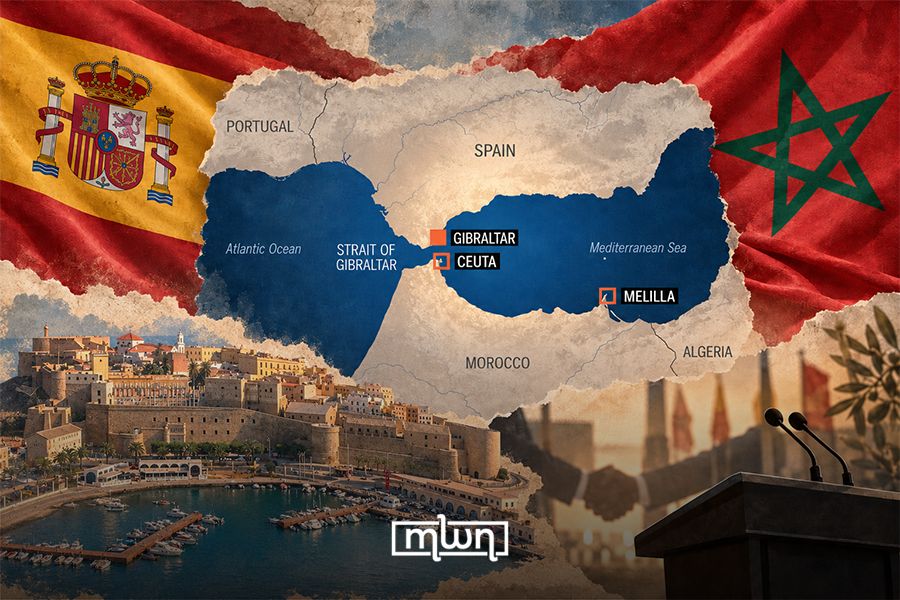
When reading Spanish articles, analyses, and public commentary about Morocco, one cannot help but notice the recurrence of an entire vocabulary of inherited expressions and stereotypes — terms that Moroccan readers have long grown accustomed to encountering. References to an alleged “invasion,” “territorial threat,” “incursion,” or “act of war,” among similar formulations, reveal less about contemporary realities than about a historical imagination that continues to shape political perceptions.
Another category of terms appears even more revealing. Such expressions recur frequently in the writings of many Spanish journalists, analysts, and political commentators, as though they seek to redefine the relationship between Morocco and Spain by narrowing the historical distance between the origins of the two kingdoms, or by projecting the Spanish political model onto the Moroccan context.
Among the most notable examples of this discourse is its use of terminology bearing broader historical implications, such as “the Alaouite mission,” “the Alaouite elite,” “Hassan II’s volunteers,” or “Mohammed VI’s activists.” These terms have appeared in various Spanish writings, including articles by Arturo Pérez-Reverte during his coverage of the Green March, and continue to resurface in contemporary commentary.
Their use appears to go beyond simple description. Rather, it contributes to constructing an image of a supposed divide between the Moroccan state and society, an interpretation that closely echoes the framework once developed by José Antonio Primo de Rivera regarding the relationship between the Spanish people and their elites.
This language also frequently operates within a broader narrative aimed at providing historical justification for the “Spanishness” of the occupied territories. At its core, it reveals a profound misunderstanding of Morocco’s historical trajectory, the nature of its monarchy, and the continuity of its institutions, which form part of one of the world’s oldest state traditions. A revealing contrast emerges when examining Moroccan discourse toward Spain. Moroccan narratives do not generally employ equivalent expressions, such as referring to Spanish society as “supporters of the Bourbons,” despite Spain’s own internal political complexities, including debates surrounding its political system and separatist movements in Catalonia and the Basque Country.
These questions are largely understood in Morocco as matters belonging to Spain’s internal political sphere, rather than as instruments for external political pressure or populist rhetoric.
The question of historical continuity
When examining the historical foundations behind these terminologies, a clear paradox emerges. The reductive framing adopted by these Spanish authors, particularly during times of crisis, reflects a very limited understanding of the continuity of the Moroccan state and the historical foundations of its monarchy.
The Alaouite dynasty does not represent a rupture with what came before it; rather, it constitutes a continuation of a much older historical trajectory. It inherited, preserved, and developed political structures established by previous Moroccan dynasties, drawing on the same historical foundations, social legitimacy, and national institutions that shaped Morocco’s state tradition over centuries.
By contrast, the Bourbon dynasty that occupies the Spanish throne today came to power after the establishment of the Alaouite dynasty and traces its Spanish royal lineage to Philip V, Duke of Anjou, and grandson of the French King Louis XIV. He ascended the Spanish throne following the War of the Spanish Succession, with French support.
That period remains a living and contested memory, particularly in Catalonia, where September 11, 1714, the date Barcelona fell to Philip V’s forces, continues to hold a central place in collective remembrance.
The historical roots of the Alaouite dynasty, meanwhile, extend back centuries before its political rise. Moulay Ali al-Sharif (1362–1446), an ancestor of the Alaouite family, was among the prominent figures of Sijilmasa during the final period of the Marinid era. He maintained close relations with Moroccan and Nasrid scholars.
According to historical accounts, several Andalusian scholars called upon him to lead a project aimed at defending Granada. Yet he chose instead to respond to the call for resistance, participating in several campaigns in both Al-Andalus and Morocco, most notably in the defence of Tangier during the battle of 1437 against the Portuguese. He did so without seeking political power, despite the opportunities that were available to him, opportunities that could have potentially placed him in a position of authority in Al-Andalus following the decline of the Nasrid dynasty.
The Alaouite family entered a new political phase at a time when Morocco required strong leadership following the turmoil that accompanied the fall of the Saadian dynasty. They emerged as a unifying force, gaining the support of communities seeking to restore political cohesion across the country. In this context, two of the most notable Alaouite sultans, Moulay al-Rashid and his brother Moulay Ismail, rose to prominence during the seventeenth and early eighteenth centuries, consolidating the Moroccan state, recovering several occupied territories, and extending Morocco’s diplomatic and military presence.
Their rule represented a continuation of the principles and institutions established by earlier Moroccan dynasties rather than a historical break.
For this reason, narratives that attempt to reduce Morocco to a simplified image overlook this deeper historical dimension. They interpret its symbols and institutions through predetermined frameworks rather than through the complexity of its own historical development.
In some cases, such readings appear closer to the way Don Quixote perceived the world around him.
The return of history in contemporary political discourse
This perspective can also be observed in the statements of certain Spanish officials, including Juan José Imbroda, the president of the occupied city of Melilla, whose recurring remarks often reveal a particular historical reading of Morocco-Spain relations. His latest statement, made on the margins of a recent economic conference, is a notable example:
“We still ask ourselves why we left the Sahara.”
Through this statement, Imbroda criticized Madrid’s policy toward Rabat, arguing that the “concessions’’ made to Morocco without receiving equivalent gains represented a political mistake. Yet this interpretation overlooks a fundamental reality: questions of sovereignty are not determined solely by short-term political calculations; they are shaped by historical transformations, legal developments, and the realities imposed by the passage of time.
Had Imbroda revisited the history of the city he governs, he would have encountered a much more complex narrative. Melilla itself bears the imprint of a past closely connected to the House of Medina Sidonia, one of Spain’s oldest and most controversial noble families, which led the occupation of the city in 1497.
The family traced its lineage to Guzmán el Bueno (whom we know to have served as a military adviser to the Moroccan Marinid sultan Abu Yusuf Yaacoub Al Mansour, following a dispute with King Alfonso X; a document later brought to light by Luisa Isabel Álvarez de Toledo further suggested that he was not Spanish by origin, but a vassal of the King of Spain who had come from somewhere within the wider Moroccan sphere), a medieval Castilian nobleman whose legacy became deeply embedded in Spanish historical memory. In contemporary times, however, the House of Medina Sidonia also became associated with a different reading of Spain’s imperial past, particularly through the figure of its last duchess, Luisa Isabel Álvarez de Toledo.
The duchess became an exceptional and controversial figure due to her defence of her family’s historical archives and her efforts to revisit aspects of Spanish imperial history. Among the documents preserved in these archives were materials related to the age of exploration and to the possible contacts between Muslim Moroccan sailors and the wider Atlantic world before the voyages traditionally attributed to Christopher Columbus.
She presented these ideas in her book “África versus América: La fuerza del paradigma” (The Power of the Paradigm), which she presented to King Mohammed VI during her audience with him in Tangier in 2000, in the presence of a delegation of Moroccan and Andalusian intellectuals.
Her views on Spanish history generated considerable debate. According to an article published in Diario de Almería on 20 February 2012 by journalist José Ángel Pérez, some inhabitants of occupied Ceuta called for the removal of her signature from the city’s guestbook after she stated, during the presentation of her book in the same year as her visit to Tangier, that Ceuta and Melilla belonged to “Moroccan territories.”
More broadly, her positions regarding Spain’s colonial and imperial past, as well as the controversial historical legacy of her own family in relation to Morocco, made her a unique figure in contemporary Spanish debates on memory. This was particularly evident through the manuscripts discovered in Sanlúcar de Barrameda, inside the family palace, whose foundations partly date back to the Almoravid period.
Her confrontation with established narratives of Spanish history, including her repeated clashes with the Francoist system, transformed her into one of the most distinctive voices challenging conventional interpretations of Spain’s imperial memory.
Toward a more balanced view of the Southern neighbor
These examples reveal that the relationship between Spain and Morocco still unfolds, in many respects, within a space where memory, history, and politics remain deeply intertwined. Even narratives that express a degree of admiration toward Morocco may, in reality, be shaped by emotional attachments that transform the southern neighbor into a mirror onto which Spain projects its own unresolved questions of identity, history, and its relationship with eight centuries of shared historical presence.
Understanding Spanish discourse toward Morocco therefore requires more than following current events. It demands a broader reading of the historical trajectories and political language that have contributed to shaping contemporary perceptions.
A more measured Spanish approach, one freed from recurring historical traumas and from the lingering illusions of reconquest, could open the way toward a more realistic and balanced relationship with Morocco. Such an approach would not seek to erase disagreements, but rather to overcome them without constantly invoking a past that risks deepening tensions between the two countries and reinforcing internal divisions within Spanish society itself.
Ultimately, the challenge is not to deny history, but to engage with it responsibly: to develop a political discourse that acknowledges the complexity of the past without allowing it to determine the possibilities of the future.