
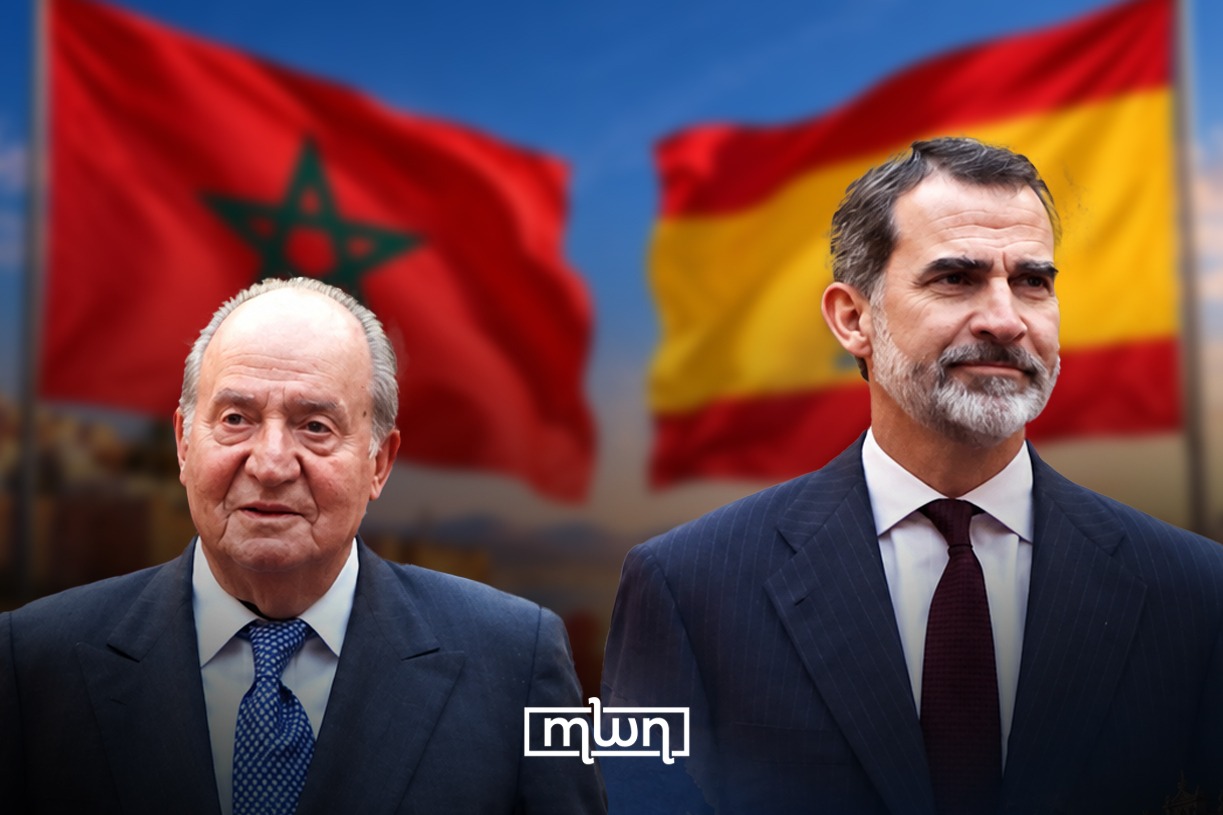
There is something deeply revealing in the fact that, two months after the mass entry of migrants into Ceuta, Felipe VI decided to publicly bring up what happened and describe as “unacceptable” the entry of tens of thousands of people across a border he defined not only as Spanish, but also as European.
It is true that the King did not name Morocco, nor did he use any wording that might imply Moroccan responsibility for what happened. But in a constitutional monarchy where the head of state speaks sparingly, and every public word is weighed beforehand with the government, the choice of setting, the choice of audience, and the choice of words all carry meaning. Silence, too, is a form of language, and so is breaking it. That he decided to speak about Ceuta in front of French President Emmanuel Macron, to reaffirm the Spanish and European character of its border, and to call for greater European Union involvement in protecting it, is particularly significant. And it becomes even more so when set against the attitude his father adopted during earlier crises with Morocco.
2005: The same crisis, the same accusations
What happened this summer has a strikingly similar precedent. Between late September and early October 2005, Ceuta and Melilla faced a wave of mass attempts to storm their border fences by hundreds of Sub-Saharan migrants. Over a dozen people lost their lives in the space of a few days, and the images of men scaling the fences, some wounded, others trapped between the two lines of wire, made headlines across Europe. Madrid deployed troops to reinforce the perimeter and decided to raise the height of the fences. The episode triggered in Spain a discourse against Morocco that, read 21 years later, seems almost a carbon copy of the one we have heard over the past two months.
Morocco was accused at the time of using immigration as an “instrument of pressure” on Spain, of “taking advantage” of the surges to internationalize its claim over Ceuta and Melilla, and of deliberately allowing hundreds of sub-Saharan migrants to reach the fences. The accusation did not come only from commentators or fringe voices. Javier Arenas, then president of the Popular Party in Andalusia and former deputy prime minister in José María Aznar’s government, went so far as to consider it “possible” that Morocco was using the surges to “pressure” the Spanish government, then led by José Luis Rodríguez Zapatero. The argument followed a familiar pattern: whenever a crisis erupts on the southern border, the suspicion of a hidden Moroccan agenda resurfaces almost automatically in part of the Spanish political media landscape, regardless of the migratory dynamics at play across the continent.
The atmosphere grew so heated that Taieb Fassi Fihri, then Morocco’s Minister of Foreign Affairs, felt compelled to point out that “in Spain, the immediate neighbor is frequently blamed,” and to reject outright the notion that Morocco was using migrants to advance its territorial claim. “It is not a Green March with immigrants as proxies,” he said, in a pointed reference to the 1975 march in which some 350,000 Moroccans crossed into Western Sahara, an event that still weighs heavily on the Spanish imagination whenever the border question comes up. The fact that a Moroccan minister had to publicly rule out such a comparison says a great deal about the climate of the time.
The telephone diplomacy of Juan Carlos I
But this is where the fundamental difference between then and now emerges. Rather than publicly joining the debate over Ceuta and Melilla, Juan Carlos I drew on his personal relationship with King Mohammed VI to try to defuse the crisis. That relationship was no small asset; the Spanish monarch had cultivated close ties with the Alaouite dynasty for decades, first with King Hassan II and then with his son, and he was widely regarded in Rabat as a trusted interlocutor, someone with whom problems could be solved by phone rather than through press statements. Over the years, this personal channel had often served as a safety valve in a relationship prone to sudden flare-ups, precisely because it operated beyond the reach of domestic political pressures on both sides.
When migratory pressure reached its peak, he called the Moroccan monarch three times and asked him to help stem the flow. Morocco responded by reinforcing its border security and, in an exceptional gesture, agreeing to the return of 73 sub-Saharan migrants under a bilateral readmission agreement signed in 1992 that had until then remained largely a dead letter. The crisis did not vanish overnight, and the way some migrants were subsequently treated on the Moroccan side drew criticism from humanitarian organizations. But it was contained, and above all, it did not escalate into an open diplomatic confrontation between the two countries. On the contrary, the following year Rabat hosted the first Euro-African ministerial conference on migration and development, co-sponsored by Spain, turning a moment of tension into a framework of cooperation.
Felipe VI: From discretion to public assertion
Twenty-one years later, Felipe VI has chosen a different path. At a time when the Spanish monarchy is undergoing a clear erosion of its institutional legitimacy, weakened in no small part by the scandals surrounding his own father, whose departure to Abu Dhabi in 2020 left a lasting mark on the institution, and when the Ceuta crisis has sparked a strong surge of Spanish national sentiment, the King has chosen to publicly raise the issue of Ceuta, call what happened “unacceptable,” and frame the matter within the European context of border defense. In doing so, he is speaking not only to Paris and Brussels, but also, and perhaps above all, to a domestic audience.
The calculation is understandable. For a monarch who has spent much of his reign distancing himself from his father’s legacy and rebuilding the Crown’s image around ideas of exemplarity, institutional rigor and national unity, a firm stance on Ceuta offers an opportunity to appear in tune with public opinion. Yet this choice comes at a cost. By speaking out, Felipe VI gives up part of the room for manoeuvre that his father’s discretion once preserved. A king who has publicly called a situation “unacceptable” is less well placed to act as a quiet intermediary when the time comes to rebuild bridges.
The contrast in style between father and son is hard to ignore. While Juan Carlos I relied in 2005 on discreet mediation and his personal relationship with King Mohammed VI to help ease tensions, Felipe VI chose in 2026 to make Ceuta part of his public discourse before one of Europe’s leading figures. In 2005, Juan Carlos I relied on quiet mediation and his personal rapport with Mohammed VI to help lower the temperature. In 2026, Felipe VI has chosen to make Ceuta part of his public discourse before one of Europe’s most prominent leaders. One approach treated the crisis as a problem to be solved between neighbors; the other frames it as a question of sovereignty to be defended before Europe.
The Europeanization of the issue itself is a telling choice. By presenting Ceuta’s border as a European one, Felipe VI is seeking to share the burden of a bilateral dispute with Brussels, and to enlist France, a country with its own close and complex relationship with Rabat, as a witness. It is a strategy that may strengthen Spain’s hand in European forums, but one that Morocco is likely to read as an attempt to multilateralize a question it has always wished to address directly with Madrid.
And one is entitled to ask to what extent this shift reflects not only the deterioration of the relationship between the two royal houses, but also a deeper transformation in the role the Spanish Crown intends to play in relations with Morocco.
For decades, the personal bond between the Bourbons and the Alaouites functioned as a parallel channel of diplomacy, one that ran alongside, and sometimes ahead of, the official relationship between the two governments. When ministers clashed, when the press on both sides of the Strait sharpened its tone, when fishing agreements, migration, or the Sahara threatened to derail relations, there was always the possibility of a call between the two palaces. That channel rested on trust, on familiarity and on a shared understanding that some matters are better settled out of public view. Its value lay precisely in its discretion.
What Felipe VI’s words suggest is that this channel may no longer carry the weight it once did, or that the King no longer considers it the right instrument. Either way, the consequence is the same: the Crown is moving from the role of mediator to that of spokesman. Instead of acting as a buffer that absorbs tensions before they turn into open disputes, it is now positioning itself as one more voice asserting the national position, in line with public sentiment and within a European rather than a bilateral framework.
This transformation is not without logic. A monarchy whose legitimacy is under strain has every incentive to align itself with the mood of the country, and few issues mobilize Spanish national feeling as readily as Ceuta and Melilla. But it also carries a risk. By giving up the discreet mediating role that his father played, Felipe VI deprives Spain of a tool that proved its usefulness at moments of acute tension. Governments come and go, and their relations with Rabat swing between warmth and hostility. The Crown, by contrast, offered continuity, a stable point of contact above the fray of partisan politics.
Relations between Spain and Morocco have always oscillated between crisis and reconciliation, and there is little reason to believe that this cycle will end. The question is who, the next time tensions flare, will be in a position to pick up the phone. In 2005, the answer was obvious. In 2026, it is far less so.
Samir Bennis is the co-founder and publisher of Morocco World News. You can follow him on Twitter @SamirBennis.