
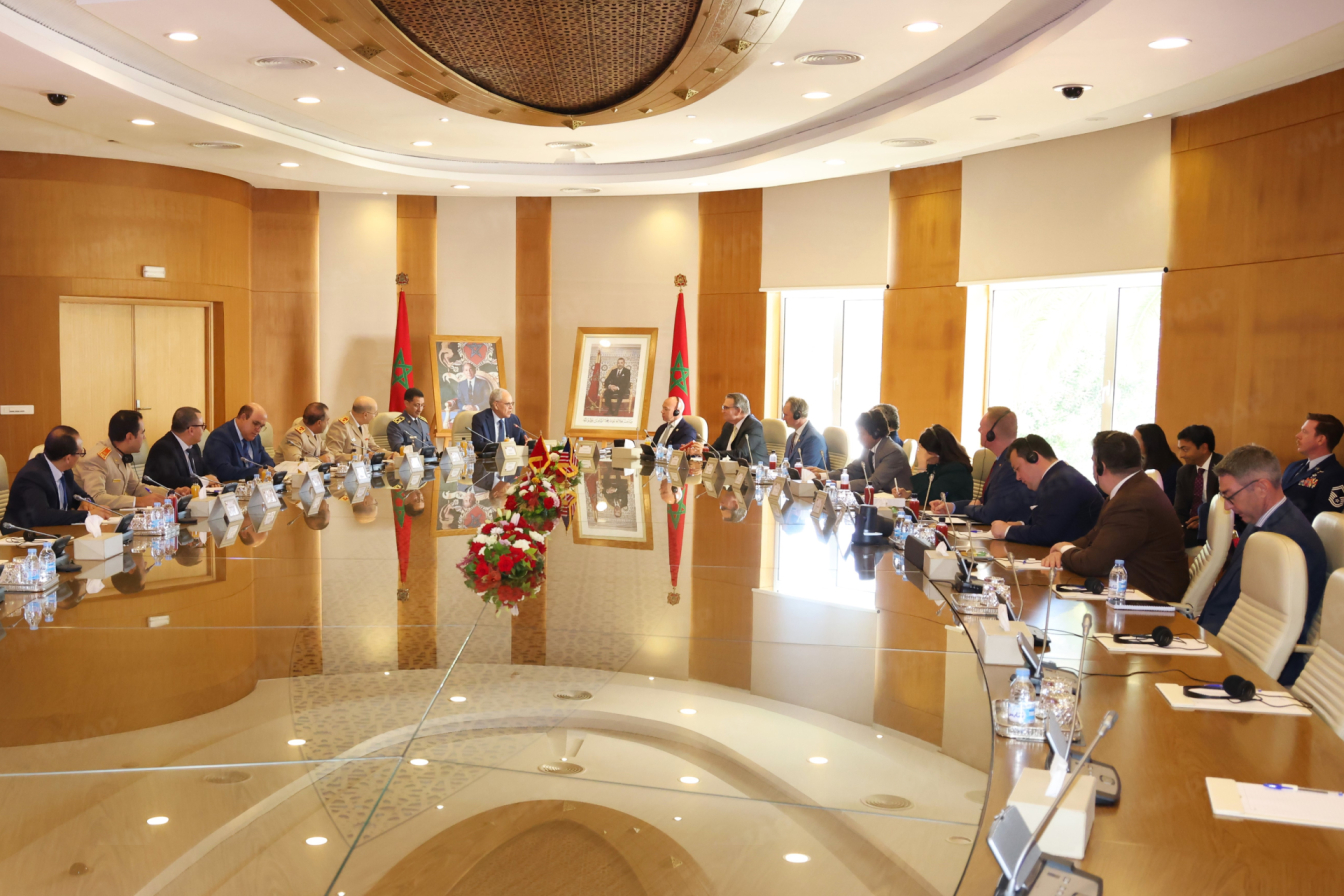
Marrakech – Morocco’s National Defense Administration hosted a US congressional delegation in Rabat on Friday, with military cooperation between the two countries at the center of the talks.
Abdeltif Loudyi, Minister Delegate to the Head of Government in charge of the National Defense Administration, received the delegation led by Congressman Mike Rogers, chairman of the US House Armed Services Committee. The meeting was held on royal instructions, according to a statement from the National Defense Administration.
Loudyi and Rogers reviewed the state of defense ties, which the statement described as marked by “centuries-old” links and a high level of military coordination. Both reaffirmed their commitment to deepen the relationship.
Their review covered several pillars of cooperation. These included the 2026-2036 military cooperation roadmap signed in April, the regular meetings of the Defense Consultative Committee, frequent exchanges of senior officials, and the annual “African Lion” exercise.
The statement called the drill a major tool for improving interoperability among participating forces, particularly African ones.
Loudyi welcomed the “frank and positive” US support for Morocco’s sovereignty over its entire territory and the Moroccan character of the Western Sahara, pointing to Washington’s constructive role in efforts to resolve the dispute.
He further cited Morocco’s South-South cooperation and regional integration initiatives, which he linked to the vision of King Mohammed VI. For its part, the delegation credited the King’s leadership and framed Morocco as an important actor for stability and peace in a challenging regional security environment.
Both sides closed the meeting by pointing to a shared ambition to consolidate the strategic partnership. They identified defense industry, cybersecurity, and the space domain as priority areas for future work.
The visit followed a similar one last month. On September 24, Loudyi received another congressional delegation in Rabat, led by Brian Mast, chairman of the House Foreign Affairs Committee.
That meeting covered much of the same ground, including the Defense Consultative Committee, exchanges of senior officials, African Lion, and US backing for Morocco’s position on the Sahara.
The two visits reflect a defense partnership that spans decades. The US designated Morocco a Major Non-NATO Ally in 2004, a status that opens access to defense trade, training, and research.
African Lion, which Morocco has hosted since the late 1990s and which AFRICOM has managed since 2008, has grown into the largest military exercise on the continent. Its 2026 edition drew participants from more than 40 countries across four host nations.
Washington also remains Morocco’s largest supplier of major arms. According to the Stockholm International Peace Research Institute (SIPRI), the US accounted for 60% of Morocco’s arms imports between 2021 and 2025, followed by Israel at 24% and France at 10%. Morocco ranked 28th globally and first in Africa for major arms imports.
US-approved programs in recent years have covered F-16 fighter jets, AH-64E Apache helicopters, HIMARS launchers, Javelin anti-tank missiles, and Stinger air defense systems. Morocco received its first Apache aircraft in early 2025.
Cooperation is now extending toward joint training and experimentation. In July, the Royal Armed Forces (FAR) and AFRICOM signed a memorandum to establish the Africa Multidomain Training and Experimentation Center (AMTEC) in Tan-Tan.
The planned site, targeted for 2030, is to include a multidomain training area, a drone academy, and an innovation and experimentation center.
The partnership approaches a historic milestone in 2027, marking 250 years since Sultan Mohammed III opened Moroccan ports to American vessels in 1777, an early recognition of the newly independent United States. The two countries subsequently formalized their relationship through the 1786 Treaty of Peace and Friendship.